A young humpback whale got tangled in more than 800 feet of coaxial cable off Maui in 2017. It was something rescuers had never seen before. They cut it free, not knowing if it would survive. Seven years later, a stranger's photo of a whale's tail turned up on a tracking website. Researchers matched it to the very same whale. It was alive and fully healed.

Freed From 800 Feet of Cable, This Whale Came Back

Posted 8 days agoUpdated 6 minutes ago

In June 2025, NOAA published a follow-up nobody had planned on writing. Years after a rescue team freed a whale they feared wouldn't make it, a stranger's snapshot proved the story wasn't over after all.

A Whale Anchored in Place

In 2017, a young humpback whale turned up off the coast of Maui wrapped in cable so heavy it could barely reach the surface to breathe.

Ed Lyman, the Large Whale Entanglement Response coordinator for Hawaiian Islands Humpback Whale National Marine Sanctuary, was near the end of his 15th whale season and had already helped free two dozen whales. This one was different.

The whale was frantic and hard to approach, dragging itself through the water while anchored by the weight of the gear.

800 Feet of Cable

When the team finally got close enough to work, they found something they had never seen before.

"It was the first time we had ever seen a humpback whale entangled in cable," Lyman said.

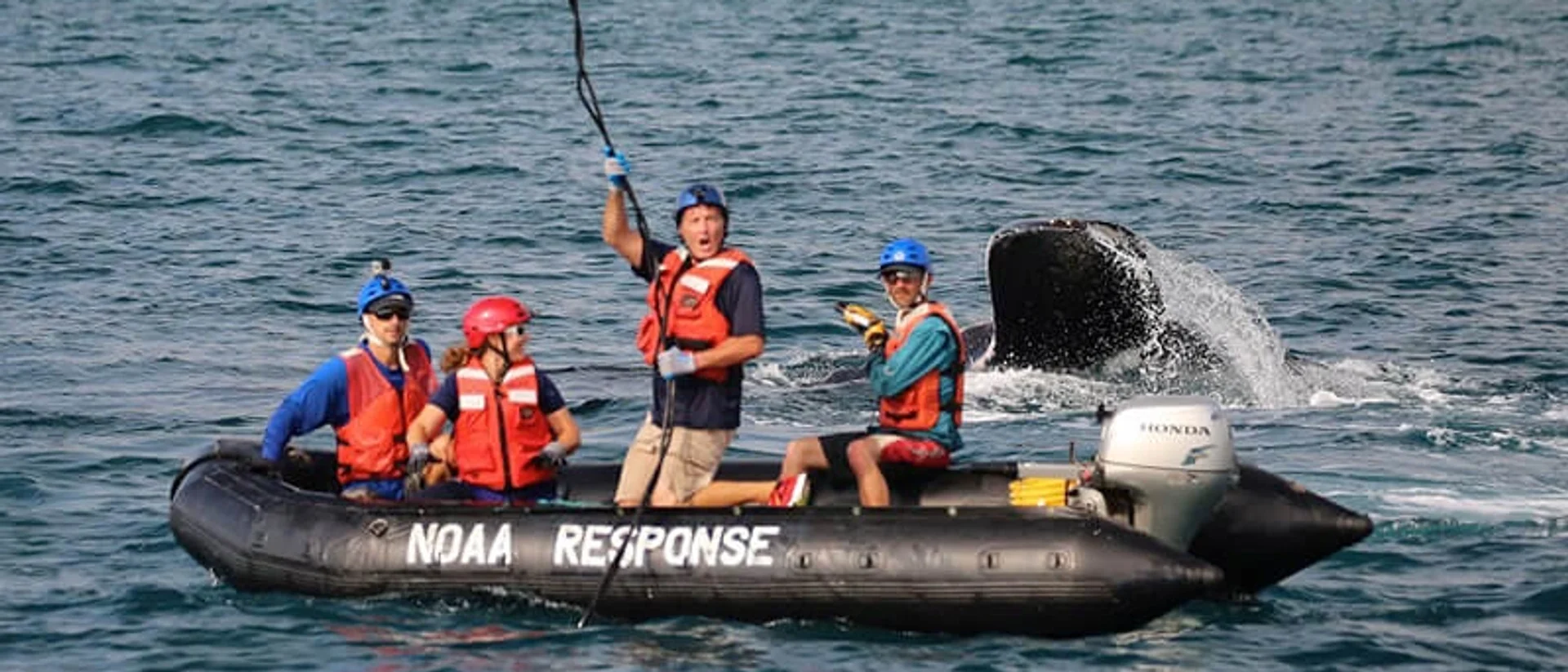
Responders carefully cut away more than 800 feet of 5/8-inch coaxial cable, hauling it into their boats piece by piece. Some of it was wedged so deep in the whale's mouth that it could not be safely removed.

The team freed what they could and let the whale go, with no way of knowing whether it would survive.

A Photo That Changed Everything

Seven years passed with no confirmed sighting.

Then a member of the public uploaded a photo of a whale's tail, or fluke, to Happywhale.com, a public database that uses the unique markings on a whale's fluke the way investigators use fingerprints.

Researchers with the sanctuary compared the pattern to their old case files and got a match. It was the same whale, spotted again not far from where it had been freed years earlier.
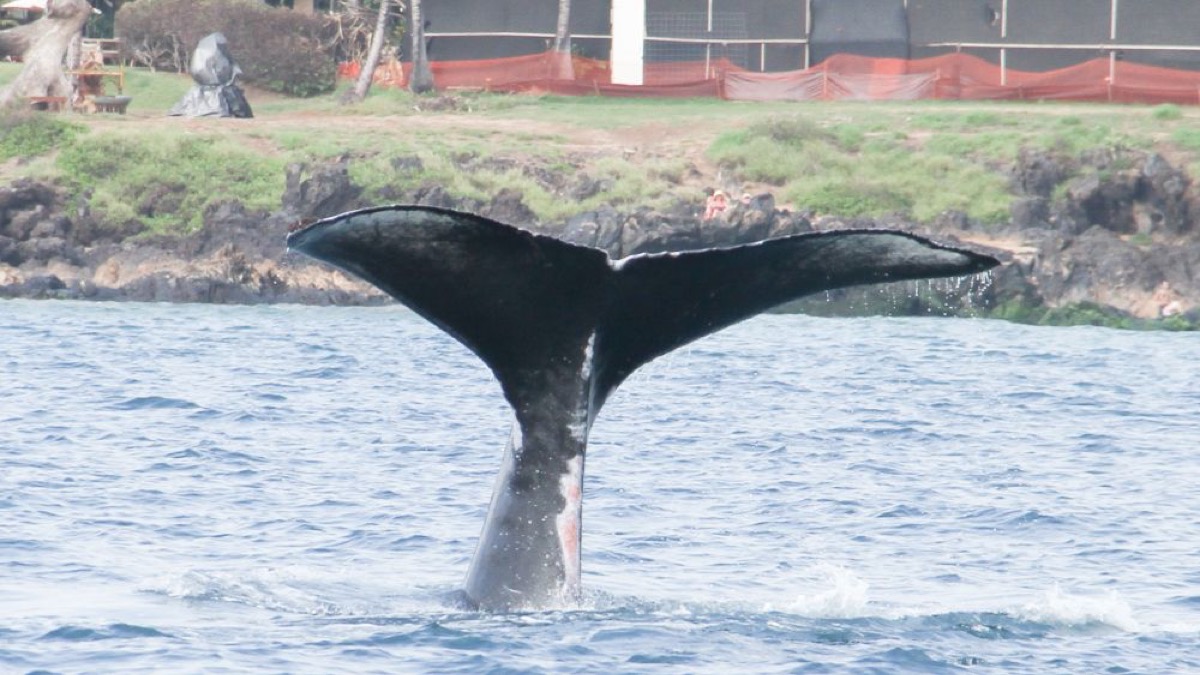
A healthy humpback whale fluke (tail) breaking the surface, photographed by a member of the public and uploaded to Happywhale.com, the exact type of image NOAA researchers used to re-identify this whale seven years after its rescue
A photo like this one, uploaded to Happywhale.com, is what let researchers match this whale to its 2017 rescue.

What They Found

Now a full-grown adult, the whale showed no signs of injury, no remaining gear, and no visible wounds.

It had healed completely and was gliding through the same sanctuary waters where it had once fought just to breathe.

A Bigger Network Behind One Whale

The rescue was never a one-person job. Lyman and fellow coordinator Maria Harvey run Hawaii's Large Whale Entanglement Response Network, which now counts more than 350 trained members.

Since 2022 alone, the network has freed 44 large whales from life-threatening entanglements, pulling in more than 15,690 feet of rope and netting.

The 2024-2025 season was its busiest yet, with 17 on-water responses to seven different animals in just three months.

None of that would matter to any one whale if the story simply ended at the moment the last cable was cut. This one didn't. It survived.

Enjoyed this? Get a new fact every day.

Follow FunFactz for the best ones in your feed.

or get one in your inbox

Frequently Asked Questions

How did researchers know it was the same whale seven years later?
A member of the public uploaded a photo of a whale's fluke (tail) to Happywhale.com. Every humpback whale has a unique fluke pattern, and NOAA researchers matched the new photo to their old case records from the 2017 rescue.
How much cable was removed from the whale?
Responders removed more than 800 feet of 5/8-inch coaxial cable from the whale off Maui in 2017. Some of the cable was wedged so deep in the whale's mouth that it could not be safely removed.
What is Happywhale?
Happywhale.com is a public database where anyone can upload whale photos, especially of the fluke, to help scientists track individual whales over time using pattern-matching. It played a key role in confirming this whale's identity years after its rescue.
Where did the whale rescue take place?
The entanglement and rescue happened off the coast of Maui, Hawaii, within what is now the Hawaiian Islands Humpback Whale National Marine Sanctuary.
Who leads whale rescues in Hawaii?
Ed Lyman is NOAA's Large Whale Entanglement Response coordinator for the Hawaiian Islands sanctuary. He and coordinator Maria Harvey run a network of more than 350 trained responders who have freed over 40 large whales from entanglements since 2022 alone.

Verified Fact

Verified Aug 4, 2026

Source: NOAA Office of National Marine Sanctuaries
Show verification details

Verified 2026-08-04 (fact-verifier independent audit). Primary source read in full: NOAA Office of National Marine Sanctuaries, A Life on the Line: A Powerful Humpback Whale Recovery (sanctuaries.noaa.gov/news/2025/humpback-whale-recovery.html, published Jun 2025). Claims checked: 2017 Maui entanglement CONFIRMED; more than 800 feet of 5/8-inch coaxial cable removed CONFIRMED; first cable entanglement seen by team CONFIRMED (direct Lyman quote); cable embedded in mouth could not be removed CONFIRMED (direct quote); Ed Lyman, Large Whale Entanglement Response coordinator, 15th season, 24 whales freed prior CONFIRMED; seven-year gap to resight CONFIRMED; Happywhale.com public fluke-photo match mechanism CONFIRMED (direct quote); whale healthy adult, no gear/wounds at resight CONFIRMED (direct quote); network stats (350+ members, 44 whales freed, 15,690+ ft line, since 2022) CONFIRMED. source_url supports every headline specific - citation fidelity PASS. Numeric coherence: text/social_text/caption/FAQs all internally consistent (800 ft, 2017, seven years). DISCREPANCY FOUND AND CORRECTED: social_engagement_comment and one FAQ answer both said the network freed 40+ whales over the past two decades - the article explicitly scopes that 44-whale count to since 2022 (~3 seasons), not two decades (network itself is in its 23rd season, but the 44-count stat is recent-only). Corrected both fields to since 2022 alone. Also corrected social_link_comment: uploaded by a random beachgoer changed to uploaded by a random stranger - source says only a member of the public, not beachgoer specifically (fluke photos are typically taken from boats/tours, not beaches - unsupported invented specific). Short-form fields (social_text, caption, engagement/link comments) stay on awe framing with no suffering/wound language; graphic entanglement detail confined to article. Reversed-agency check: no agency reversal found (rescuers freed whale; public uploaded photo; researchers matched it - all directionally correct). engine=1 (emotional-animal/awe, unnamed whale) POLICED and CORRECT - not a famous-name trivia case. nov=2 POLICED and reasonable - web search found only NOAA + Maui Now/local coverage, not a widely recycled viral classic. pf=2 left as image-curator will confirm actual photo availability (NOAA holds rescue + fluke photos under MMHSRP Permit 18786 per creator research). bf=2 - checked last 60 days of whale/rescue facts in DB, no duplicate animal-comeback-confirmed sub_beat found; closest are active in-water rescues (melby-manatee, texas-turtles) which are a different narrative shape (resight-years-later vs in-the-moment rescue), though noting rescue-adjacent content has been dense in the last 2 weeks - a soft pacing caution for social-manager, not a bf veto. No scheduled_posts existed for this fact (pre-imaging stage) so no cascade cancellation needed. No image fields set yet - nothing to null.

Related Topics

More from Animals

View all Animals