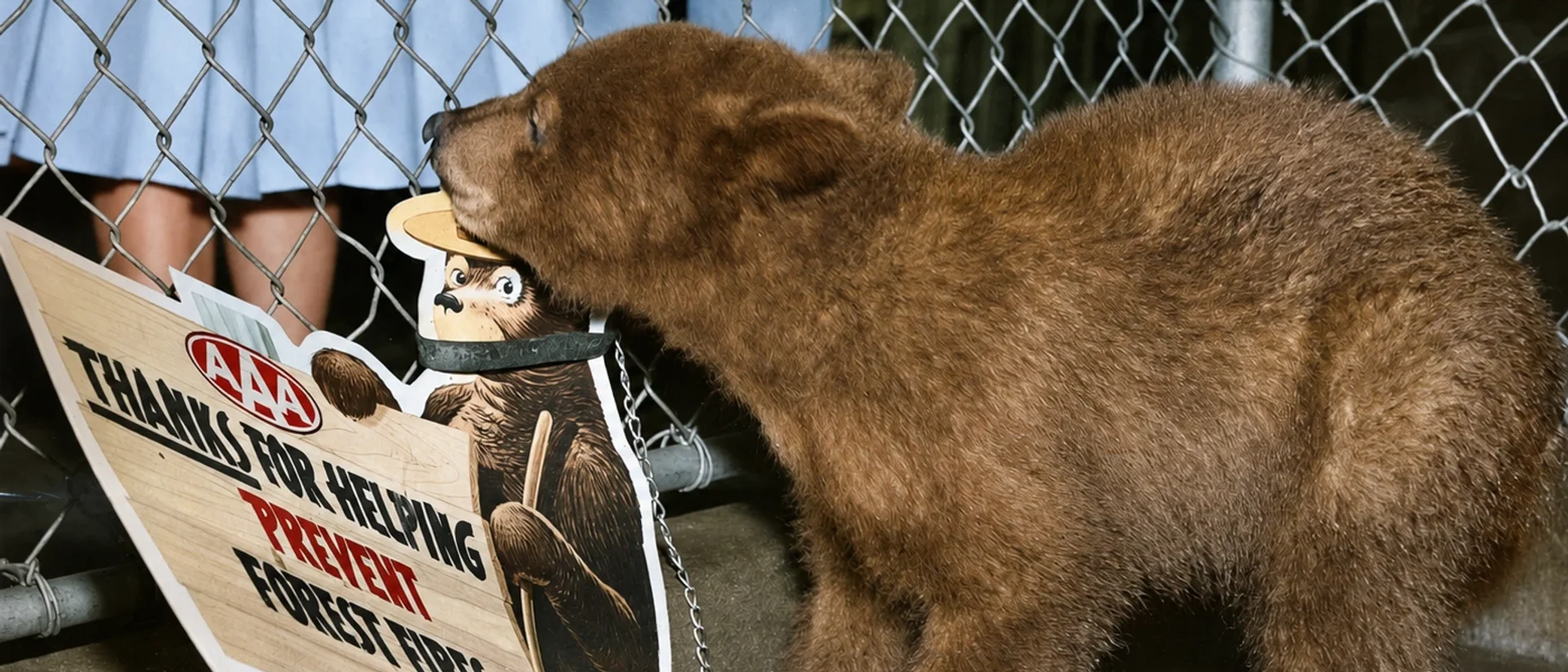
Smokey Bear was a poster before he was a real bear. In 1950, firefighters in New Mexico found a three-month-old black bear cub clinging to a burned tree, his paws scorched from a wildfire. They nursed him back to health, named him Smokey, and sent him to the National Zoo in Washington DC. He lived there for 26 years. He got so much fan mail he was given his own ZIP code: 20252. He is buried in Capitan, New Mexico.
The Real Bear Behind Smokey Bear
Most Americans grew up seeing his face on road signs and campfire posters. But behind the ranger hat and the famous warning was something almost no one expects: a real bear, rescued from a real fire, who spent 26 years greeting visitors at the National Zoo.
A Campaign Without a Face
In August 1944, the U.S. Forest Service and the Ad Council created a fictional bear to front their wildfire-prevention campaign. Artist Albert Staehle drew a young bear wearing a campaign hat, and the longest-running public service campaign in American history was born. For six years, Smokey Bear lived only on posters and radio spots.
The Fire That Changed Everything
In May 1950, a wildfire tore through the Capitan Mountains of New Mexico. The Capitan Gap Fire burned more than 17,000 acres of Lincoln National Forest before crews brought it under control. When the smoke cleared, a Forest Service ranger heard a strange noise coming from a charred tree. Clinging to the blackened bark was a three-month-old black bear cub. His paws and hind legs were badly burned.
Nursed Back to Health
Ray Bell, a New Mexico game warden and pilot, flew the injured cub to Santa Fe for veterinary treatment. Bell took the cub home, where his family helped nurse the little bear back to health. Once recovered, the New Mexico state game warden gave the cub to the Forest Service, which named him Smokey - after the campaign character he now embodied. He arrived at the Smithsonian's National Zoo in Washington DC about a month after his rescue, welcomed by a ceremony attended by 500 children.
A National Celebrity
Smokey quickly became one of the zoo's most beloved residents. Fan mail poured in at a rate of about 5,000 letters a week - so much that the U.S. Postal Service assigned him his own ZIP code: 20252. He was only the second individual in the country to hold that distinction. The other was the President of the United States. In 1962, zoo keepers introduced him to a female bear named Goldie, and the pair later adopted an orphaned cub from the Lincoln National Forest. In 1975, Smokey retired from federal service, and the National Association of Retired Federal Employees gave him a membership card.
His Last Journey Home
Smokey Bear died peacefully at the National Zoo on November 9, 1976, after 26 years as America's most famous bear. He was flown back to New Mexico and buried at the Smokey Bear Historical Park in Capitan - the same mountain town where firefighters had found him clinging to a burned tree a quarter-century before.
Enjoyed this? Get a new fact every morning.
A fascinating fact in your inbox every morning. Free. Unsubscribe anytime.
Frequently Asked Questions
Was Smokey Bear a real bear?
What was the Capitan Gap fire?
Why did Smokey Bear have his own ZIP code?
When did the real Smokey Bear die?
When was Smokey Bear created?
Verified Fact
Verified Jun 15, 2026 · 6 sources checked
Source: Smithsonian MagazineShow verification details
Claims checked
- Smokey Bear mascot campaign began in 1944, before the real bear was found
- The cub was found after the 1950 Capitan Gap Fire in New Mexico
- He lived at the National Zoo from 1950 to 1976 and received his own ZIP code (20252)
- He died November 9, 1976, and is buried in Capitan, New Mexico
Sources: Smithsonian Magazine, smokeybear.com, WETA Boundary Stones, Firehouse.com, zoohistories.com, Smithsonian Institution Archives
Related Topics
More from Animals
View all Animals →