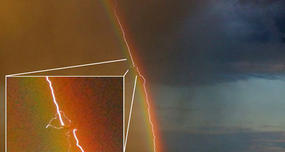
It is possible to see a rainbow at night!
You Can Actually See Rainbows at Night
When most people think of rainbows, they picture bright arcs stretching across the sky after an afternoon storm. But there's a much rarer, more mysterious version that appears only at night: the moonbow, also called a lunar rainbow.
Moonbows are created by the exact same physics as regular rainbows. When moonlight hits water droplets in the air—whether from rain, mist, or waterfall spray—the light refracts, reflects, and disperses into its component wavelengths. The result is a rainbow arcing across the night sky, always positioned opposite the moon from where you're standing.
Why They Look Like Ghost Rainbows
Here's the weird part: moonbows usually appear white to the human eye. That's because moonlight is roughly 400,000 times dimmer than sunlight. Our eyes have two types of photoreceptors—rods for low light (black and white vision) and cones for color. In the darkness where moonbows appear, there simply isn't enough light to activate our cone receptors.
The colors are absolutely there, though. Long-exposure photographs reveal moonbows in full color—red, orange, yellow, green, blue, indigo, and violet, just like their daytime cousins. Your camera can see what your eyes can't.
The Perfect Storm (Literally)
Spotting a moonbow requires an alignment of very specific conditions:
- The moon must be full or nearly full and low in the sky (no higher than 42 degrees above the horizon)
- The sky must be very dark—no competing light pollution or clouds blocking the moon
- Water droplets must be present in the air opposite the moon
- Your timing has to be perfect—within a few nights of the full moon
This explains why most people have never seen one. The conditions align so rarely that moonbows are among the least common optical phenomena in nature.
Where to Hunt for Moonbows
Your best bet is at waterfalls during a full moon. The constant mist provides reliable water droplets, and the timing is predictable. Cumberland Falls in Kentucky is famous for moonbows and even advertises "moonbow nights" to visitors. Yosemite National Park in California and Victoria Falls on the Zambia-Zimbabwe border are also renowned moonbow destinations.
Some dedicated photographers have also captured moonbows during nighttime rain showers, though this requires more luck and patience. You need the rain to be in the right position relative to the moon while the moon itself peeks through breaks in the clouds.
So yes, you really can see a rainbow at night—if you're patient, lucky, and willing to stay up late with the full moon. Just don't expect the vivid colors. For that, bring a camera.
Frequently Asked Questions
What is a moonbow?
Why do moonbows appear white?
When is the best time to see a moonbow?
Where can I see a moonbow?
Are moonbows rare?
Verified Fact
This fact has been reviewed and verified against original sources.
Show verification details
Confirmed accurate. Moonbows (lunar rainbows) are real optical phenomena caused by moonlight refracting through water droplets, following the same physics as daytime rainbows.