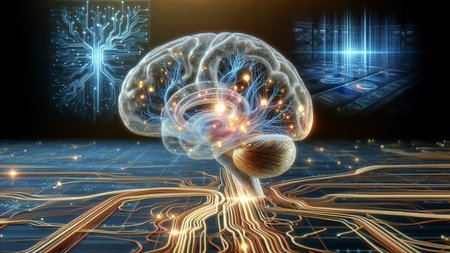
Mental rehearsal can significantly improve physical performance. Brain scans show that imagining an action activates many of the same neural pathways as actually performing it.
Your Brain Practices Even When Your Body Doesn't
Close your eyes and imagine shooting a basketball. Picture the weight of the ball, the arc of your arm, the satisfying swish of the net. Congratulations—you just gave your brain a mini workout that's surprisingly similar to actually playing.
This isn't wishful thinking. It's neuroscience.
Your Brain Can't Quite Tell the Difference
When researchers put people in fMRI machines and asked them to either perform a task or vividly imagine it, something remarkable happened. The motor cortex—the brain region responsible for planning and executing movement—lit up in both scenarios.
The overlap isn't perfect, but it's substantial. Imagining a movement activates about 80% of the same neural pathways as performing it. Your brain is essentially running a simulation, strengthening the connections that matter.
The Science of Mental Reps
This phenomenon, called motor imagery, has been studied extensively since the 1990s. Here's what we know:
- Mental practice improves muscle strength by 10-35% without any physical exercise
- Pianists who mentally rehearsed pieces showed similar brain changes to those who physically practiced
- Stroke patients use mental imagery as part of rehabilitation to rebuild motor function
The mechanism seems to involve the same neural pathways getting "primed" through repeated mental activation. It's like your brain is laying down the tracks before the train arrives.
Why Athletes Swear By It
Elite athletes have used visualization for decades, often without knowing the neuroscience behind it. Olympic swimmers imagine every stroke before a race. Golfers picture the perfect swing. Basketball players see free throws sinking before they step to the line.
Michael Phelps famously spent hours mentally rehearsing races, including everything that could go wrong. When his goggles filled with water during the 2008 Olympics, he'd already "swum" that scenario hundreds of times in his mind. He won gold anyway.
The Catch
Mental practice works best as a supplement, not a replacement. Studies show the ideal combination is about 75% physical practice and 25% mental rehearsal. Visualization alone won't make you a concert pianist if you've never touched a keyboard.
The quality of imagination matters too. Vague daydreaming doesn't cut it. Effective mental practice requires vivid, detailed, first-person visualization—feeling the movements, not just watching yourself from the outside.
Your brain is remarkably adaptable, constantly rewiring itself based on experience. The twist? It doesn't always distinguish between experiences that happened and experiences you imagined with enough intensity. For athletes, musicians, and anyone learning a skill, that's a feature, not a bug.
Frequently Asked Questions
Does mental practice really work?
How do athletes use visualization?
Can you build muscle by just thinking about exercise?
What is motor imagery in psychology?
How effective is mental practice compared to physical practice?
Verified Fact
This fact has been reviewed and verified against original sources.
Show verification details
Clarified the claim - mental practice improves performance but works best when combined with physical practice. The brain does show similar activation patterns, but 'barely tell the difference' is an overstatement.