You can't tickle yourself.
Why You Can't Tickle Yourself (Your Brain Won't Allow It)
Go ahead, try it right now. Run your fingers along your ribs or the bottom of your foot. Nothing, right? Maybe a slight sensation, but nothing like the involuntary squirming, gasping laughter that happens when someone else does it. This isn't willpower or mind over matter—your brain is actively blocking the tickle response before it even happens.
Your Brain Is a Prediction Machine
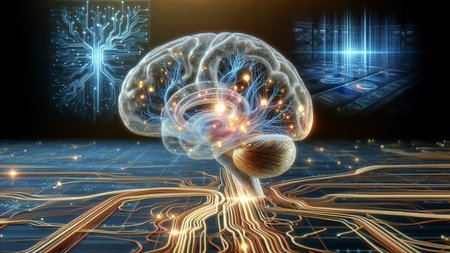
The culprit is your cerebellum, the brain region that coordinates movement and predicts sensory consequences. When you move your hand toward your ribs, your cerebellum sends out what neuroscientists call an efference copy—essentially a heads-up to your somatosensory cortex about exactly when, where, and how strong the incoming touch will be.
Because your brain knows what's coming, it dampens the sensation before you even make contact. Brain imaging studies show dramatically less activity in the somatosensory cortex during self-touch compared to external touch. Your cerebellum is basically saying, "False alarm, folks. That's just us."
This predictive cancellation happens unconsciously and instantaneously. You can't override it through concentration or surprise movements—the system is too fast and too fundamental to your brain's architecture.
The Schizophrenia Exception
Here's where it gets fascinating: people with schizophrenia often can tickle themselves. The same disruptions in brain connectivity that cause hallucinations and delusions also interfere with this predictive mechanism. Their brains struggle to distinguish self-generated sensations from external ones.
This finding has helped researchers understand schizophrenia as partly a disorder of prediction—the brain fails to accurately forecast the sensory consequences of its own actions, leading to experiences that feel externally imposed.
Tricking Your Cerebellum
Scientists have found workarounds. University College London researchers developed a robotic tickling device that introduces a time delay between your hand movement and the tickling sensation. With enough delay (around 200 milliseconds), you can tickle yourself—the unpredictability bypasses your cerebellum's prediction.
The same principle explains why you might feel a slight tickle if you use your opposite hand in an awkward position or trace unexpected patterns. You're introducing just enough uncertainty to partially defeat the cancellation mechanism.
Why This Matters Beyond Parties
Understanding self-tickle suppression has implications far beyond novelty. It reveals how your brain constantly distinguishes "self" from "other"—a fundamental cognitive ability. This mechanism helps you:
- Ignore the sensation of your clothes touching your skin
- Focus on external threats rather than self-generated movement
- Maintain a stable sense of agency over your actions
- Differentiate your touch from someone else's in social interactions
Yet despite 2,000 years of philosophical interest (Aristotle wrote about tickling), neuroscientists published research in May 2025 arguing we've barely scratched the surface. Most studies use light touch rather than genuine tickling, and the full neural circuitry remains mysterious.
So next time you absentmindedly scratch an itch without thinking about it, thank your cerebellum for the prediction that makes it unremarkable. And if you want a good laugh, you'll still need to find a friend.
Frequently Asked Questions
Why can't you tickle yourself?
Can anyone tickle themselves?
How can you trick your brain to tickle yourself?
What part of the brain stops you from tickling yourself?
Why does tickling make you laugh?
Verified Fact
This fact has been reviewed and verified against original sources.
Show verification details
Confirmed by current neuroscience research (2025). The cerebellum's predictive mechanism prevents self-tickling by anticipating self-generated touch sensations.
Related Topics
More from Body & Health
View all Body & Health →