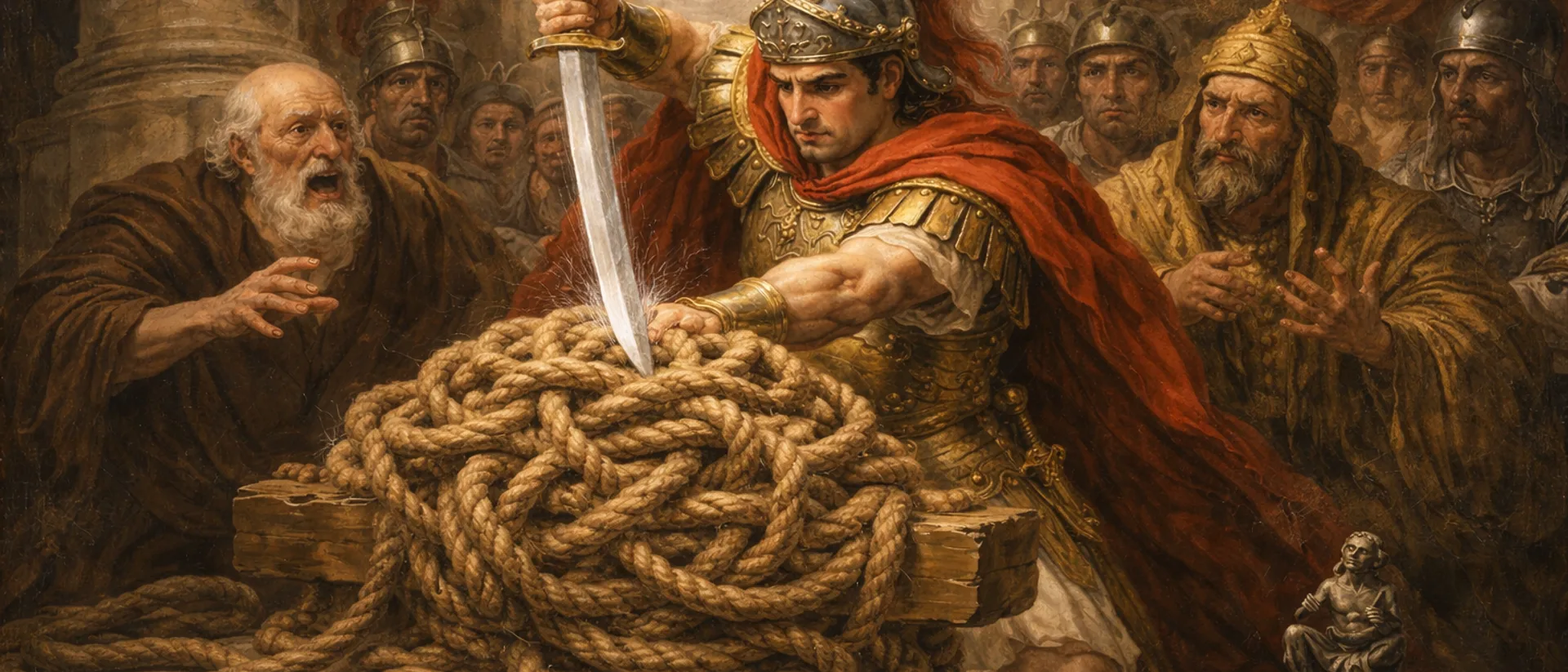
For centuries, the Gordian Knot defeated every scholar and king who tried to untie it. An oracle declared whoever solved it would rule all of Asia. Alexander the Great studied it for a moment — then drew his sword and cut straight through it.
Alexander the Great and the Knot That Defeated Everyone
In the ancient city of Gordium — capital of Phrygia, in what is now Turkey — sat an oxcart tied to a post with an impossibly intricate knot of cornel bark. According to legend, an oracle had declared that whoever could untie it would rule all of Asia. For over a century, the knot remained unsolved.
The Knot's Origin
The story begins with a peasant farmer named Gordias, who arrived in Gordium in an oxcart. An oracle had prophesied that the future king would arrive in just such a wagon, and Gordias was promptly made ruler. His son — some accounts say King Midas himself — dedicated the cart to the gods, tying the yoke to a pole with a knot so complex that no one could find its ends.
Alexander Arrives
In 333 BCE, Alexander the Great marched his army through Gordium on his way to confront the Persian Empire. He was 23 years old and already one of the most successful military commanders in history. When he heard about the knot and its prophecy, he went to see it for himself.
What happened next depends on which ancient historian you ask. The most famous version, recorded by Arrian, says Alexander studied the knot briefly, declared "It makes no difference how they are loosed," and sliced through it with his sword. The historian Aristobulus offered a different account: that Alexander cleverly removed the pin holding the yoke to the pole, exposing the rope's hidden ends and pulling it apart without cutting.
The Aftermath
That night, thunder and lightning reportedly rolled across the sky — interpreted as a sign from the gods that Alexander had fulfilled the prophecy. Within a decade, he had conquered the Persian Empire and most of the known world, building an empire that stretched from Greece to India.
A Phrase That Endures
"Cutting the Gordian Knot" became one of history's most enduring metaphors — the idea that sometimes the boldest, most direct solution is the right one. Whether Alexander actually used a sword or a pin, his approach to the problem has defined how we think about creative problem-solving for over 2,300 years.
Frequently Asked Questions
Did Alexander the Great really cut the Gordian Knot with a sword?
What was the Gordian Knot prophecy?
Where was the Gordian Knot located?
What does cutting the Gordian Knot mean today?
Verified Fact
Verified Aug 26, 2026 · 3 sources checked
Source: BritannicaShow verification details
Claims checked
- Alexander cut through the Gordian Knot with his sword
- Oracle said the knot’s solver would rule Asia
- Encounter at Gordium occurred in 333 BCE
- Knot had existed since the time of Gordias/Midas
Sources: Britannica, Arrian, Plutarch, Quintus Curtius Rufus