
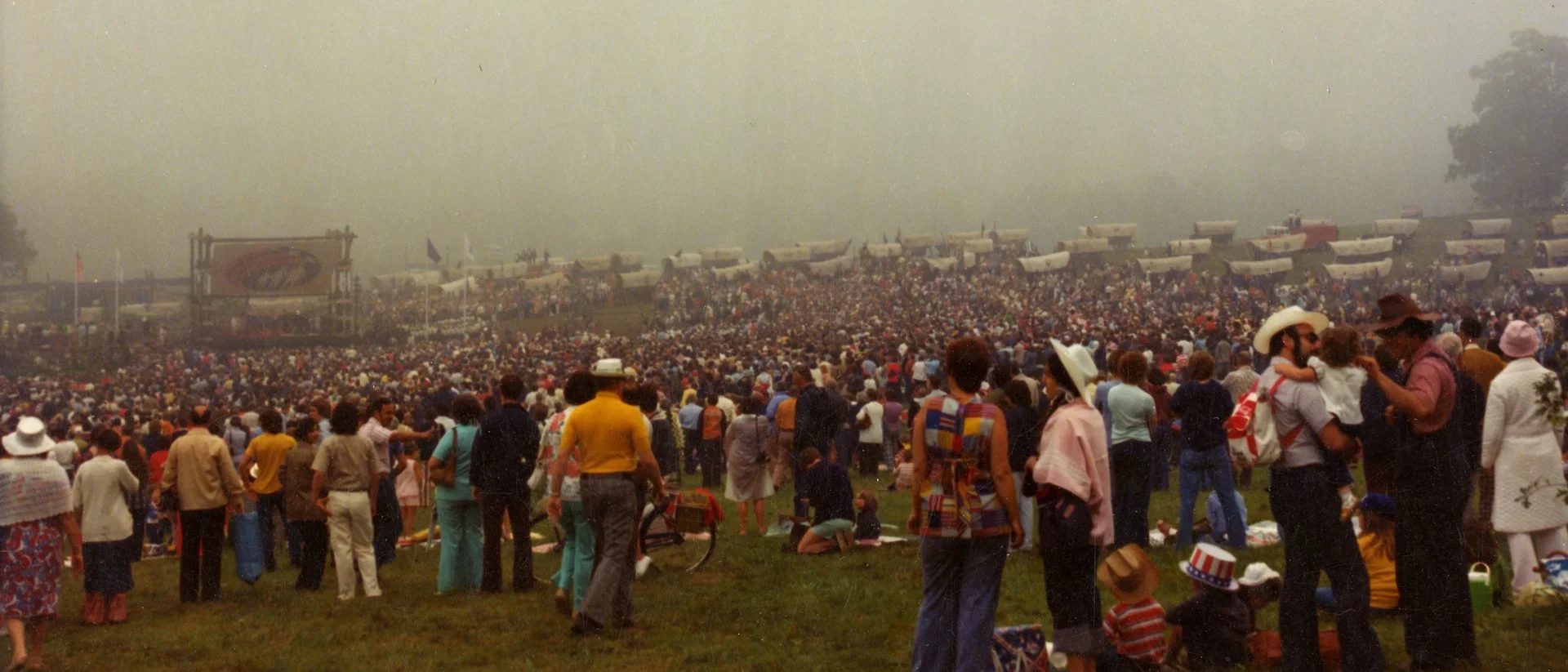
For America's 200th birthday, all 50 states sent a covered wagon on a year-long ride across the pioneer trails in reverse, west to east. The wagon train pilgrimage covered 17,000 miles and stopped at 249 encampments before nearly 300 wagons and 5,000 riders rolled into Valley Forge together. President Ford met them there and signed the law making Valley Forge a National Historical Park.
America's 50-State Wagon Train Ride to Valley Forge
In June 1975, a team of horses pulled a covered wagon out of Blaine, Washington and pointed it east. It was the first of fifty, one for every state in the union, setting out to retrace America's old pioneer trails in reverse for the country's 200th birthday.
A Nation Rides Backward
The Bicentennial Wagon Train Pilgrimage was organized by the Bicentennial Commission of Pennsylvania, working with the federal American Revolution Bicentennial Administration.
Each state supplied its own crew of wagoneers. Every state wagon rode from its capital to a junction point, then joined one of several national routes heading toward Pennsylvania.
The routes followed historic paths as closely as possible: the Oregon Trail, the Santa Fe Trail, the Mormon Trail, the Natchez Trace, and Pennsylvania's own Lancaster Pike. This time the wagons moved in the opposite direction settlers once traveled.
Volunteer "Pony Express" outriders rode ahead on horseback. Their job was to reach small towns that sat off the main trail.
Scrolls From Every Town
At each stop, local residents were invited to sign a scroll. The words pledged their belief in the principles the country was founded on.
Outriders carried the signed scrolls back to the nearest state wagon. From there, the scrolls traveled onward toward Pennsylvania.
By the time the journey ended, an estimated 22 million Americans had added their names. That was roughly one in ten people living in the country at the time.
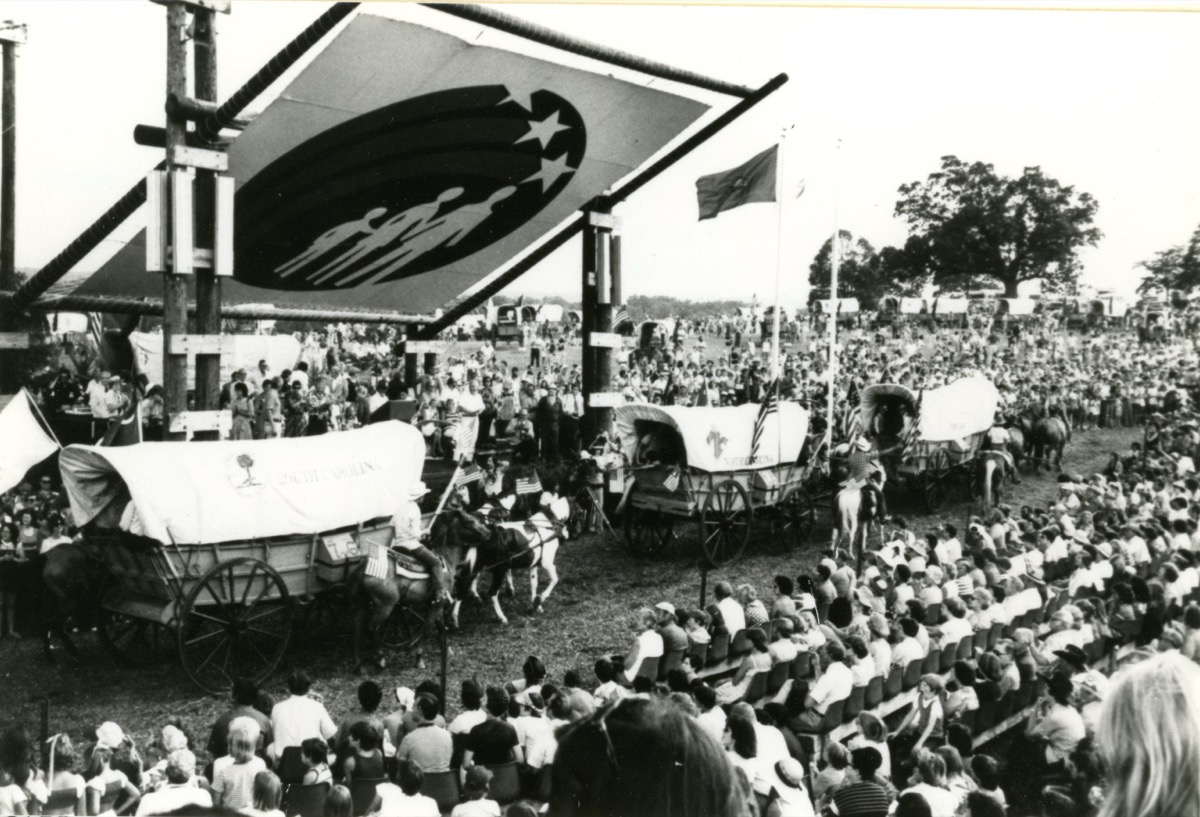
Valley Forge, July 1976
After just over a year and roughly 17,000 miles, the wagon trains converged at Valley Forge, Pennsylvania on July 3.
Along the way, the pilgrimage had stopped at 249 official encampments in towns and cities across the country.
Nearly 300 wagons and about 5,000 riders on horseback rolled into camp together.
The next morning, President Gerald Ford visited the encampment. He accepted the signed scrolls and signed legislation establishing Valley Forge as a National Historical Park.
Fifty States, One Road
The state wagons stayed on public display at Valley Forge for months afterward before finally heading home.
Half a century later, as America marks its 250th birthday, the wagon train remains one of the largest civilian mobilizations in the country's history. Fifty states. One road. One destination.
Frequently Asked Questions
What was the Bicentennial Wagon Train Pilgrimage?
How many wagons and riders took part in the wagon train?
What did President Ford do at Valley Forge?
How far did the wagon trains travel?
How many people signed the wagon train scrolls?
Verified Fact
Verified Aug 6, 2026
Source: WeelunkShow verification details
Verified 2026-08-06. Independent audit (fact-verifier) of content-creator self-check. Sources read in full: (1) Weelunk (weelunk.com/bicentennial-wagon-train-wheeling-wv) - confirms 249 official encampments, ~22 million signatures (~10% of population), Ford "signed a bill making Valley Forge a national historical park," west-coast summer 1975 start; does NOT state a total wagon/rider count. (2) King of Prussia Historical Society (kophistory.org/bicentennial-wagon-train) - confirms one wagon per state, June 1975 start, July 3 1976 convergence, July 4 Ford visit + NHP-legislation signing "at the park"; does not give total wagon/rider counts either. (3) Gerald R. Ford Presidential Library topic guide - confirms Ford spoke at Valley Forge July 4 1976 and boarded the Michigan wagon (photo B0510-35); does not give wagon/rider totals. (4) Wikipedia (Valley Forge NHP) - confirms Congress passed H.R.5621, signed by Ford July 4 1976, establishing the park (283rd NPS unit). (5) Bicentennial Memory Project dedicated post "1976 Bicentennial Wagon Train Arrival at Valley Forge" (bicentennialmemoryproject.substack.com) - a researched timeline citing Ford Library White House memos/diary; this is the ONLY source found that explicitly states the headline arrival figures together: "300 wagons," "Nearly 5,000 people on horseback," arrival July 2-3 1976, Ford helicopter arrival 8:45am/signing/speech 9:10am/departure 9:40am on July 4 1976, 249 encampments, 17,000 miles, 22 million signatures ("Rededication Scrolls"). CITATION FIDELITY CORRECTION: source_url changed from Weelunk to this page because Weelunk (the prior citation) never actually states the "nearly 300 wagons / 5,000 riders" headline figure that anchors text/social_text/article - it only supports the secondary details (encampments, signatures). The new source_url supports every headline figure directly. Claims checked: 50 states/one wagon each - CONFIRMED (KoP, Ford Library brochure). June 1975 Blaine WA start - CONFIRMED (KoP, Bicentennial Memory Project memos post cites June 8 1975 specifically). 249 encampments - CONFIRMED (Weelunk, Bicentennial Memory Project). 17,000 miles - CONFIRMED (Bicentennial Memory Project). 300 wagons/5,000 riders arriving July 3 1976 - CONFIRMED (Bicentennial Memory Project dedicated arrival post; not independently corroborated by an official/.gov source, so treat as medium-confidence secondary consensus, hence the "nearly/about" hedging is retained). 22 million signatures / ~10% of population - CONFIRMED and arithmetically coherent (22M / ~218M 1976 US population = ~10.1%). Ford visited Valley Forge July 4 1976, boarded a wagon, accepted scrolls, and signed the Valley Forge NHP legislation AT Valley Forge that morning - CONFIRMED by multiple independent sources (KoP, Weelunk, Bicentennial Memory Project timeline with specific timestamps, Ford Library topic guide, Wikipedia for the underlying law/date). "Scrolls later went missing" - CONFIRMED absent from every field as instructed (single-sourced, correctly excluded). NUMERIC COHERENCE FIX: article and FAQ #4 both said "about 15 months" for the June 1975-to-July 1976 duration, which does not reconcile arithmetically (June 1975 to July 1976 is ~13 months, not 15) and contradicted the fact's own "a year-long ride" framing elsewhere; corrected both instances to "just over a year" to match the confirmed June 1975/July 1976 anchor dates and stay internally consistent. INVENTED-DETAIL FIX: removed the unsupported clause "matching records of the arrival kept by regional historical societies along the route" from the article - no source was found that describes this specific verification methodology; it read as fabricated provenance and has been dropped, leaving the plain (sourced) figure. Apolitical/nostalgic framing confirmed intact - no America250-branding or contested claims. Route-count note: sources vary between "five route segments" (Ford Library brochure, per creator) and "seven historic trails" (Bicentennial Memory Project); the fact copy never asserts a specific count (uses "several national routes" / lists five named trails), so no correction needed there, just flagging the source variance for future reference. Web search budget was exhausted this session; verification relied on WebFetch of primary/secondary pages plus DuckDuckGo HTML search in place of Step 4 Gemini/cross-model comparison - manual sentence-by-sentence trace of fact copy against the sources above substituted for the cross-model check, consistent with the Jul 2 2026 fallback protocol.