The Buck 110 is the brass-and-wood folding knife in a million pockets. At 13, Hoyt Buck forged his first blade from a worn-out file. In WWII, the country ran short of knives for soldiers. He built a basement forge in Mountain Home, Idaho. "I didn't have any knives, but I sure knew how to make them," he said. His son Al built the company. The 110 came in 1964. The family still makes them.
How a 13-Year-Old Blacksmith's Knife Became the Buck 110
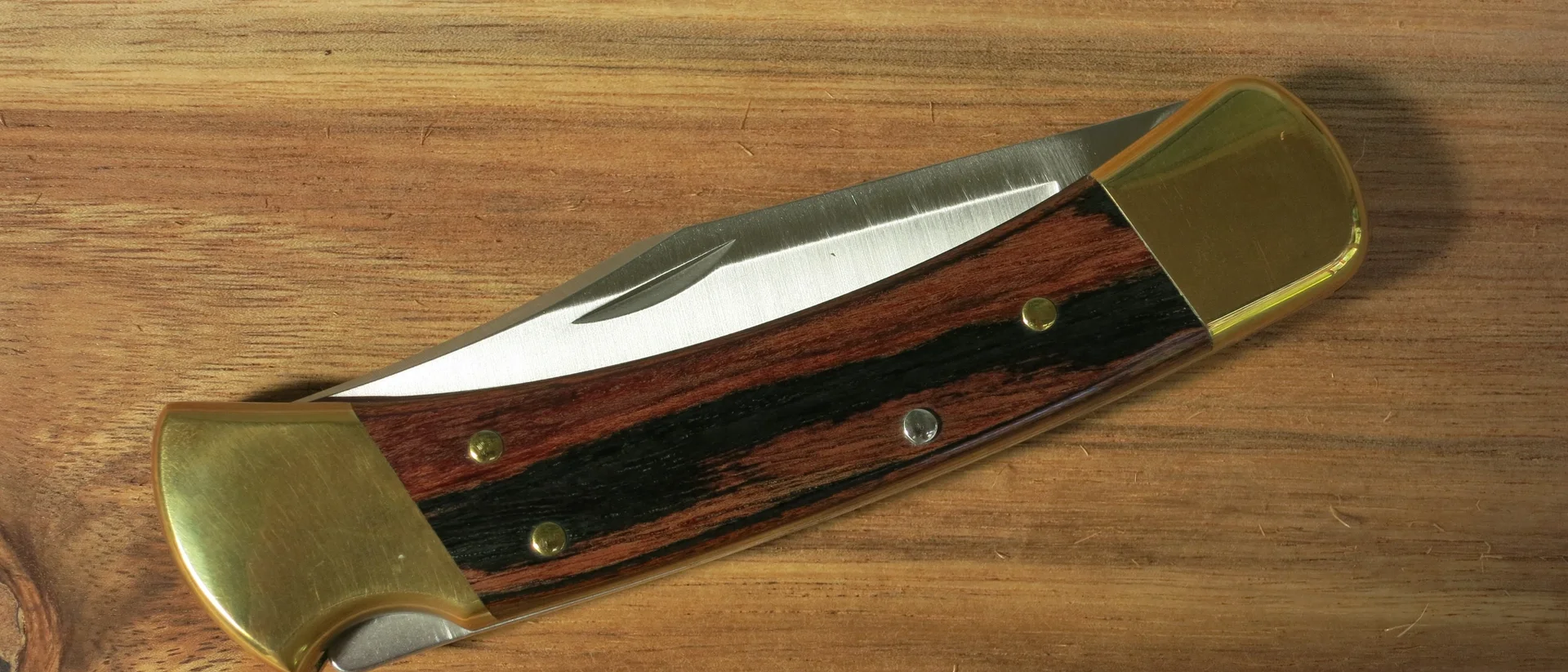
If you know one folding knife by shape alone, it is probably this one: a clip-point blade, a brass bolster, a slab of wood for a handle. The Buck 110 has been riding in tackle boxes and back pockets since 1964. It started with a boy hammering scrap steel in a Kansas blacksmith shop.
A 13-Year-Old With a File and a Forge
Hoyt Buck became a blacksmith's apprentice in Kansas in 1899, at age 10. By 1902, at just 13, he had worked out a heat-treatment method that made steel hold an edge longer.
He didn't have money for raw steel, so he made his early knives out of worn-out file blades - the same rasps and files a blacksmith would otherwise throw away.
Each knife was stamped one letter at a time: B-U-C-K. Collectors still call these early pieces "four strikes."
When the Country Ran Short of Knives
Hoyt left Kansas in 1907, moved to the Pacific Northwest, and eventually served in the U.S. Navy. Decades later, when the United States entered World War II, the government put out a call for knife donations - there simply weren't enough to go around for soldiers heading overseas.
Hoyt was living in Mountain Home, Idaho by then, serving as pastor of a small church, with no factory and no stock of blades to give. So he bought an anvil, a forge, and a grinder, set them up in the church basement, and started making knives himself, one at a time.
"I didn't have any knives," he said, "but I sure knew how to make them."
Al Buck Builds the Company
After the war, Hoyt moved to San Diego with his son Al and started "H.H. Buck & Son" in 1947. The handmade knives sold well, but Hoyt could only turn out about 25 a week. He died in 1949, and it was Al who spent the next decade turning a one-man forge into an actual company.
Buck Knives filed its articles of incorporation on April 7, 1961 - what Popular Mechanics later called "the true beginning of the modern era" for the brand.
The 110 Becomes a Classic
Two years after incorporating, in April 1963, the Buck board approved a new folding hunting knife. It went into production in 1964: a 3.75-inch clip-point blade, a heavy brass bolster, and a wood handle, built around a locking mechanism strong enough to do a fixed-blade knife's job.
It was one of the first lockback folders anyone trusted for real field work instead of just whittling. Hunters, campers, and anyone who wanted one good knife for everything bought it by the millions, and other knife makers spent the next sixty years copying its shape.
Five Generations Later
Buck Knives is still a family company. It moved its headquarters from San Diego to Post Falls, Idaho in 2005, and today it's run by the fifth generation of Bucks, with CJ Buck as chairman and CEO.
Buck Knives had made roughly 15 million Model 110s by the early 2010s, reaching a production rate of about a million a year in 2010 - the same clip-point shape a 13-year-old blacksmith's apprentice first learned to forge out of a worn-out file.
Frequently Asked Questions
Who invented the Buck 110?
What is the Buck 110 made of?
Why did Hoyt Buck start making knives during World War II?
Is Buck Knives still a family-owned company?
How many Buck 110 knives have been made?
Verified Fact
Verified Aug 19, 2026 · 1 sources checked
Source: Wikipedia (citing Popular Mechanics, June 2001, and Ables, 1991)Show verification details
Claims checked
- Hoyt Buck made his first knife at age 13 from a worn-out file
- WWII-era forge was in Mountain Home, Idaho
- Buck 110 introduced in 1964 with brass and wood handle
- Production figure of 15 million corrected to "by the early 2010s," not current total
- Fifth-generation family-run company in Post Falls
Sources: Wikipedia
Related Topics
More from History & Culture
View all History & Culture →