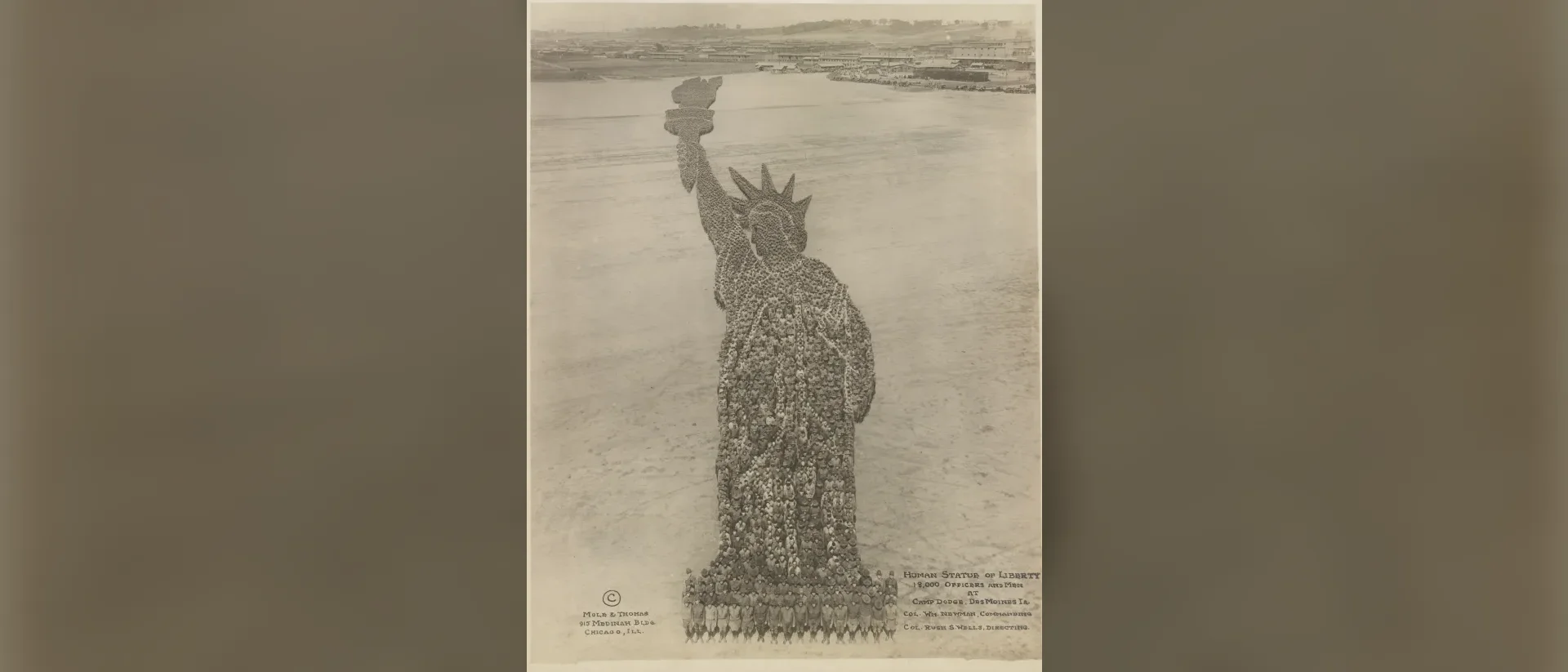
Eighteen thousand soldiers formed a Statue of Liberty a quarter mile long at Camp Dodge in 1918. 12,000 men made up the torch alone - just 17 formed the base. Several fainted in the 105 degree heat.
18,000 Soldiers Formed a Human Statue of Liberty
From ground level at Camp Dodge, Iowa, all a visitor could see was a field packed with thousands of soldiers, seemingly standing in no order at all. Climb an 80 foot tower and look down, and the same field became Lady Liberty herself, torch raised, exactly as she stood in New York harbor.
A Week of Tape and Stakes
The image was the work of Arthur Mole and John Thomas, a pair of commercial photographers who spent World War One traveling between military training camps building what Mole called "living photographs." Before a single soldier moved into place, the two men spent about a week platting the design across the parade ground with tape and marker stakes, working out exactly where each rank needed to fall so the shape would read correctly from a single fixed point far overhead.
18,000 Men in the Iowa Heat
In the summer of 1918, an estimated 18,000 officers and men of the camp's Depot Brigade took their marks under Colonel William Newman's command, with Colonel Rush S. Wells directing the formation itself.
Temperatures reportedly climbed near 105 degrees, and the men held their positions in heavy wool uniforms for hours while Mole and Thomas made final corrections from the tower.
According to a later account in the Fort Dodge Messenger, several soldiers fainted in the heat before the photograph was finally taken.
The Math That Fooled the Camera
The finished figure stretched roughly a quarter mile across the ground, yet through the camera it looked perfectly proportioned.
That illusion depended on a deliberate imbalance: soldiers nearer the tower needed to fill only a small space on film, while soldiers far in the distance had to be packed in far greater numbers to register at the same visual scale.
Historians at the Public Domain Review, drawing on the surviving photograph, describe the split as roughly 12,000 men forming the torch alone, positioned hundreds of yards from the tower, against just 17 men making up the entire base, closest to the camera.
The exact torch and base counts vary slightly between period accounts, but every version agrees on the same lopsided logic: distance, not headcount, decided who got to be a hand or a foot.
One of Thirty "Living Photographs"
Camp Dodge's Statue of Liberty was one of roughly thirty such formations Mole and Thomas staged between 1915 and 1921, including a human Liberty Bell, a human U.S. Shield, and a giant profile of President Woodrow Wilson, each built from thousands of servicemen.
The photographs were intended to help promote the sale of Liberty Bond war bonds, though by some accounts they were never actually used for that campaign.
Decades later, the Camp Dodge image circulated online often enough that the Gold Star Military Museum in Iowa fielded a wave of emails asking if it had been digitally faked.
It had not: the original prints, held today by the Library of Congress and the J. Paul Getty Museum, show an authentic photograph of 18,000 real men, many of whom shipped out for France not long after they broke formation.
Frequently Asked Questions
Who created the human Statue of Liberty photograph?
How many soldiers were used to form the human Statue of Liberty?
Why did the torch have so many more men than the base?
Is the human Statue of Liberty photo real?
Did Mole and Thomas make other formations like this?
Verified Fact
This fact has been reviewed and verified against original sources.
Source: Library of CongressShow verification details
Independently audited 2026-07-27 (fact-verifier pass, separate from content-creator self-check). Primary source read: LOC item 2002699754 (title/caption matches exactly: 18,000 officers and men at Camp Dodge, Des Moines, Ia.; Col. Wm. Newman commanding; Col. Rush S. Wells directing) -- direct WebFetch blocked (403), record content confirmed via indexed search snippets reflecting the LOC catalog note text (Google-cache equivalent per Step 3 fallback). Cross-checked: Getty object 104AGV (same caption, no torch/base breakdown -- matches), Wikimedia Commons file page (same LOC-sourced caption, date 1918, no war-bonds/temp details -- matches), Public Domain Review essay (18,000 total; 17 at base; 12,000 in torch; confirms Liberty Bell 25,000 / US Shield 30,000 / other living-photographs figures), Radio Iowa 2007 (12,000 torch, ~2,000 body+head, August 1918, Gold Star Military Museum dozens-of-emails/authenticity story), Snopes (authenticity rated true), search-synthesized LOC note text (July 1918; 1,235 ft / quarter-mile measurement verbatim; war bonds intended but never used; 105F/wool uniforms/fainting sourced by LOC itself to a July 3 1986 Fort Dodge Messenger story). Claims checked -- CONFIRMED: 18,000 total soldiers; Mole & Thomas photographers; 80 ft tower; quarter-mile/1,235 ft length; Col. Newman commanding / Col. Wells directing; ~30 living photographs 1915-1921 incl. Liberty Bell 25,000 and US Shield 30,000; Mole personally coined the term living photographs; Gold Star Military Museum fielded authenticity emails, museum confirmed real (no reversed agency -- museum received questions, did not send them); photo held by LOC and Getty. CONFIRMED at secondary-source confidence, correctly hedged in copy: 12,000-torch/17-base breakdown (Public Domain Review, corroborated in spirit by Radio Iowa 12,000/2,000 split; NOT in the LOC/Getty caption text itself -- article/FAQ/social_ai_notes all flag this as a secondary detail with wording that vaguely-may-vary, matching the source disagreement); 105F/wool/fainting detail correctly attributed to a later (1986) Fort Dodge Messenger account, not treated as contemporaneous; never-used-for-war-bonds kept hedged (by some accounts) even though LOCs own note states it plainly -- conservative, not an error. Date precision correctly left at summer 1918 / year-only -- sources disagree on month (July per LOC/Fort Dodge Messenger, August per Radio Iowa, September per National Archives Flickr caption). Numeric coherence: all figures (18,000 total, 12,000 torch, 17 base, quarter mile, 80 ft tower, 105F, ~30 living photographs, 25,000 Liberty Bell) are internally consistent across text/social_text/caption/article -- text equals social_text with markdown stripped. Citation fidelity: source_url (LOC item 2002699754) is the exact primary record for this photograph and directly supports the headline specifics (soldier count, location, commanders) -- PASSES, no change needed. One correction made: FAQ 3 (why did the torch have more men than the base) said just a few dozen at the base, inconsistent with the specific 17 used everywhere else in the fact (text/article/social_text/social_caption/social_link_comment) -- corrected to 17 with PDR attribution for internal numeric consistency. No other fields changed; no scheduled_posts existed to cancel; no image set yet so no image nulling needed. Engine=1, mainstream_novelty=1, proof_photo_strength=2, affinity_pool=2 all reviewed and confirmed appropriate: engine=1 is correct (spectacle-shape formed by anonymous mass of soldiers, no famous face, real Statue of Liberty not depicted -- same mechanism as hawkeye-wave, distinct from statue-of-liberty-arm-1876 where the actual landmark is the subject); novelty=1 is fair (the photo itself is a widely-recirculated, oft-debunked-as-fake image, not a fresh find, but also not a fully-saturated meme); proof_photo_strength=2 correct (a real, striking period aerial photograph exists and is the whole point of the fact); affinity_pool=2 correct (Statue of Liberty imagery + WWI patriotism is a mass, near-universal US symbol, not a regional/niche subject -- not a jo-malone-style home-market-fame error). No reversed agency found anywhere. No invented precision beyond what sources state. No contested-causation language present. Cross-model step: gemini CLI dead, codex not attempted -- manual sentence-by-sentence trace of text/article/FAQs/social fields against the LOC/PDR/Radio Iowa/Getty source text performed instead, per Jul 2 2026 guidance.