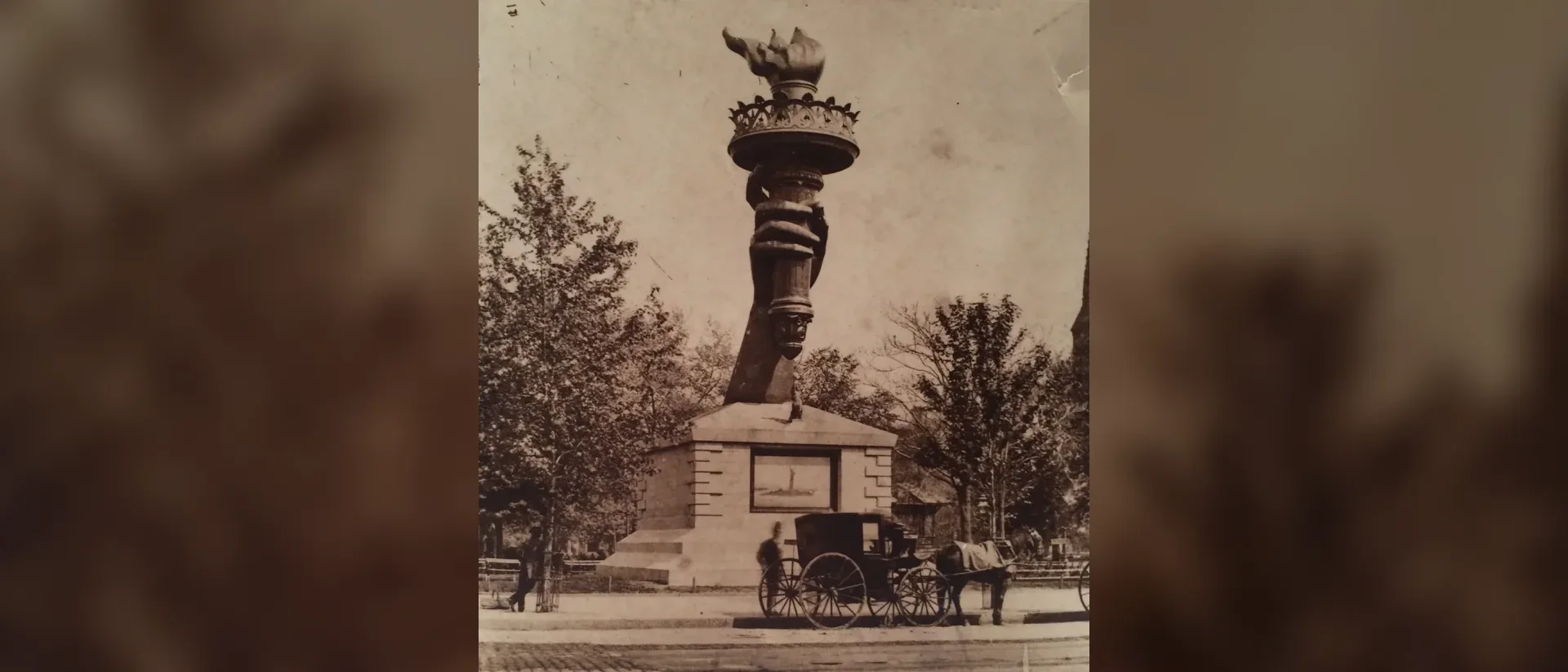
The Statue of Liberty once had no body. For six years, just her arm and torch stood in Madison Square Park. France paid for the statue - Americans had to fund the pedestal. Visitors paid 50 cents to climb inside the arm. Wealthy New Yorkers living right beside it refused to donate. Pulitzer shamed them publicly, and the full statue arrived in 214 crates.
Before the Statue Was Complete, Her Arm Stood Alone in Manhattan
Before it became the most recognized symbol of American freedom, the Statue of Liberty spent five years as just a giant arm poking above the trees of Manhattan. What happened in between is a story of national embarrassment, a well-timed newspaper campaign, and 120,000 Americans who each gave less than a dollar.
Only the Arm Was Ready
When sculptor Frederic Auguste Bartholdi began the project in the 1870s, France agreed to fund the statue itself while the United States would build and pay for the pedestal. But fundraising on the American side stalled almost immediately. To generate attention and donations, Bartholdi made a practical decision: he would ship the most completed portion of the statue across the Atlantic to go on display.
That portion was the right arm and torch. It appeared first at the 1876 Philadelphia Centennial Exposition, where adventurous visitors paid to climb a ladder inside the forearm and step out onto a balcony at the base of the torch.
Six Years on a Manhattan Street Corner
In early 1877, the arm arrived in New York City and was installed at the northern edge of Madison Square Park, then one of Manhattan's most fashionable addresses. For the next five years, anyone walking through the park would see Lady Liberty's enormous copper fist rising above the treetops - the index finger alone was 8 feet long, and the torch flame was visible for several city blocks. For 50 cents, visitors could climb a ladder inside the arm and stand on a viewing balcony. Souvenir photographs were sold at the base.
The New York Times was not impressed. In February 1877, the paper ran a satirical editorial noting that "a piece of a statue is better than no statue whatever," and sarcastically suggested distributing the other body parts around the city. Meanwhile, the wealthy residents of Madison Square - living right beside the arm - mostly kept their wallets shut.
Pulitzer's Campaign Changes Everything
In 1883, after fundraising had stalled for years, newspaper editor Joseph Pulitzer took over the New York World and made the pedestal his cause. He publicly criticized the wealthy for failing to act, and shamed the middle class for waiting on others. Then he launched a campaign with a simple promise: the World would print the name of every single donor, regardless of how little they gave.
The response was extraordinary. The campaign launched in March 1885. By August, more than 120,000 people had donated more than $100,000 - most contributing under a dollar. Working-class readers, schoolchildren, and immigrants sent in pennies and dimes. The pedestal was funded.
214 Crates From France
The complete Statue of Liberty arrived from France in 214 wooden crates in 1885 and was assembled on the newly finished pedestal on Liberty Island. President Grover Cleveland officially dedicated the statue on October 28, 1886 - ten years after the arm had first appeared at the Philadelphia exposition. The arm that New Yorkers had walked past for five years was finally attached to a body.
Frequently Asked Questions
Why was the Statue of Liberty arm displayed in Madison Square Park?
How much did it cost to climb inside the Statue of Liberty torch in the 1870s?
How did Joseph Pulitzer help fund the Statue of Liberty?
How many crates did the Statue of Liberty arrive in?
How big was the Statue of Liberty arm in Madison Square Park?
Verified Fact
Verified Jun 19, 2026 · 7 sources checked
Source: New York Public LibraryShow verification details
Claims checked
- Statue's arm and torch stood alone in Madison Square Park for six years
- Admission to climb the arm cost 50 cents
- Statue arrived in 214 crates (earlier said 350 crates)
- Pulitzer's fundraising campaign launched in March 1885
- Over $100,000 raised from 120,000+ donors
Sources: New York Public Library, Bowery Boys, Flatiron NoMad, VinePair, Gizmodo, SOFII, NPS
Related Topics
More from History & Culture
View all History & Culture →