
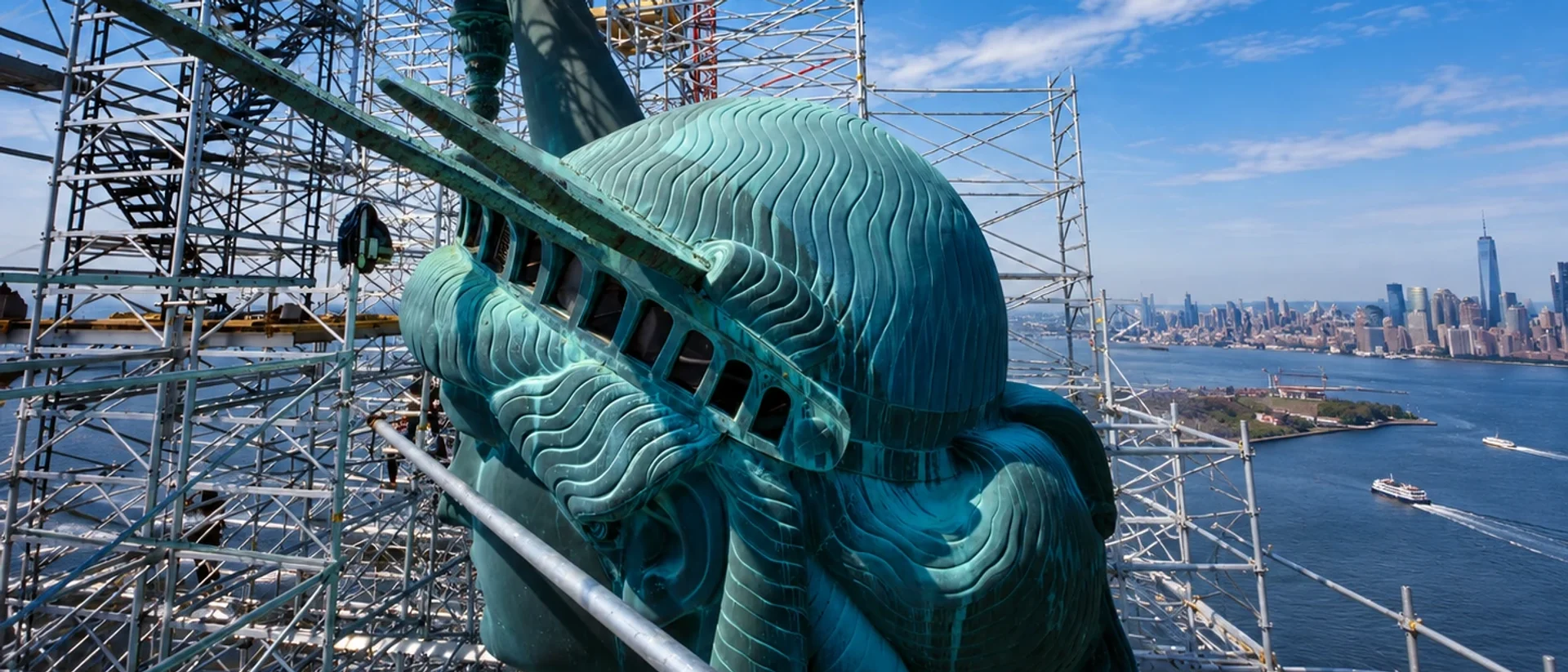
The Statue of Liberty's torch arm sits 18 inches from where it was designed to be. Before her 100th birthday, engineers found it swaying in strong winds, with a spike of her crown threatening to pierce it. Crews turned the spike away and swapped almost every iron bar holding her copper skin while she stood. They never moved the arm, or her head, which still sits 2 feet off-center.
The Statue of Liberty's Head Is 2 Feet Off-Center
The most famous arm in America has never been quite where it was meant to be. When engineers studied the Statue of Liberty ahead of her 1986 centennial, they found her raised torch arm 18 inches from its designed position and her head 2 feet off center. They fixed almost everything else, and left both exactly where they were.
Thirteen Trouble Spots
A French-American committee was formed in May 1981 to plan the statue's restoration. Four French consultants began the technical work, and in 1982 the committee began looking for American consultants to join them.
By July 1983 they had finished a joint diagnostic report. On July 20, 1983, The New York Times ran the "13 trouble spots" of the statue on its front page.
The shoulder was not a new worry. The War Department, which had charge of the statue at the time, had already reinforced the arm-shoulder structure in 1932.
The survey showed how far off things were. The upheld arm sat 18 inches from where it was designed to be, and the head had been installed about 2 feet off center.
Computer drawings showed the misalignment had caused the spikes of her crown to damage a section of the torch-bearing arm. American Heritage reported in 1984 that one spike had rubbed against the arm, "denting and threatening to pierce the skin."
Accounts differ on how dangerous the arm had become. A 1985 history of the statue described the arm swaying more in strong winds and a significant risk of structural failure. American Heritage wrote in 1984 that the shoulder was "not about to give way" but needed reinforcement before it weakened further.
A Mystery Nobody Has Settled
Nobody knows for certain who put the arm and head out of line.
One theory blames a mismatch between the design methods of Eugene Viollet-le-Duc, the statue's first engineer, and those of Gustave Eiffel, who designed her iron skeleton. A second blames the American crews who reassembled her in New York in 1886.
A third points at the sculptor himself, Frederic Auguste Bartholdi, who may have changed the design in Paris because he thought the arm and head sat too close together.
Rebuilding Her From the Inside
Work began on January 23, 1984. A 240-foot scaffold, designed specifically for the statue, rose around her and hid her from view. The torch came down on July 4, 1984.
The real trouble was inside. Her copper skin is held to Eiffel's frame by a web of iron armature bars, and the iron had been reacting with the copper for nearly a century.
Eiffel had insulated the two metals with asbestos cloth soaked in shellac. Over time it turned into a spongy material that held saltwater against the metal.
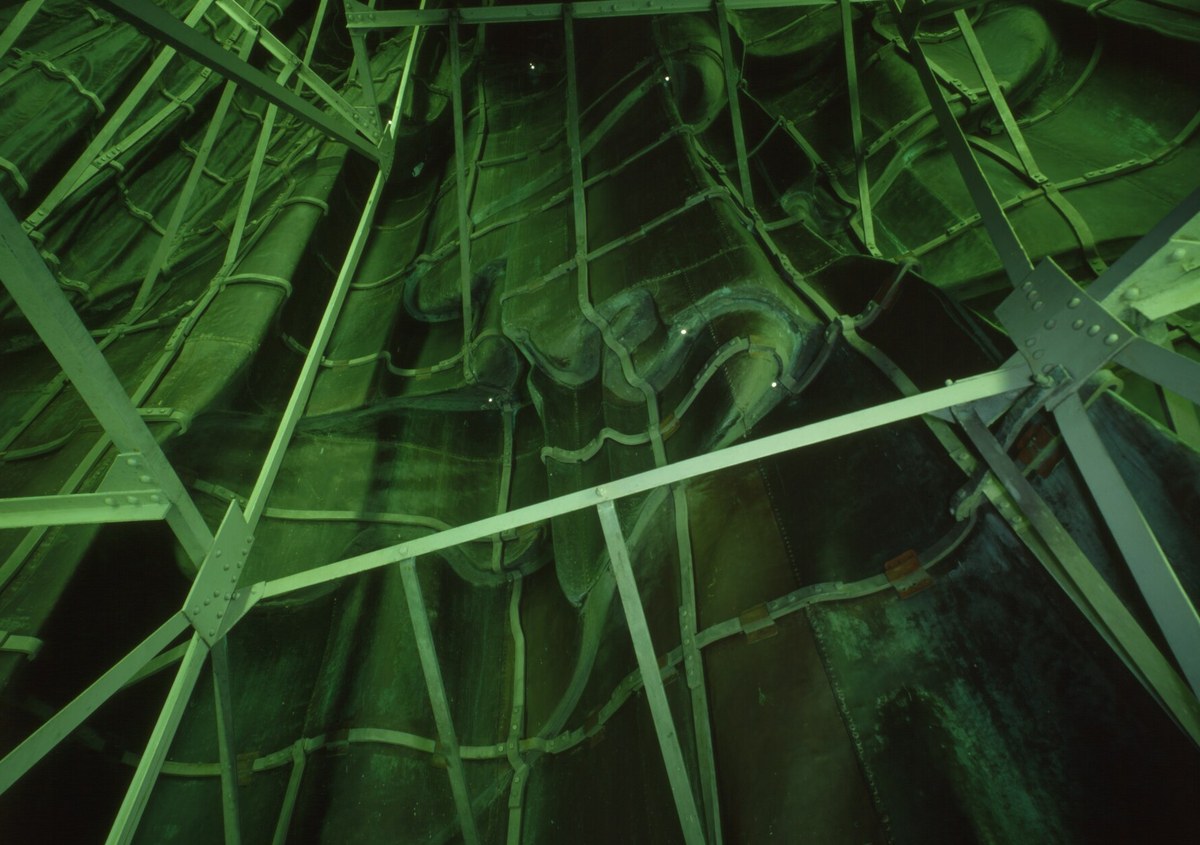
Workers replaced the bars with stainless steel, insulated from the copper with Teflon tape. Most accounts put the number at about 1,800 bars; others give 1,350 or 1,600.
The statue stayed standing the whole time. No more than four bars from each of four sections were out at once, and each new bar went in within 36 hours of the old one coming out.
Crews also realigned the offending crown spike by several degrees, repaired and reinforced the shoulder rather than rebuilding it, and put extra supports inside the head.
Still Off Center, By Choice
The engineers decided not to straighten her. As The New York Times reported in December 1985, the positions of the arm and head would remain as they had been since they were reassembled in 1886.
Not every original bar came out either. Workers left a handful of the original iron bars in her right foot, where they remain as examples of the statue's first structure.
The statue reopened to the public on July 5, 1986, during her 100th birthday celebrations. The original torch now stands in the Statue of Liberty Museum on Liberty Island.
Her arm is braced and her spike has been moved, but her head still sits 2 feet off center, just as it did the day she went up.
Enjoyed this fact?
2 people loved this
Get a new fact every morning.
A fascinating fact in your inbox every morning. Free. Unsubscribe anytime.
Frequently Asked Questions
Is the Statue of Liberty's head off center?
Why is the Statue of Liberty's arm out of position?
When was the Statue of Liberty restored?
What holds the Statue of Liberty's copper skin in place?
Can you go up into the Statue of Liberty's crown?
Verified Fact
Verified Oct 14, 2026 · 4 sources checked
Source: Wikipedia (Conservation-restoration of the Statue of Liberty)Show verification details
Claims checked
- The raised arm sits 18 inches from its designed position and the head about 2 feet off center
- The arm swayed in strong winds and a crown spike had dented it, threatening to pierce the copper
- The spike was turned several degrees away from the arm
- Nearly all of the iron bars holding the copper skin were replaced, a few at a time, while the statue stood
- The arm and head were left where they had been since 1886, and a few original bars remain in the right foot
Sources: American Heritage, National Park Service, PBS NOVA, Wikipedia
Related Topics
More from Places & Culture
View all Places & Culture →