A stray puppy was smuggled onto a troopship in a coal bin in 1917. He served 18 months in the WWI trenches, warned his regiment of mustard gas attacks, located wounded men in No Man's Land, and bit a German spy's leg until soldiers arrived. He is the most decorated war dog of WWI and the only dog promoted to sergeant through combat. His body is at the Smithsonian.
The Stray Dog Who Became WWI's Most Decorated Soldier
Most decorated war dogs get a medal and a plaque. Sergeant Stubby got a Smithsonian exhibit. The short-tailed Boston Terrier mix who started his military career hiding in a coal bin ended it as the most decorated war dog of World War I - and the only dog ever promoted to sergeant through combat.
Smuggled Across the Atlantic
In July 1917, Private J. Robert Conroy discovered a stray puppy wandering the Yale University campus in New Haven, Connecticut, where the 102nd Infantry Regiment was drilling before deployment. He named the dog Stubby, after his short tail, and trained him to recognize bugle calls and salute on command.
When the regiment shipped out for France aboard the SS Minnesota, Conroy hid Stubby in the ship's coal bin. The secret did not last long. When the commanding officer discovered the stowaway, Stubby reportedly saluted - and the officer let him stay. The dog sailed to war.
18 Months in the Trenches
Stubby served with the 102nd Infantry, 26th "Yankee" Division, for 18 months on the Western Front. He participated in 17 battles and four major offensives - Meuse-Argonne, Aisne-Marne, Saint-Mihiel, and Champagne-Marne.
Early in his deployment, Stubby survived a German mustard gas attack. The encounter left him acutely sensitive to gas. From then on, he could detect its presence before humans could, running through the trenches and barking to alert soldiers to mask up. Those extra seconds mattered. Soldiers fitted Stubby with his own gas mask, and he continued his watch.
He also developed an ear for incoming artillery. The high-pitched whine of shells was audible to him before humans detected it. He located wounded soldiers in No Man's Land - the deadly strip between opposing trenches - and either stayed with them until medics arrived or barked to alert the unit.
The Spy in the Argonne
Stubby's most famous act came in the Argonne Forest. One morning, he discovered a German soldier mapping Allied trench positions. He gave chase, bit the man's legs, and held on until American soldiers arrived. It was this act that led to his battlefield promotion to sergeant - the only dog to receive that rank through combat in U.S. history. The rank was honorary and acknowledged within his regiment, and is recognized in connection with the Smithsonian's exhibit on the war.
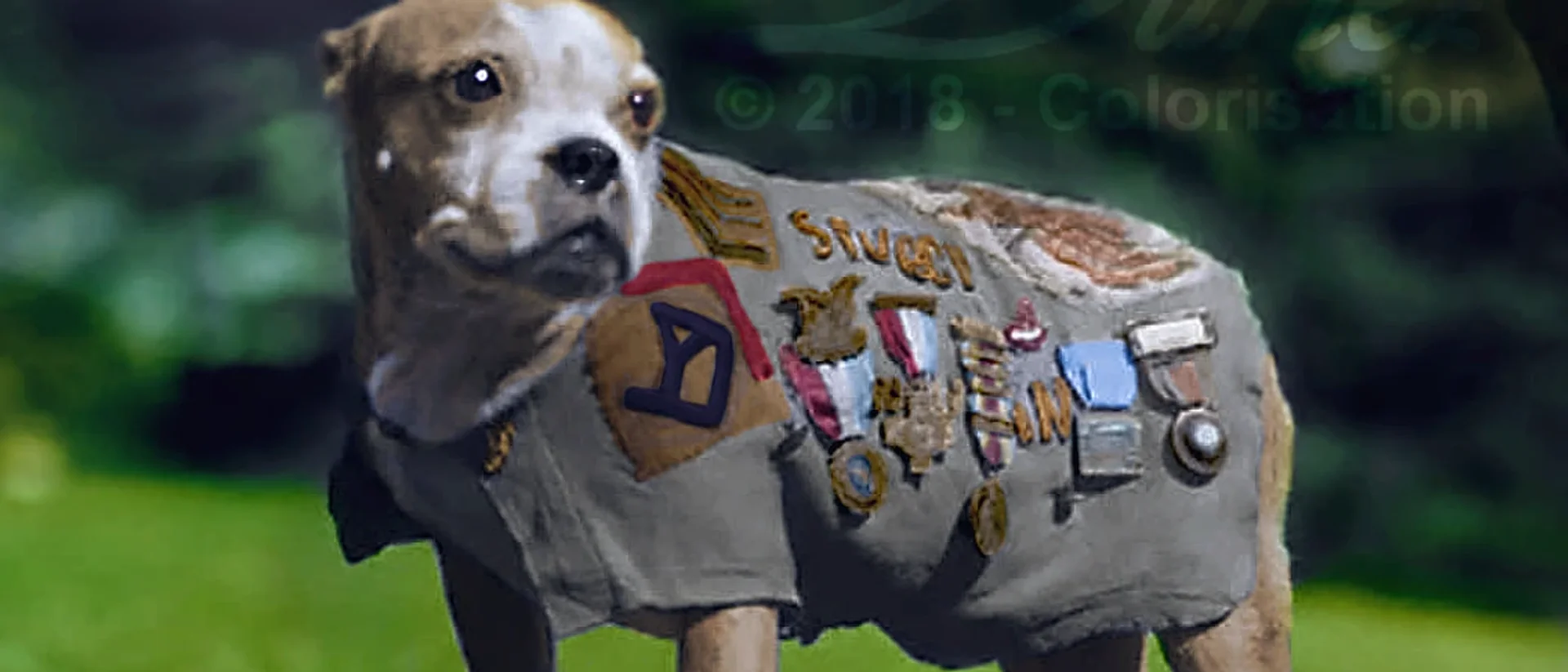
The women of Chateau-Thierry, a French town the regiment helped liberate, sewed Stubby a chamois coat decorated with Allied flags and his name stitched in gold thread. He wore it with his medals.
Three Presidents and a Football
Stubby returned to the United States in 1919. He met Presidents Woodrow Wilson, Warren G. Harding, and Calvin Coolidge. He led parades and appeared at veterans' events across the country. When Conroy enrolled at Georgetown University Law School, Stubby came along and became the Georgetown Hoyas' first sports mascot - trotting onto the football field at halftime to nudge a ball for the crowd.
He died in his sleep in March 1926. Conroy had him preserved through taxidermy and in 1956 donated him to the Smithsonian Institution. Stubby - still wearing the chamois coat - is on display at the National Museum of American History in the "Price of Freedom: Americans at War" exhibit.
He was a stray who wandered onto a drill ground. He ended up in 17 battles. He never stopped doing his job.
Frequently Asked Questions
How many battles did Sergeant Stubby fight in?
How did Sergeant Stubby warn soldiers about gas attacks?
How did Sergeant Stubby catch a German spy?
Where is Sergeant Stubby today?
Was Sergeant Stubby officially promoted to sergeant?
Verified Fact
Verified Aug 26, 2026 · 5 sources checked
Source: Wikipedia / Smithsonian NMAHShow verification details
Claims checked
- Served 18 months in WWI trenches, in 17 battles
- Warned regiment of mustard gas attacks
- Bit a German spy's leg until soldiers arrived (not the seat of his pants)
- Smuggled aboard troopship SS Minnesota in a coal bin
- Only dog promoted to sergeant through combat (honorary, not formal)
Sources: Wikipedia, Smithsonian NMAH, Britannica, Connecticut History, National WWI Museum
Related Topics
More from History & Culture
View all History & Culture →