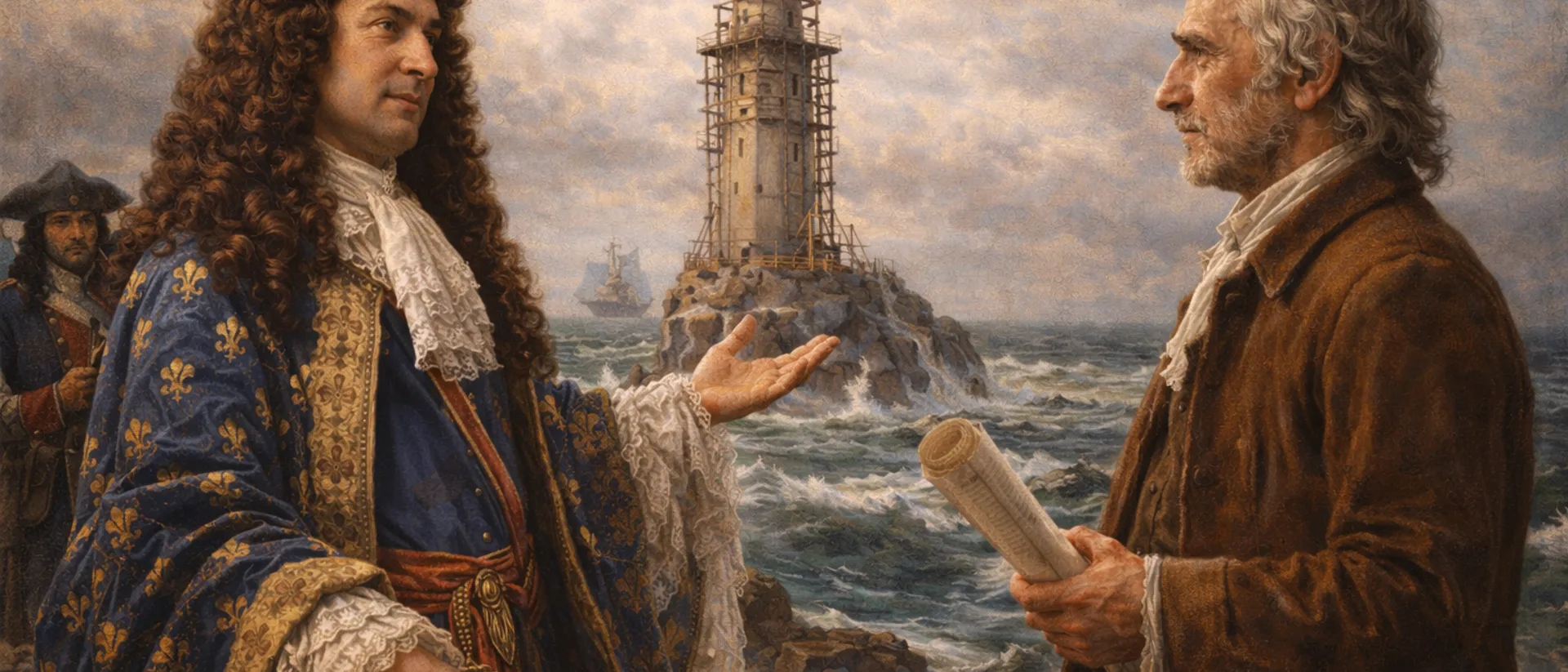
During a war between France and England in 1697, Louis XIV ordered the release of a captured English engineer who had been building a lighthouse. His reasoning: "France is at war with England, not with humanity."
Louis XIV Freed an Enemy Engineer Building a Lighthouse During Wartime
In the summer of 1697, a French privateer sailed toward a half-finished structure rising from a deadly reef in the English Channel. The men working on it had no warship to protect them that day. Within hours, the builders were captured, their work was shelled, and the man behind the project - an English painter, inventor, and eccentric showman named Henry Winstanley - found himself a prisoner of France. What happened next became one of the most celebrated acts of wartime chivalry in European history.
The Deadly Eddystone Rocks
The Eddystone Rocks sit roughly 14 kilometers south of Plymouth, England, a jagged cluster of reef that lurks just beneath the surface at high tide. For centuries, they were one of the most feared hazards in British waters. Ships entering the English Channel often hugged the French coastline just to avoid them - which, ironically, led to additional shipwrecks along the northern coast of France.
The numbers were staggering. By some estimates, around 50 vessels were lost on the Eddystone every year before any lighthouse existed there. No one believed a lighthouse could ever be built in such a treacherous location.
Henry Winstanley: The Unlikely Engineer
Henry Winstanley was born in Saffron Walden, Essex, in 1644. He was not a trained engineer. By profession, he was a painter and engraver who had spent years documenting the architecture of Audley End House, one of England's grandest estates. He also ran a popular attraction known as the "Essex House of Wonders" at his home in Littlebury - a building stuffed with clockwork figures, trick furniture, and mechanical curiosities. A comfortable-looking chair would clamp its arms around anyone who sat in it. A tea trolley would hover down from the ceiling. The house was so popular that Winstanley installed a turnstile at the gate to manage the crowds.
He was also a merchant and investor. Two of the five ships he owned were wrecked on the Eddystone reef. Furious, Winstanley demanded to know why nothing had been done about the hazard. When told the rocks were too dangerous to mark, he declared he would build a lighthouse there himself.
The Admiralty and Trinity House, England's lighthouse authority, agreed to support him. Construction began on 14 July 1696. The plan was ambitious: an octagonal tower of Cornish granite and wood, anchored to the rock by 12 massive iron stanchions, topped with a glass lantern room where 60 tallow candles would burn as a beacon.
Building on the Impossible
The construction was an extraordinary undertaking. Workers had to row out to the reef each day, a journey that could take up to six hours in rough seas. They could not leave materials on site overnight - everything would be washed away. During the first year, the team managed only to drill 12 holes into the rock and cement iron rods into place as anchors for the structure above.
The work was painfully slow, and it was dangerous even without the added complication of war. Britain and France were locked in the Nine Years' War (1688–1697), and French privateers prowled the English Channel.
Captured by a French Privateer
On 27 June 1697, the escort ship protecting the work crew was ordered to join the main fleet, and no replacement was arranged. That same morning, a French privateer appeared at the reef. Winstanley and his men were captured. The privateer then fired several cannon shots at the lighthouse's foundations before sailing for Saint-Malo, France.
"France Is at War with England, Not with Humanity"
News of the capture reached King Louis XIV. The French monarch's response has echoed through the centuries. He ordered Winstanley's immediate release, reportedly declaring: "France is at war with England, not with humanity."
It was a remarkable statement. Louis XIV understood that a lighthouse on the Eddystone would save not just English sailors but French ones too - and the sailors of every nation whose ships passed through the Channel. According to some accounts, Louis even offered Winstanley jewels and a position at the French court as an architect. Winstanley declined. He wanted to finish his lighthouse.
The First Offshore Lighthouse
Construction resumed, and on 14 November 1698, Winstanley lit the candles in his lighthouse for the first time. It was the world's first open-ocean lighthouse. The effect was immediate and dramatic. During the five years the lighthouse stood, not a single ship was wrecked on the Eddystone. For a reef that had been claiming 50 vessels a year, it was nothing short of transformative.
Winstanley expressed supreme confidence in his creation, reportedly saying he wished to be inside it during "the greatest storm there ever was."
The Great Storm of 1703
On the night of 26–27 November 1703, Winstanley got his wish - and it cost him his life. The Great Storm of 1703 struck southern England with a ferocity that has never been matched in recorded British history. Winds comparable to a Category 2 hurricane tore across the country. In London, 2,000 chimney stacks collapsed. An estimated 8,000 to 15,000 people perished.
Winstanley had gone out to the lighthouse to make repairs. When morning came on 27 November, there was no trace of the lighthouse, Winstanley, or the five other men who had been inside. The structure had been obliterated.
A Legacy That Endures
Three more lighthouses would be built on the Eddystone after Winstanley's. The current structure, the Douglass Lighthouse, was lit in 1882 and automated in 1982. John Smeaton's famous 1759 granite tower was so well built that its upper portion was relocated to Plymouth Hoe, where it still stands as a monument today.
But it is Winstanley's story, and Louis XIV's extraordinary gesture, that captures the imagination most. In the middle of a bitter war, a king recognized that some achievements belong to everyone. A lighthouse does not distinguish between friendly ships and enemy ships. Its light shines for all.
Frequently Asked Questions
Who was the engineer that Louis XIV released during the war?
What happened to the Eddystone Lighthouse after Winstanley was released?
How did Henry Winstanley die?
Why were the Eddystone Rocks so dangerous to ships?
Verified Fact
Verified Sep 11, 2026 · 3 sources checked
Source: Trinity HouseShow verification details
Claims checked
- A French privateer captured Henry Winstanley while he was building the Eddystone Lighthouse in June 1697
- Louis XIV ordered his immediate release, saying France is at war with England, not with humanity
- The Eddystone Rocks wrecked around 50 ships a year before the lighthouse existed
- Not a single ship was wrecked on the Eddystone during the five years the lighthouse stood
- Winstanley and five other men died when the Great Storm of 1703 destroyed the lighthouse
Sources: Trinity House, Wikipedia, Guinness World Records