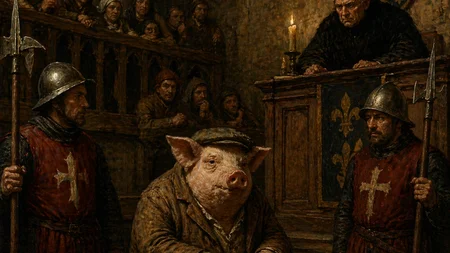
In 1386, a pig in Falaise, France was publicly executed by hanging for killing a child. The pig was even dressed in human clothes for the execution.
The Pig That Was Hanged for Murder in Medieval France
In the Norman town of Falaise in 1386, locals gathered in the public square for an execution. The condemned? A pig. The charge? Murder of a child.
This wasn't some fever dream or satirical play—it was medieval justice in action. The pig had killed an infant, and the townspeople demanded accountability. So they put the animal on trial, complete with a formal legal proceeding.
Dressed for Death
The execution wasn't a simple slaughter. Officials dressed the pig in a waistcoat, gloves, and breeches—human clothing meant to underscore the gravity of the crime. The animal was then paraded through the streets before being hanged in the town square.
To modern eyes, this seems absurd bordering on insane. But in medieval Europe, it made perfect sense.
Animal Trials Were Everywhere
The Falaise pig wasn't an anomaly. Between the 13th and 18th centuries, hundreds of animals faced formal legal proceedings across Europe:
- Pigs (the most common defendants, as they roamed freely and occasionally attacked children)
- Rats and mice (often tried in absentia for destroying crops)
- Weevils, locusts, and other insects
- Horses, cows, and donkeys
- Even a rooster, accused of laying an egg (a sign of witchcraft)
These weren't kangaroo courts. Animals received defense lawyers. Witnesses testified. Verdicts followed deliberation.
Why Put Animals on Trial?
The medieval mind operated differently than ours. The prevailing belief held that God created a moral order encompassing all living creatures. When an animal committed a crime, that order was violated—and justice demanded restoration.
There was also a practical element. Public executions served as warnings. By trying and executing the pig with full legal ceremony, authorities demonstrated that no transgression would go unpunished. Order would be maintained.
Some historians suggest another motive: liability. If an animal was formally tried and convicted, its owner couldn't be held responsible. The beast itself bore the guilt.
The Church Got Involved
Ecclesiastical courts handled cases against pests like rats and insects. These trials often featured excommunication as punishment—the church literally banishing vermin from the community. Defense lawyers argued for their tiny clients, sometimes successfully. One famous case saw a lawyer win leniency for rats by arguing they couldn't safely travel to court because of cats.
The Falaise pig's execution was documented in the town's records, and a fresco commemorating the event reportedly decorated a local church for centuries.
The End of Animal Justice
By the 18th century, Enlightenment thinking rendered animal trials obsolete. The idea that a pig could understand morality—let alone be held accountable for violating it—became intellectually indefensible.
But for roughly 500 years, Europeans genuinely believed that animals could sin, stand trial, and face execution. The pig of Falaise, dressed in its human finery and swinging from a rope, represents one of history's strangest collisions between law, religion, and the desperate human need to make sense of senseless tragedy.
Frequently Asked Questions
Were animals really put on trial in medieval times?
Why did medieval people execute animals?
What was the most common animal put on trial?
Did animals have lawyers in medieval trials?
When did animal trials stop?
Verified Fact
This fact has been reviewed and verified against original sources.
Show verification details
Core claim is accurate. This is a well-documented case from medieval animal trials.
Related Topics
More from History & Culture
View all History & Culture →