
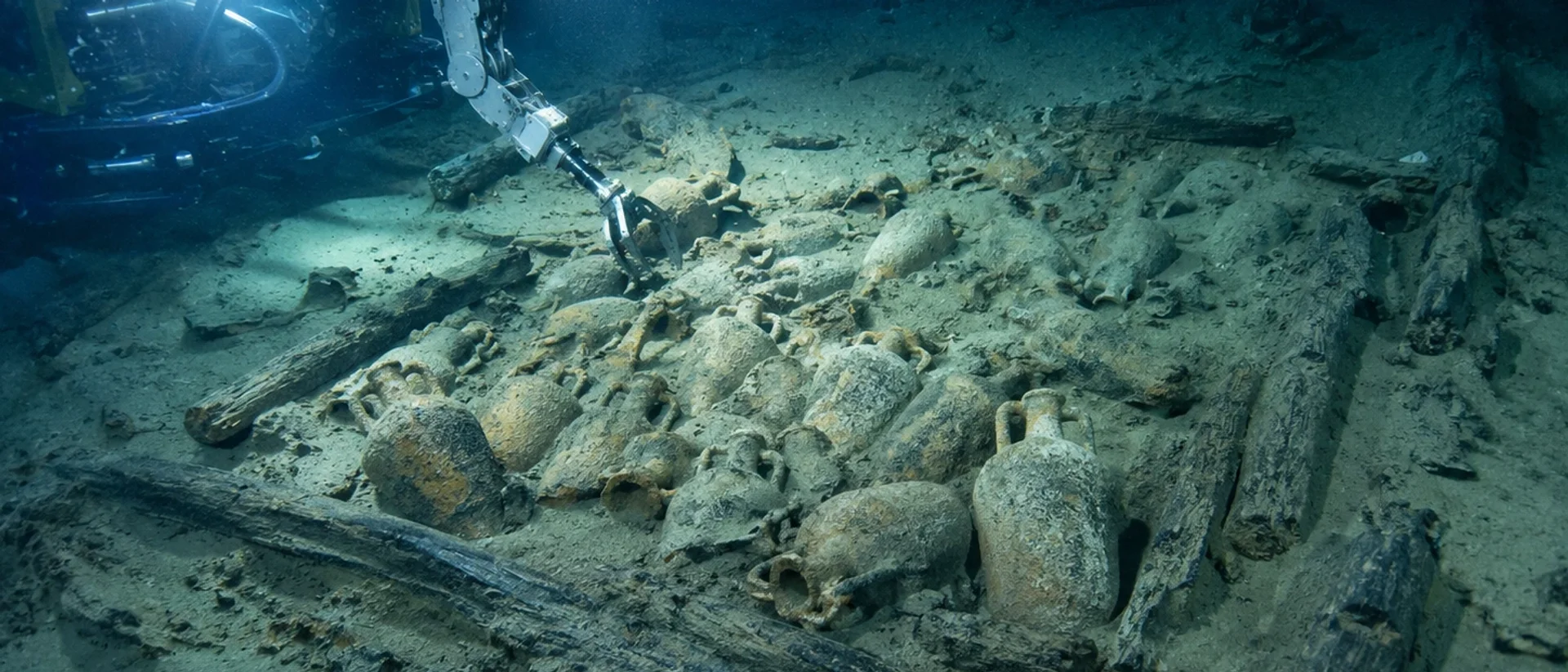
A natural gas company's robot found hundreds of ancient jars on the Mediterranean floor: a 3,300-year-old Canaanite cargo ship, the oldest ever found in deep water. At 1.8 km depth, cold oxygen-free water kept it perfectly intact. Bronze Age sailors were crossing the open sea by the stars, not hugging the coast.
3,300-Year-Old Canaanite Wreck Found by a Gas Robot
When Energean, a London-listed natural gas company, sent a remote-operated robot to survey the deep Mediterranean seabed near Israel's proposed Katlan gas field, the last thing anyone expected was ancient history.
The Accidental Find
In 2023, the robot's sonar picked up something unusual on the ocean floor roughly 90 kilometres off Israel's northern coast - a dense cluster of pottery shapes. The team alerted the Israel Antiquities Authority (IAA), which launched a follow-up mission. What they found was the oldest deep-sea shipwreck ever discovered: a Canaanite merchant vessel that had sat undisturbed on the seabed for approximately 3,300 years. The IAA announced the discovery publicly in June 2024.
What the Robot Saw
The wreck site spans roughly 14 metres by 6 metres, carpeted with hundreds of complete Canaanite storage jars called amphorae. Two were retrieved to the surface and dated to around 1300 BCE. The wooden hull is believed to lie beneath the jar layer, shielded by the cargo that settled over it. The depth - 1.8 kilometres below the surface - is the key to the extraordinary preservation: the water is near-freezing, almost entirely without oxygen, and too cold and dark for the wood-boring worms that destroy most ancient shipwrecks in shallower water.
The Part That Rewrote the Textbook
The wreck's location - 90 km from any coastline, far beyond the visible horizon - upended a longstanding assumption in archaeology. Scholars had believed Bronze Age Mediterranean sailors stayed within sight of land, using coastal landmarks to navigate. Jacob Sharvit, director of marine archaeology at the IAA, said sailors at that depth of sea could see only the horizon: "To navigate they probably used the celestial bodies, by taking sightings and angles of the sun and star positions." The find is the first physical proof that Canaanite merchants were crossing the open Mediterranean by the stars more than 3,000 years ago.
Left Where It Lay
The IAA recovered only two jars for study. The rest of the cargo - and the ship beneath it - remain on the seabed, undisturbed. Energean's vessel provided the support for the retrieval operation; the company had no commercial interest in the site. The wreck now sits at the bottom of the Mediterranean as it has since the Bronze Age, the oldest confirmed deep-water shipwreck in the world.
Frequently Asked Questions
What is the Canaanite shipwreck discovered off Israel in 2024?
How did Energean find the ancient shipwreck?
Why is the Canaanite shipwreck so well preserved?
What does the shipwreck reveal about Bronze Age navigation?
What happened to the Canaanite shipwreck cargo?
Verified Fact
Verified against: Scientific American
Source: Scientific AmericanShow verification details
Verified against: Scientific American (June 2024), CBS News, Wikipedia/Canaanite_shipwreck, Wikipedia citing IAA/Energean sources. Core claims confirmed: Energean robot discovered cargo in 2023 during gas field survey; IAA announced June 2024; 1.8km depth; ~3,300 years old / 1300 BCE; hundreds of amphorae intact; two retrieved; hull presumed buried beneath cargo not yet confirmed visible; Jacob Sharvit (also spelled Yaakov Sharvit) heads IAA marine archaeology unit; 90km off northern Israel coast; celestial navigation quote confirmed (CBS News). NOTE: The hull has NOT been visually confirmed - cargo (jars) is visible, hull is presumed buried beneath. User brief said "largely intact" - article is precise on this distinction. Category Q (quirky/discovery - no H/M hero or money-find). Score 14/22 CONDITIONAL on image-curator landing the IAA/Energean ROV amphorae-on-seabed photograph. If curator returns DEFERRED or only stock/generic-amphora photos, this is Support-tier, NOT prime-slot candidate.