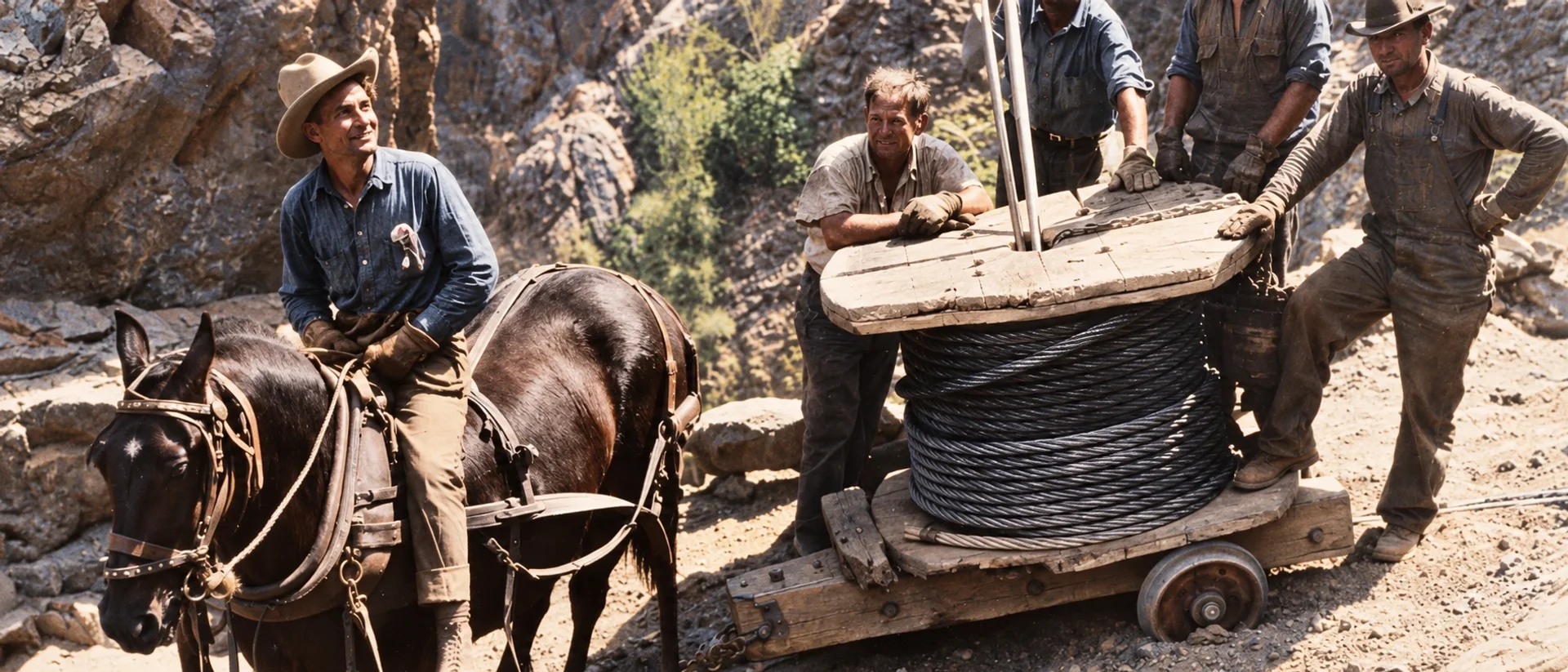
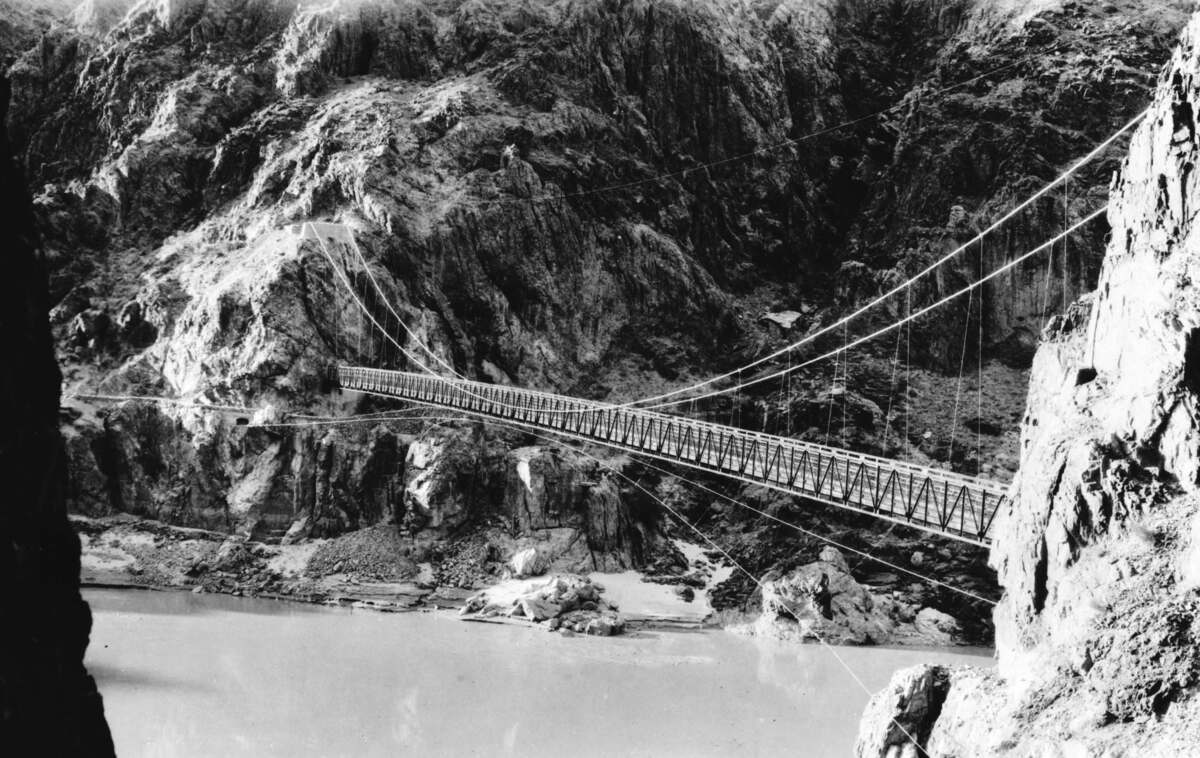
42 men, most of them Havasupai, carried a steel cable that weighed over a ton down the Grand Canyon on their shoulders in 1928. No road reached the Colorado River, so each 550-foot cable for the Black Bridge went down the South Kaibab Trail in a single-file line, a drop of about 4,750 feet, with about 50 pounds on every man.
42 Men Carried a One-Ton Cable Down the Grand Canyon
The Colorado River runs through the bottom of the Grand Canyon, and in 1928 the only way down to it was a trail. When the National Park Service needed a new bridge there, every piece had to travel that trail, and the biggest pieces were the steel cables, each about 550 feet long and heavier than a ton. The solution was 42 men and their shoulders.
A Bridge With No Road
The first bridge across the river inside the canyon opened in 1920 near the foot of the Bright Angel Trail. By 1927 the Park Service had built a new trail across the canyon, the Kaibab Trail, and the park decided the original crossing was too light and too springy for the growing traffic.
The new Kaibab Trail Suspension Bridge, known today as the Black Bridge, went up at the same spot on the river. But the rim of the canyon sits about four miles away in a straight line and 4,750 feet above the water, and the trail between them has many sharp turns and switchbacks.
Everything Came Down by Hand or Hoof
The materials were shipped by railroad to Grand Canyon, then trucked about three and a half miles to the head of the trail at Yaki Point. From there, the Park Service pack train carried almost everything else down to the river. Only 26 tons of structural steel went down with a different outfit, the Fred Harvey pack train.
Pack animals work well for pieces under about ten feet long and 200 pounds. A steel cable more than 500 feet long is neither.
Single File Down the Trail
Construction engineer John H. Lawrence described what happened in his February 1929 report: each main cable, about 550 feet long and weighing over a ton, was "carried down on the shoulders of 42 men - mostly local Indians." Arizona Highways identifies the carriers as mostly Havasupai.
The engineer figured each man's share at about 50 pounds. The men walked in a single line down the trail, a formation the Park Service has described as moving "centipede style."
It was a one-time method. Lawrence noted the wind cable, a single piece about 900 feet long, was cut to length at Yaki Point and sledded to the bridge on a "go-devil." That saved money but took about two and a half times as long, and there was no time to spare for the main cables.
The Camp at the Bottom
The camp at the junction of Bright Angel Creek and the Colorado River began with a bridge foreman, nine skilled laborers and a cook. The crew later grew to 20 men. Active construction began March 9, 1928, and the bridge and approaches were complete on August 3, 1928.
The new bridge was built about 16 feet above the old one, which stayed in use until the new bridge opened.
A Landmark, For Now Closed
The bridge has a 440-foot stiffening truss and is hung from 550-foot steel suspension cables. The American Society of Civil Engineers named it a National Historic Civil Engineering Landmark in 2019, describing it as still in service and unmodified from its original 1928 construction.
After the August 29, 2026 flash flood in Bright Angel Canyon, the Park Service closed the Black Bridge, along with the Silver Bridge, Phantom Ranch and the North Kaibab Trail. As of October 13, 2026, the park listed no estimated reopening date.
Enjoyed this fact?
Be the first to love this
Get a new fact every morning.
A fascinating fact in your inbox every morning. Free. Unsubscribe anytime.
Frequently Asked Questions
Who carried the cables for the Kaibab Suspension Bridge?
How heavy were the Black Bridge cables?
Why were the cables carried by hand?
Is the Black Bridge in the Grand Canyon still in use?
Verified Fact
Verified Oct 15, 2026 · 6 sources checked
Source: Historic American Engineering Record, National Park ServiceShow verification details
Claims checked
- 42 men carried each 550-foot, ton-plus main cable down the trail on their shoulders in 1928
- The carriers were mostly Havasupai (the 1929 engineer's report says "mostly local Indians")
- Each man's share was about 50 pounds
- Trail drop corrected to about 4,750 feet from rim to river (was 4,700 feet in seven miles)
Sources: Historic American Engineering Record, National Park Service, American Society of Civil Engineers, Arizona Highways, Wikipedia
Related Topics
More from History & Culture
View all History & Culture →