
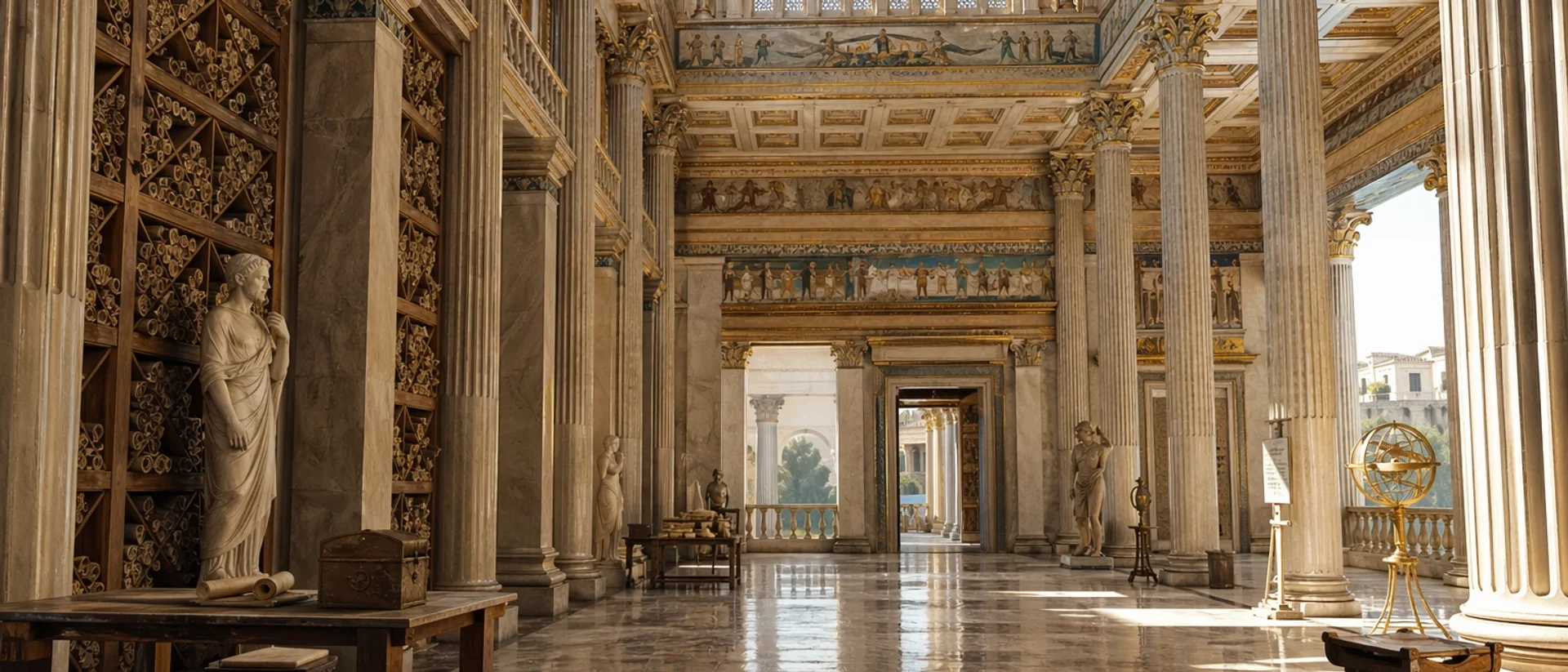
The Library of Alexandria held up to 700,000 scrolls. To fill it, guards searched every ship in the harbor, seized any books on board, and kept the originals. It wasn't destroyed in one fire - it died over 500 years. Less than 1% of ancient Greek writing survives. Sophocles wrote 120 plays. Only 7 made it.
The Library That Took Every Book on Earth
At its peak, the Library of Alexandria was the single greatest storehouse of human knowledge ever assembled. Founded in the 3rd century BC under Ptolemy I, it grew into a complex that held an estimated 400,000 to 700,000 scrolls - the equivalent of roughly 100,000 modern books. Nothing else in the ancient world came close.
A Kingdom Built on Stolen Knowledge
The Ptolemaic rulers of Egypt didn't just collect books politely. Under a decree from Ptolemy III, every ship that docked in Alexandria's harbor was searched by guards. Any manuscripts found on board were confiscated and taken to the library. Official scribes made copies, and the copies - not the originals - were returned to the ship owners. The originals stayed in Alexandria forever.
The library also acquired Aristotle's entire personal collection, reportedly at enormous expense. Scholars from across the Mediterranean were invited to live and work there, and the result was a brain trust unlike anything the world had seen.
What Was Achieved Inside Those Walls
The Library wasn't just a warehouse. It was a working research institution. Eratosthenes, the library's third head librarian, calculated the circumference of the Earth using nothing but shadows and geometry - and got it right to within a few hundred kilometers. Euclid wrote his Elements there. Herophilus performed the first systematic dissections of the human body and identified the brain as the seat of intelligence, not the heart.
Death by a Thousand Cuts
The library wasn't destroyed in a single dramatic fire, despite the popular myth. It died slowly over centuries. Julius Caesar accidentally burned part of it in 48 BC during the Siege of Alexandria - ancient sources suggest around 40,000 scrolls were lost in that fire alone. Roman Emperor Aurelian's forces destroyed the Broucheion quarter, where the main library stood, in 272 AD. The Serapeum, a daughter library that held tens of thousands of additional scrolls, was demolished in 391 AD.
By the time the last recorded director, mathematician Theon, died around 405 AD, there was no great library left to direct.
What the World Lost
The scale of what disappeared is staggering. Scholars estimate that less than 1% of all ancient Greek literature survives today. The poet Sappho wrote roughly 10,000 lines of poetry across nine books - only about 650 lines remain. Sophocles wrote at least 120 plays. We have 7. Aeschylus wrote between 70 and 90 plays. We have 6.
Not all of this can be blamed on Alexandria alone. Books were lost across the ancient world through neglect, conflict, and decay. But the library represented the single best chance humanity had at preserving that knowledge in one place - and it slipped away, scroll by scroll, over 500 years.
Frequently Asked Questions
How many scrolls did the Library of Alexandria hold?
What percentage of ancient Greek literature has survived?
How was the Library of Alexandria destroyed?
Did the Library of Alexandria really seize books from ships?
Verified Fact
Verified Aug 26, 2026 · 5 sources checked
Source: WikipediaShow verification details
Claims checked
- Library held 400,000-700,000 scrolls at peak
- Ships in harbor were searched and books seized
- Library declined over centuries, not one fire
- Less than 1% of ancient Greek writing survives
- Sophocles wrote 120+ plays, only 7 survive
Sources: Wikipedia, World History Encyclopedia, History.com, Open Culture, historyfacts.com