
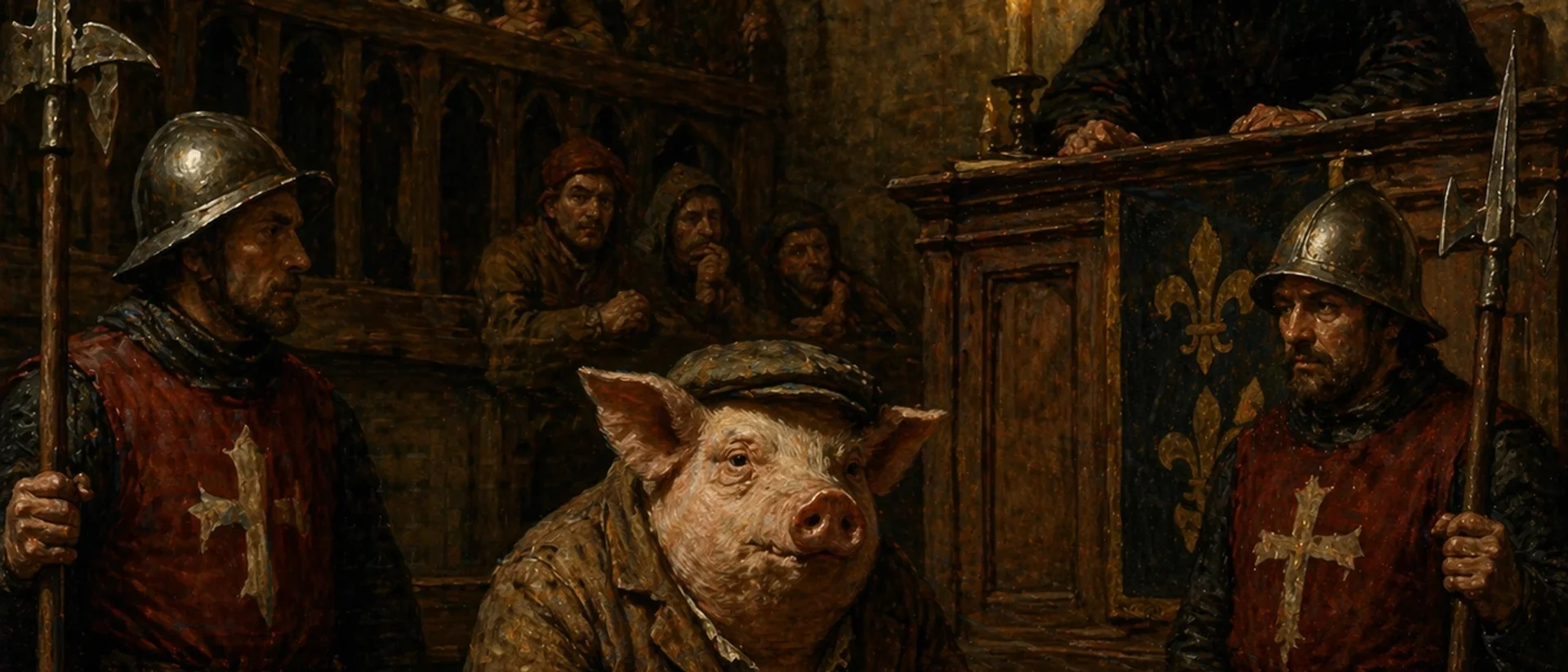
Medieval courts put animals on trial for real. A sow in Falaise, France was dressed in a jacket and breeches in 1386 and hanged in the market square for attacking a child. Rats, weevils, and beetles got court-appointed lawyers. One French jurist, Bartholomew Chassenée, built his whole career defending rodents.
When Medieval Courts Put Pigs on Trial and Dressed Them in Human Clothes
A crowd gathered in a French market square in 1386 to watch an execution. The condemned prisoner wore a new waistcoat, breeches, and a pair of gloves. The executioner also wore new gloves, symbolising clean hands before the law. Then they hanged the prisoner from the gallows. The prisoner was a pig.
The Sow of Falaise
In the Norman town of Falaise, a sow had savaged a small child who later died. The local court ran a full trial. Witnesses were heard, a verdict was reached, and the animal was sentenced to be "mangled and maimed in the head and forelegs" before being hanged, mirroring the injuries it had caused. The scene was painted in fresco on the west wall of the Church of the Holy Trinity in Falaise, where it remained for centuries before being whitewashed over.
Why Pigs Kept Ending Up in Court
Medieval pigs roamed freely through villages and frequently came into contact with unattended children. Between the 13th and 16th centuries, historians have documented at least 15 cases where pigs were executed for attacking or killing infants. Other defendants included cows, horses, dogs, and even a rooster accused of laying an egg, which was considered unnatural. Secular courts handled these "murderer" cases. Ecclesiastical courts handled the pests.
Rats With Legal Counsel
In 1522, the town of Autun sued its rats for devouring the barley harvest. The bishop assigned them a defence lawyer, a rising jurist named Bartholomew Chassenée. When the rats failed to appear in court, Chassenée argued the summons had not reached them all, since they were scattered across the diocese. When they still failed to appear, he pointed out that his clients could not safely travel to court on account of the cats prowling every road. The case made his reputation and launched a distinguished legal career.
Weevils, Beetles, and Excommunication
The vineyards of St. Julien went to court against a plague of weevils in 1545. The ecclesiastical judge refused to punish creatures that had not sinned, and instructed the villagers to repent and pay their tithes instead. The weevils reportedly left. When they returned in 1587, the townspeople proposed setting aside a patch of land as a sanctuary for the insects, on condition they stay out of the vineyards. In 1478, the Bishop of Lausanne threatened seed beetles with excommunication, noting they had not been passengers on Noah's Ark and therefore had no right to be there.
When the Trials Finally Ended
Animal trials declined through the 1700s but never fully disappeared. According to the 1906 study by Edward Payson Evans, the last case he could trace was a dog tried in Delémont, Switzerland, the same year his book went to press. Evans catalogued 196 cases from 14 countries. For roughly 600 years, pigs stood trial in jackets, and rats had better legal representation than most peasants.
Frequently Asked Questions
Did medieval courts really put animals on trial?
Why were pigs dressed in human clothes before execution?
Who was Bartholomew Chassenée?
Could insects really be excommunicated?
When did animal trials finally end?
Where did most animal trials happen?
Verified Fact
Verified 1478 Lausanne seed beetles instead
Source: Wikipedia / E.P. Evans 1906Show verification details
Confirmed across Wikipedia (Animal trial), Project Gutenberg text of E.P. Evans 1906 book, Atlas Obscura, JSTOR Daily, Cabinet Magazine, Leiden Medievalists Blog, Ancient Origins, Public Domain Review.