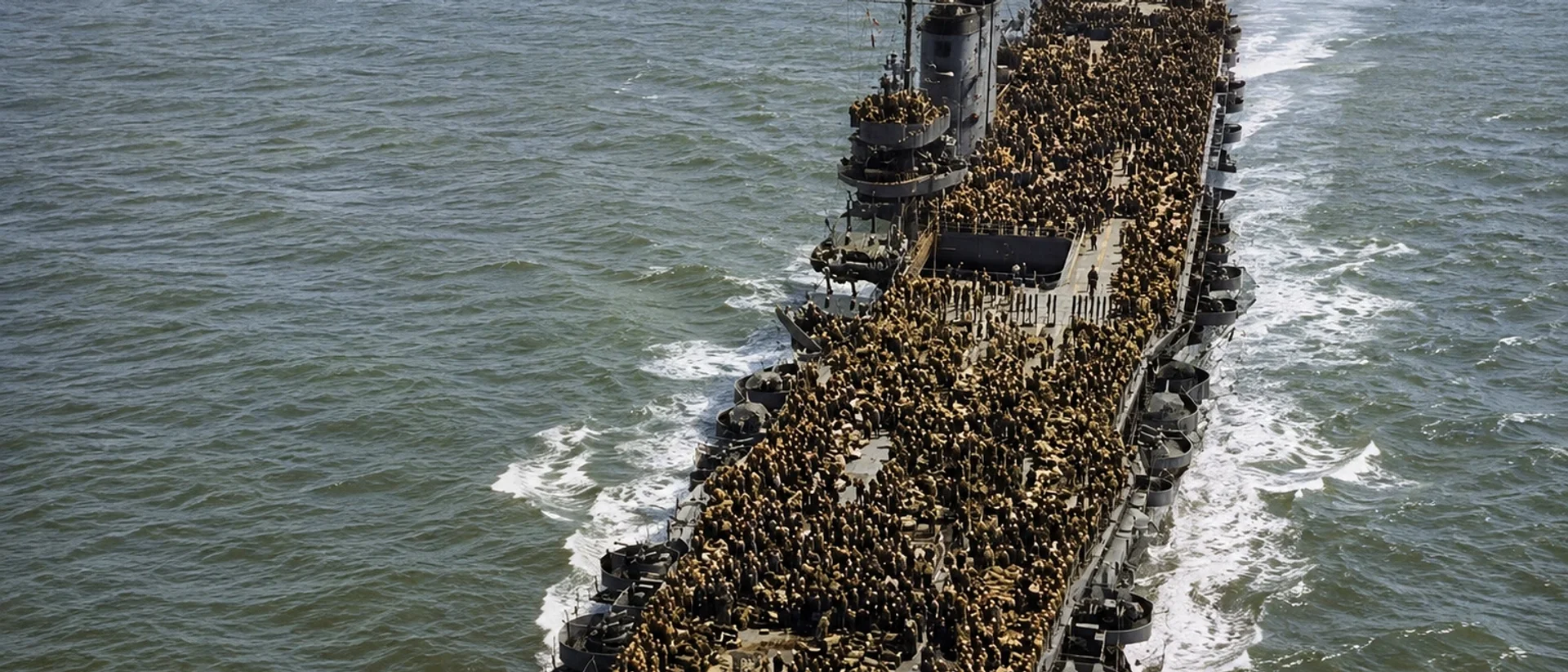
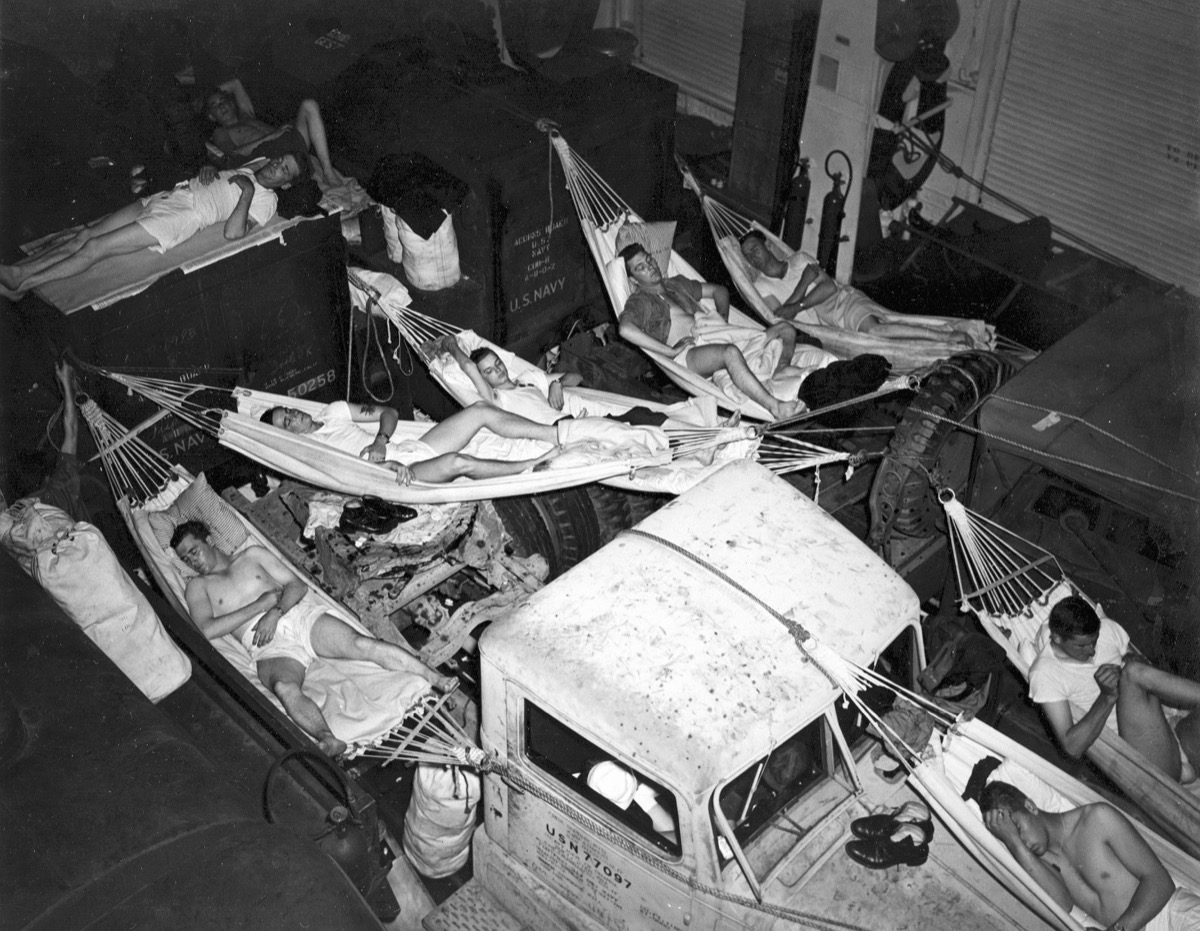
Operation Magic Carpet turned Navy warships into giant floating dorms. The mission: bring 8 million WWII troops home. Nearly 370 Navy ships took part in the Pacific, with bunks stacked up to five tiers high on hangar decks. USS Saratoga alone carried more troops than any other ship in the fleet: 29,204 men. Flight decks built for fighter planes were packed wall to wall with veterans, finally sailing home.
How the Navy Brought 8 Million WWII Troops Home
By September 1945, the fighting was over, but millions of American service members were still scattered across the Pacific and Europe with no way home. The ships built to win the war would now be repurposed to finish the job properly: bringing every one of them back.
A Fleet Built for War, Repurposed for Peace
In the Pacific, the task fell to the U.S. Navy under a mission code-named Operation Magic Carpet, launched within days of Japan's formal surrender. Troops in Europe were already heading home aboard converted cargo ships.
Fleet Admiral Ernest J. King authorized nearly 370 Navy warships in the Pacific to switch from combat duty to ferry duty. Aircraft carriers, battleships, cruisers, and hospital ships all joined transports built specifically for troops.
It was, by scale, the largest sealift the Navy had ever attempted.
Bunks Stacked Up to Five Tiers High
Aircraft carriers made ideal troop ships for one simple reason: their hangar decks. The same wide-open space normally used to store and repair fighter planes could just as easily hold people.
Crews welded temporary bunks into those decks, stacking them three to five tiers high to fit as many men as possible. A crewman aboard USS Monterey later recalled workers at the Brooklyn Navy Yard installing bunks on the hangar deck five high, then building a steel platform over the top just to store gear.
The Ship That Carried the Most
No ship in the operation brought home more men than the aircraft carrier USS Saratoga.
Over the course of her Magic Carpet service, the Saratoga ferried a total of 29,204 Pacific War veterans back to the United States, more than any other single vessel in the entire fleet.
Eight Million People, One Year
Operation Magic Carpet ran for about a year, from the fall of 1945 into the fall of 1946, moving more than 22,000 troops home every day on average.
December 1945 was the busiest stretch, with nearly 700,000 people arriving back in the United States in a single month, as the Navy raced to get as many families reunited by Christmas as it could.
By the time the operation wound down, it had carried more than 8 million American service members home. For most of them, that crowded flight deck was the last stop between the war and their front door.
Frequently Asked Questions
What was Operation Magic Carpet?
How many troops did Operation Magic Carpet bring home?
How many ships were used in Operation Magic Carpet?
Which ship carried the most troops home during Operation Magic Carpet?
Why did aircraft carriers stack bunks so high during Operation Magic Carpet?
Verified Fact
Verified via Wikipedia raw text that the 369-ship breakdown
Source: The National WWII MuseumShow verification details
Audited 2026-08-05. Primary anchor: National WWII Museum "Home Alive By '45: Operation Magic Carpet" (nationalww2museum.org/war/articles/operation-magic-carpet-1945) - confirms >8M total repatriated (all theaters, all services combined), Dec 1945 peak "almost 700,000", USS Saratoga 29,204 "more than any other individual ship", and its own self-consistent rate stat "22,222 Americans home every day for nearly one year straight" (22,222 x 360 approx 8.0M - reconciles). Cross-checked Wikipedia "Operation Magic Carpet" (raw article text pulled directly) and history.navy.mil (NHHC digital exhibit, via search cache) and warhistoryonline.com. CORRECTIONS MADE (2 real errors, both scope/precision, core claim intact): 1. NUMERIC COHERENCE FAIL (article + FAQ + social_engagement_comment): original text stated "ran for about 14 months... averaging 435,000 troops home every month" alongside "more than 8 million" total. 435,000 x 14 = 6.09M, undercounting the stated 8M total by ~24%. Traced the "435,000/14-months" figure to warhistoryonline.com, which has the same internal math error in its own article (its title says "8 million" but its own average x duration = 6.09M). Replaced with the primary source's own internally-consistent statistic: "more than 22,000 people a day for about a year" (22,222 x 360 approx = 8.03M, reconciles). Fixed in: article, faqs (Q2), social_engagement_comment. 2. CITATION/SCOPE FAIL (text, social_text, article, faqs Q1/Q3): "Nearly 370 [Navy] ships" was presented as if it covered the full 8-million repatriation across Pacific+Europe. Verified via Wikipedia raw text that the 369-ship breakdown (222 attack transports, 6 battleships, 18 cruisers, 57 carriers, 12 hospital ships) is explicitly scoped to the PACIFIC theater Navy fleet only, appearing in Wikipedia's "Asia and the Pacific" section. NWWII Museum gives "over 700 ships of all shapes, sizes, and nationalities" for the whole operation and "546 vessels" by VE-Day for the European sealift alone (mostly Liberty/Victory ships and civilian liners, not Navy warships - Navy ships were explicitly excluded from the initial European sealift per Wikipedia). A search-indexed NHHC exhibit page corroborates: "the U.S. Navy sealift brought more than 3.1 million servicemen home from all quarters of the Pacific" - i.e. the 369-ship Navy fleet moved ~3.1M of the 8M total, not all of it. Added "in the Pacific" scoping to the ship-count claim everywhere it appears, and added a clarifying sentence that Europe was handled separately by converted cargo ships. This is a real conflation the original copy would not have survived a WWII-history-literate commenter. MINOR PRECISION FIX (invented precision, checklist item): text/social_text/social_caption/article figure caption/social_link_comment stated bunks "stacked five tiers high" as a flat number; Wikipedia and the article's own body text (correctly, in one place) say "three to five tiers." Changed the flat "five tiers" mentions to "up to five tiers" for consistency (the FAQ answer and article body paragraph already correctly said "three to five" - left those as-is). SUPERLATIVE CHECK (USS Saratoga 29,204): source (NWWII Museum) itself makes this claim verbatim - "more than any other individual ship" - so it is directly sourced, not an AI upgrade. Confirmed this is scoped to Magic Carpet / the Navy fleet, not "any ship in WWII history" (Queen Mary/Queen Elizabeth carried far more total wartime passengers across the full war but that is a different, unrelated metric - total wartime trooping, not this operation's per-ship record). Added "in the fleet" qualifier to the two places (text, social_text) that lacked explicit scoping, matching the article/FAQ which already had it. SUPERLATIVE COUNTEREXAMPLE HUNT (mainstream_novelty): searched for viral/Reddit/TIL/mainstream-FB saturation. Found only niche military-history circulation (a "TogetherWeServed" veterans-community FB post, History Channel/military blog coverage) - not a chronically-recycled FB classic like Wojtek/Titanic-survivor/Sully. mainstream_novelty=2 stands. VERIFIED CLEAN: "sailors gave up their own bunks" detail correctly stays out of every field (no source supports it; warhistoryonline.com mentions civilians doing something similar in an unrelated anecdote, not sailors - correctly not conflated). No war-grief/casualty content, no money hooks, no hard-dated "this week"/anniversary language that would break outside VJ-Day week. Framing is a clean celebratory homecoming throughout. Set to partially_true rather than verified because two fields required real corrections beyond wording polish (numeric coherence + citation scope), consistent with policy for corrected facts. All parallel fields (text, social_text, social_caption, faqs, social_engagement_comment, social_link_comment, article) re-synced to the corrected narrative in this same pass. engine=1/W (awe-at-scale, no recognizable face) and pf=2 (real archival photos of packed carrier decks exist) confirmed reasonable, left unchanged. No image_social/image_card/image_banner set yet (pre-imaging stage), so no image null needed. No scheduled_posts existed yet for this new fact (pre-scheduling stage). ROUND 2 (same audit pass, post-advisor review): social_caption paragraph 1 and social_engagement_comment still attributed the full 8-million/all-services total to "the Navy"/"the fleet" specifically (the same conflation corrected everywhere else) - fixed: caption now attributes the 8M figure to "the country" and scopes the Navy's role to "put its own warships to work"; engagement comment now attributes the rate/total to "Operation Magic Carpet" rather than "the fleet." Also rebalanced the engagement comment so the December 700k peak isn't juxtaposed against the new 22,000/day average in the same breath (22,222/day x 31 approx 689k, which would read as barely a peak) - reworded to lead with "the busiest month of the whole operation," which is the NWWII Museum's own verbatim framing ("December of that year was the busiest in Magic Carpet's 11 months of operation"), rather than implying a dramatic multiple-of-average spike. source_url: kept nationalww2museum.org/war/articles/operation-magic-carpet-1945. It directly backs the two most checkable headline specifics - the 8 million total and the named-ship record (USS Saratoga, 29,204, "more than any other individual ship") - plus the 22,222/day rate now used in the fact. Attempted to upgrade to a dedicated Navy.mil (NHHC) page, which search-engine caches show contains the 369-ship Pacific breakdown AND the Saratoga record together in one place, but every candidate NHHC URL (history.navy.mil/.../operation-magic-carpet.html and .../vj-day/magic-carpet.html) returns a live 404 as of this audit (confirmed via curl -L with browser UA, not just WebFetch) - a currently-dead government page cannot be set as source_url even though it was once indexed. The Pacific-scoped 369-ship breakdown remains cross-sourced to Wikipedia's "Operation Magic Carpet" article (fetched directly via the Wikipedia API, raw text) in the Round 1 notes above; that page does not mention USS Saratoga so it cannot serve as the sole source_url either. nationalww2museum.org is the best available single URL that supports the central claim and the named figure. affinity_pool=1 set (large-niche military-history subject, not mass-recognizable for US 25-44 - see affinity_note). Status upgraded from partially_true to verified: all identified errors (numeric coherence, ship-count scope, invented tier precision, Navy/all-services conflation) have been corrected in place across every field (text, social_text, social_caption, faqs, social_engagement_comment, social_link_comment, article) and re-synced; no open discrepancies remain. Confirmed text still equals social_text with markdown stripped (408/432 chars respectively) and both are within the 280-450 char policy.
Related Topics
More from History & Culture
View all History & Culture →