
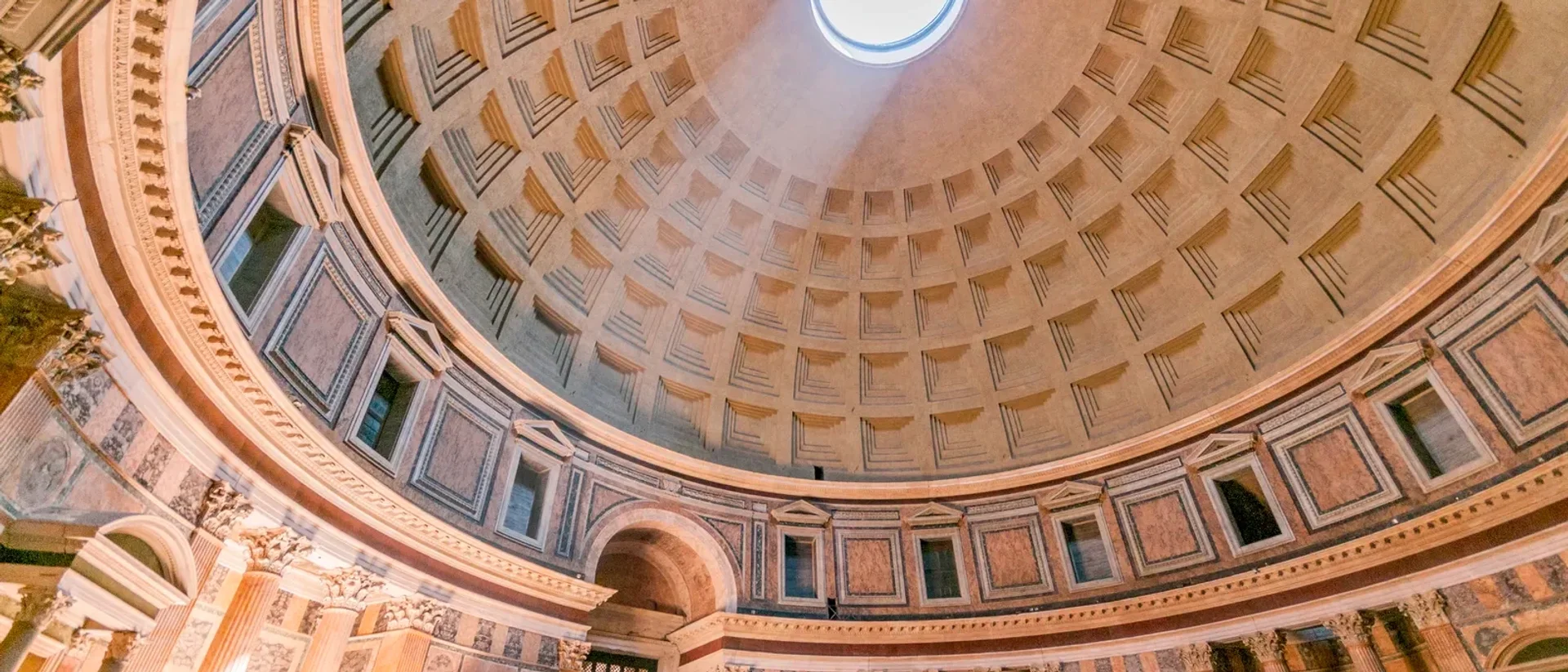
The Pantheon has stood in Rome for nearly 2,000 years, its concrete dome outlasting every modern equivalent. For centuries, engineers blamed the white chunks in Roman concrete on sloppy mixing. In 2023, MIT found the opposite: those "lime clasts" are the secret. When a crack forms and water seeps in, they react and recrystallize to seal it - the concrete heals its own cracks, 2,000 years before we understood the chemistry.
Roman Concrete Heals Its Own Cracks
The Pantheon has stood in Rome for nearly 2,000 years. Its unreinforced concrete dome - still the largest of its kind in the world - has survived earthquakes, floods, and centuries of neglect. Modern concrete would have crumbled long ago. Scientists always assumed the volcanic ash in the Roman mix was the reason. In January 2023, MIT researchers published a study in Science Advances that overturned that assumption and found the real secret: the concrete fixes itself.
The Ingredient Everyone Thought Was a Mistake
Look closely at a fragment of ancient Roman concrete and you will see small white chunks scattered through the grey mass. For years, engineers dismissed them as evidence of poor workmanship - chunks of calcium that had not been properly mixed in. MIT professor Admir Masic and a team from Harvard, Italy, and Switzerland took a closer look and found the opposite was true. Those chunks are called lime clasts, and they are exactly what the Romans intended.
Roman builders made concrete by combining quicklime - a highly reactive form of calcium - with volcanic ash from the Bay of Naples and water. The mixing happened at high temperature, a process called hot mixing. Modern construction uses slaked lime instead - hot mixing is more dangerous and expensive to apply at industrial scale. The Romans did it on purpose. The heat gave the lime clasts a brittle, high-surface-area structure that would become critical to the concrete's long-term survival.
How the Healing Works
When a crack forms in Roman concrete, it travels through the lime clasts rather than around them. Water seeping into the crack dissolves the calcium in the clasts. That creates a calcium-saturated solution that flows into the crack and quickly recrystallises as calcium carbonate - sealing the gap almost like a biological scab. The MIT team cracked their own lab samples and ran water through them to test this. The ancient-recipe samples had completely sealed within two weeks. The modern-recipe samples never healed at all.
The reaction is automatic. No maintenance is needed. As soon as a hairline crack forms and rain or groundwater reaches it, the repair begins.
A City Wall That Proved the Point
The researchers examined concrete samples from a city wall in Privernum, a Roman town in central Italy. Using X-ray analysis and electron microscopy, they could map exactly where the lime clasts sat, how the cracks had formed, and where new calcium carbonate had deposited. The pattern matched the self-healing model precisely. Professor Masic noted that it made no sense to assume the Romans - builders who designed structures still standing today - had simply failed to mix their concrete properly. The lime clasts were the plan.
What This Means for Construction Today
Cement production is responsible for roughly 8 percent of global greenhouse gas emissions. Concrete that lasts centuries rather than decades would mean far less of it needs to be made and replaced. The MIT study has prompted renewed research into incorporating hot-mixed lime clasts into modern concrete formulas. The challenge is industrial scale: hot mixing is more dangerous and expensive than standard methods, and the construction industry has spent generations optimising for the current approach.
The Pantheon was not an accident. The Romans understood something about their materials that took the rest of the world nearly two millennia to rediscover.
Frequently Asked Questions
How does Roman concrete self-heal?
What did MIT discover about Roman concrete in 2023?
What is hot mixing and why did Romans use it?
Why does modern concrete not last as long as Roman concrete?
Which Roman structures still stand because of self-healing concrete?
Verified Fact
Verified Jun 6, 2023 · 2 sources checked
Source: View sourceShow verification details
Claims checked
- MIT-led team identified lime clasts as self-healing agent in Roman concrete
- Concrete heals cracks within two weeks when water seeps in
- Modern concrete control samples did not self-heal
- Hot mixing avoided in modern use due to danger, expense, and industrial scale (not risk alone)
Sources: MIT News, Science Advances