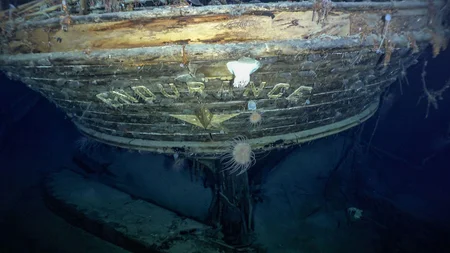
Mehmed Çakir spotted odd metal shapes on the seabed off Turkey in 1982. The sponge diver called them metal biscuits with ears. They turned out to be 3,300-year-old copper ingots from one of the richest Bronze Age shipwrecks ever found. Its cargo came from at least seven ancient civilizations, including Egyptian ivory and Baltic amber. There was enough copper and tin aboard to arm 5,000 soldiers with bronze swords.

The 3,300-Year-Old Wreck Carrying 7 Ancient Civilizations

Posted 11 days agoUpdated 2 minutes ago

In the summer of 1982, a sponge diver working the waters off southern Turkey noticed something strange on the seabed, 44 to 52 meters down. They looked like metal biscuits with ears. He sketched them and described the shapes to his crew back on shore.

A Turkish Diver Finds the Ears

The diver, Mehmed Çakir, had stumbled onto a field of copper ingots shaped like stretched animal hides, each with a handle-like corner that made them easy to sling over a mule's back. Archaeologists call them oxhide ingots, and Çakir's sketch of the "biscuits with ears" was accurate enough that specialists from the Institute of Nautical Archaeology and the Bodrum Museum came to investigate. What they found near the point called Uluburun, about six miles southeast of the town of Kas, turned out to be the wreck of a merchant ship that sank more than 3,300 years ago, around 1300 BC.

Eleven Years Underwater

Between 1984 and 1994, archaeologists led by George Bass and Cemal Pulak logged more than 22,000 dives to excavate the site, working at depths of up to 150 feet. It became one of the longest and most extensive shipwreck excavations ever conducted.

A Cargo Built From Seven Civilizations

What made the wreck extraordinary wasn't just its age. It was what the ship was carrying. Divers recovered roughly 10 tons of copper ingots and about a ton of tin, the exact ratio needed to produce high-grade bronze. Alongside the raw metal sat ebony logs, elephant and hippopotamus ivory, gold and silver jewelry, glass ingots in cobalt blue and turquoise, and beads of Baltic amber that had traveled thousands of miles from the north.

Researchers eventually traced the goods to at least seven different ancient civilizations: Canaanite, Egyptian, Cypriot, Mycenaean, Assyrian, Kassite Babylonian and Nubian. A later chemical study of the tin traced a third of it back to a mine in what is now Uzbekistan, more than 2,000 miles away, meaning the metal had already crossed Central Asia and the Near East before it ever reached the sea.

Enough Metal for an Army

The copper and tin alone could have produced about 11 metric tons of bronze, enough to arm nearly 5,000 soldiers with swords. Yet the ship itself carried only a handful of finished weapons, suggesting the raw metal was the real prize, likely bound for a royal workshop somewhere in the Aegean.

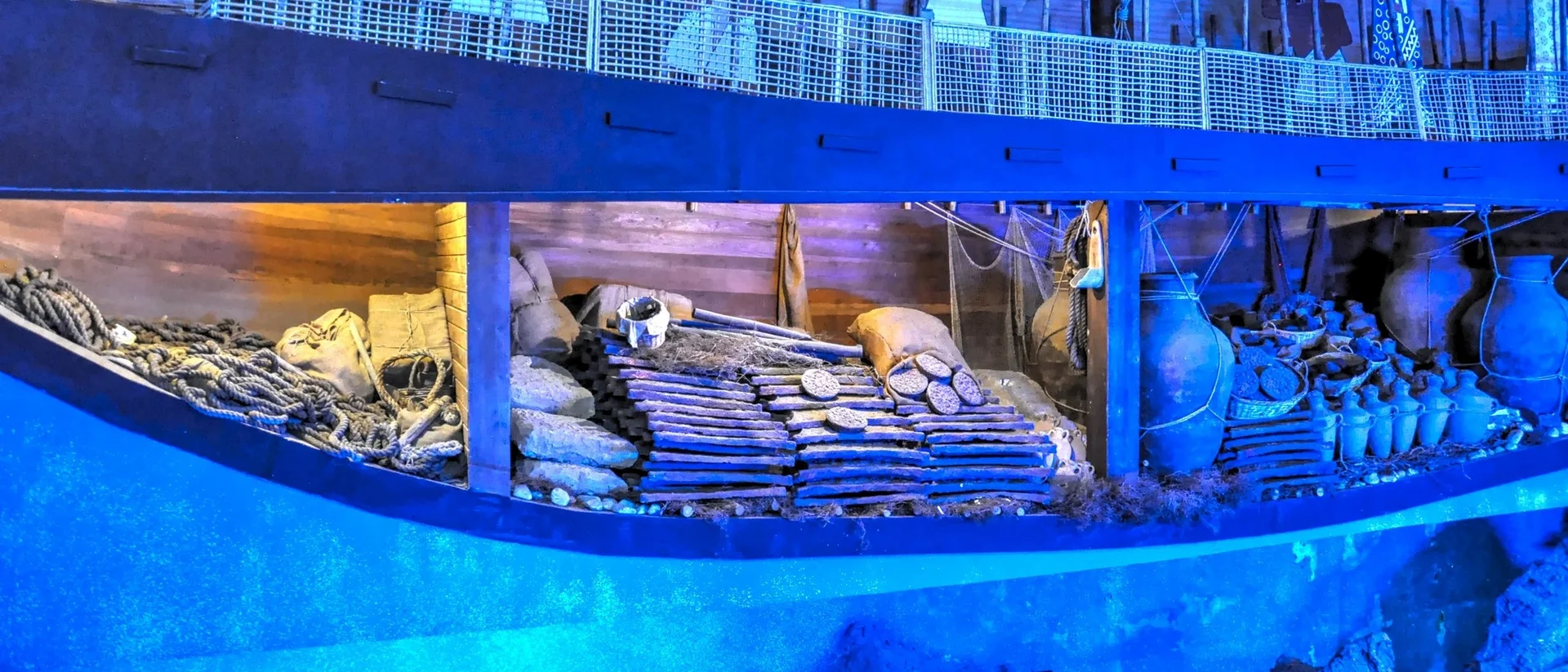
Reconstructed Uluburun shipwreck cargo displayed at the Bodrum Museum of Underwater Archaeology

Where the Ship Ended Up

Today, much of the cargo and a full-scale reconstruction of the hull are on display at the Bodrum Museum of Underwater Archaeology in Turkey. It remains one of the richest collections of Late Bronze Age trade goods ever found in one place, all because a sponge diver noticed a few odd-looking biscuits on the ocean floor.

Enjoyed this? Get a new fact every day.

Follow FunFactz for the best ones in your feed.

or get one in your inbox

Frequently Asked Questions

What is the Uluburun shipwreck?
The Uluburun shipwreck is a Late Bronze Age merchant ship that sank off the coast of Uluburun, near Kas, Turkey, around 1300 BC. It carried one of the richest and most varied cargoes ever recovered from a Bronze Age wreck, including copper, tin, gold, ivory, glass and amber.
Who discovered the Uluburun shipwreck?
A Turkish sponge diver named Mehmed Cakir spotted unusual metal shapes on the seabed in 1982. He described them as metal biscuits with ears, a phrase archaeologists later realized meant oxhide-shaped copper ingots.
How old is the Uluburun shipwreck?
The ship sank around 1300 BC, making the wreck roughly 3,300 years old. Researchers dated it using tree-ring analysis of the ships timbers combined with radiocarbon testing of the cargo.
What cargo was found on the Uluburun shipwreck?
Divers recovered about 10 tons of copper ingots and roughly a ton of tin ingots, along with ebony logs, elephant and hippopotamus ivory, gold and silver jewelry, glass ingots and Baltic amber beads. The goods came from at least seven different ancient civilizations.
Where can you see the Uluburun shipwreck cargo today?
Much of the recovered cargo and a full-scale reconstruction of the ship are on display at the Bodrum Museum of Underwater Archaeology in Turkey, where visitors can see the original ingots, jewelry and other artifacts.

Verified Fact

Verified Jul 12, 2026

Source: Turkish Archaeological News
Show verification details

Verified 2026-07-12. Sources: Turkish Archaeological News (turkisharchaeonews.net/news/uluburun-shipwreck, set as source_url), Wikipedia (en.wikipedia.org/wiki/Uluburun_shipwreck), WashU/ScienceDaily 2022 tin-isotope study (source.washu.edu/2022/11/..., sciencedaily.com/releases/2022/11/221130151458.htm). Claims checked: (1) 1982 discovery by sponge diver Mehmed Cakir - CONFIRMED verbatim on source_url (found close to the Uluburun Cape ... by Mehmed Cakir - a sponge diver from Yalikavak, in 1982). (2) metal biscuits with ears quote - CONFIRMED verbatim on source_url. (3) Dating ~3,300 years/c.1300 BC - CONFIRMED (source_url: late 14th century BC; Wikipedia: dendro ~1305 BC, radiocarbon-calibrated ~1327 BC, Bayesian 1320+-15 BC). (4) Cargo ~10 tons copper + ~1 ton tin - CONFIRMED verbatim on source_url and Wikipedia (354 copper ingots totaling 10 tons; ~1 ton tin; ~11 tons bronze when alloyed). (5) At least seven civilizations - Wikipedia actually says nine or ten cultures; fact deliberately uses the more conservative, independently-named-and-corroborated figure of seven (Canaanite, Egyptian, Cypriot, Mycenaean, Assyrian, Kassite Babylonian, Nubian) - this is UNDER-claiming relative to Wikipedia, not an inflation, so it passes the over-claim check; consistent across text/social_text/article/FAQ/caption. (6) 5,000-soldiers-with-bronze-swords equivalence and Uzbekistan (Musiston mine) one-third-of-tin detail - CONFIRMED verbatim against the WashU 2022 tin-isotope study (enough...to outfit a force of almost 5,000 Bronze Age soldiers with swords; one-third of the tin...sourced from the Musiston mine in Uzbekistan). (7) One of the richest (not the richest) - CONFIRMED used consistently in text, social_text, and article closing line; no absolute superlative found anywhere. NUMERIC COHERENCE: found ONE discrepancy - social_caption kicker read There was enough metal aboard to arm 5,000 bronze swords (garbled - arms swords, not soldiers), inconsistent with text/social_text/article (arm 5,000 soldiers with bronze swords/arm nearly 5,000 soldiers with swords). CORRECTED social_caption to arm 5,000 soldiers with bronze swords to match. All other figures (1982, 3,300 years, 10 tons copper, 1 ton tin, seven civilizations, 2,000+ miles to Uzbekistan, eleven-year/1984-1994 excavation) reconcile across text, article, FAQs, caption, and both social comments. CITATION FIDELITY: source_url (turkisharchaeonews.net) directly supports the diver name, the exact metal biscuits with ears quote, the dating, and the core cargo figures (10 tons copper, 1 ton tin, 175 glass ingots, gold/silver) - passes. Ivory/amber (secondary cargo detail) not on that specific page but independently confirmed via Wikipedia/INA. BEAT FRESHNESS: checked against canaanite-shipwreck-energean-deep-sea-discovery (verified, posted twice already - Jun 7 and Jun 22 2026, with an approved repost scheduled Aug 16 2026). Confirmed these are DIFFERENT wrecks/events: canaanite = 2024 deep-sea ROV find of jars-only cargo at 1.8km depth (sub_beat ships-hidden-beneath); uluburun = 1982 diver find of a rich multi-culture cargo trove near-shore at 44-52m (sub_beat shipwreck-found-intact). Not a near-duplicate, but same general ancient-shipwreck territory - FLAG for social-manager: do not schedule uluburun in the same week as canaanite (next canaanite repost is approved for 2026-08-16; uluburun currently unscheduled, publish_at placeholder 2099-01-01). ENGINE: engine=0 (anonymous 1982 sponge diver, dead-zone by FB-recognizability standard) is correctly labeled - not a famous-name-on-trivia case, and not an emotional-animal/wholesome awe case eligible for the Jun-20 A/W engine=1 carve-out (category_code M, discovery/mind-blowing pattern, no grief/loyalty/rescue/reunion/sacrifice core) - no relabel needed. social_text/text length: raw social_text 441 chars (with markup) but plain text field is 417 chars, within the 280-420 hard-stop-450 convention (confirmed against practice on other verified facts, e.g. george-hopkins-devils-tower text_len 448/raw 480) - PASS. text = social_text-with-markdown-stripped verified byte-for-byte identical. No emdashes found in text, social_text, article, faqs, caption, or either social comment. Discrepancies found: 1 (caption kicker grammar/inconsistency, corrected in place).

Related Topics

More from History & Culture

View all History & Culture