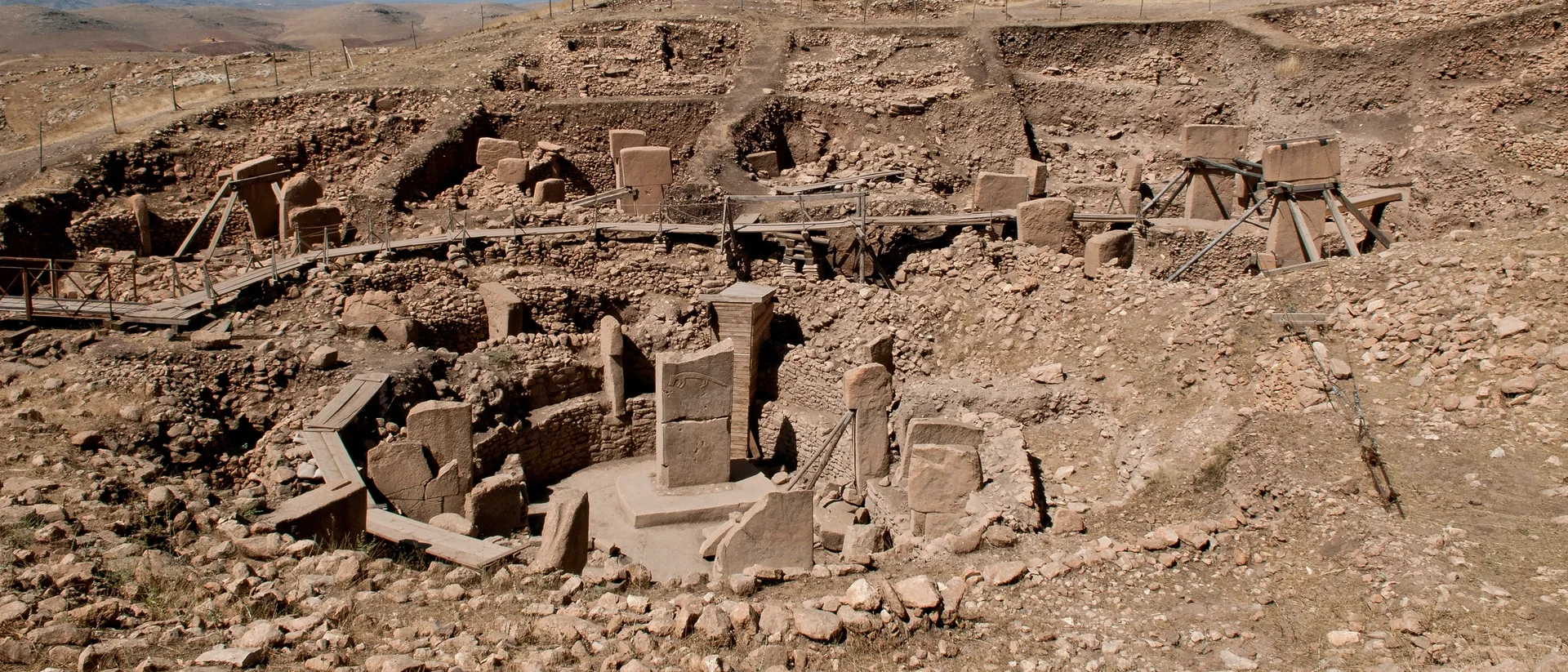
Göbekli Tepe in Turkey is the oldest known temple on Earth. Its massive stone pillars date back roughly 11,600 years, about 6,000 years before Stonehenge was built. Hunter-gatherers built it before writing, metal tools, or farming even existed. Then they deliberately buried the enclosures, and nobody knows exactly why.
This Temple Predates Farming, Writing, and Stonehenge
In the 1960s, a survey team walked a quiet hillside in southeastern Turkey, noticed some broken stone slabs poking out of the dirt, and decided they were medieval grave markers. They packed up and moved on. They were wrong by about 11,000 years.
A Mistake That Took Three Decades to Fix
The site, known locally as Gobekli Tepe, had been surveyed in 1963 by a joint team from Istanbul University and the University of Chicago.
The archaeologist on that trip, Peter Benedict, assumed the carved stone tips he saw were Byzantine or Islamic grave markers and noted the hill as a likely medieval cemetery.
The mound sat largely ignored for another 30 years.
That changed in 1994, when German archaeologist Klaus Schmidt visited the site and immediately suspected the slabs were something far older: the tops of buried prehistoric megaliths, not headstones.
He began formal excavations in 1995, and what came out of the ground rewrote the timeline of human civilization.
Older Than Farming, Writing, and Metal Tools
Radiocarbon dating placed the oldest structures at roughly 11,600 years old, built around 9600 BCE.
That makes Gobekli Tepe about 6,000 years older than Stonehenge and thousands of years older than the pyramids of Giza.
The scale is the strangest part.
The site holds T-shaped limestone pillars up to 5.5 meters tall, some weighing an estimated 10 to 16 tons, arranged in circular enclosures.
And the people who quarried, carved, moved, and raised them were hunter-gatherers.
There is no evidence of farming, pottery, permanent housing, or metal tools anywhere at the summit.
Archaeologists had long assumed that settled agriculture came first and religious monuments followed once people had time and surplus food.
Gobekli Tepe suggests the order may have run the other way: organized ritual and belief drawing people together before farming ever began.
Animals Frozen in Stone
The pillars are covered in relief carvings, mostly of dangerous or wild animals rather than the deer and gazelle the builders likely hunted for food.
Foxes, wild boars, scorpions, snakes, and vultures appear again and again, along with the occasional lion.
Archaeologists still debate what the imagery meant, but the craftsmanship is not in question.
Some of the carvings remain sharp enough to read at a glance, more than eleven thousand years after they were cut.
Then They Buried It On Purpose
Here is the part that still puzzles archaeologists.
Sometime around 8000 BCE, the people using Gobekli Tepe did not abandon it and let it collapse.
They deliberately backfilled the stone enclosures with rubble, broken flint tools, and animal bones hauled in from elsewhere, burying their own monuments under mounds of debris.
Nobody knows for certain why.
The leading theory is that the burial was a ritual closure, a formal decommissioning that may have come with large communal feasts, since the fill is packed with the kind of bone debris feasting would leave behind.
Other researchers have floated ideas ranging from shifting belief systems to changing climate.
Whatever the reason, the burial is exactly what preserved the site for millennia, undisturbed until a survey team mistook its tips for gravestones and walked away.
Why It Still Matters
Gobekli Tepe is now a UNESCO World Heritage Site, and archaeologists estimate that most of it, at least 16 additional stone rings detected by geophysical survey, is still buried and unexcavated.
Every new dig risks overturning assumptions again.
For now, the oldest known temple on Earth keeps its biggest secret: why the people who built it chose to bury it.
Enjoyed this? Get a new fact every morning.
A fascinating fact in your inbox every morning. Free. Unsubscribe anytime.
Frequently Asked Questions
How old is Gobekli Tepe?
Is Gobekli Tepe older than Stonehenge?
Who built Gobekli Tepe?
Why was Gobekli Tepe buried?
Who discovered Gobekli Tepe?
Verified Fact
Verified Jul 12, 2026 · 4 sources checked
Source: Smithsonian MagazineShow verification details
Claims checked
- Oldest known temple on Earth
- Pillars date to about 11,600 years ago, roughly 6,000 years before Stonehenge
- Built by hunter-gatherers before farming, metal tools, or writing
- Deliberate burial scoped to the enclosures, not the whole site
Sources: Smithsonian Magazine, German Archaeological Institute (DAI), History.com, World History Encyclopedia
Related Topics
More from History & Culture
View all History & Culture →