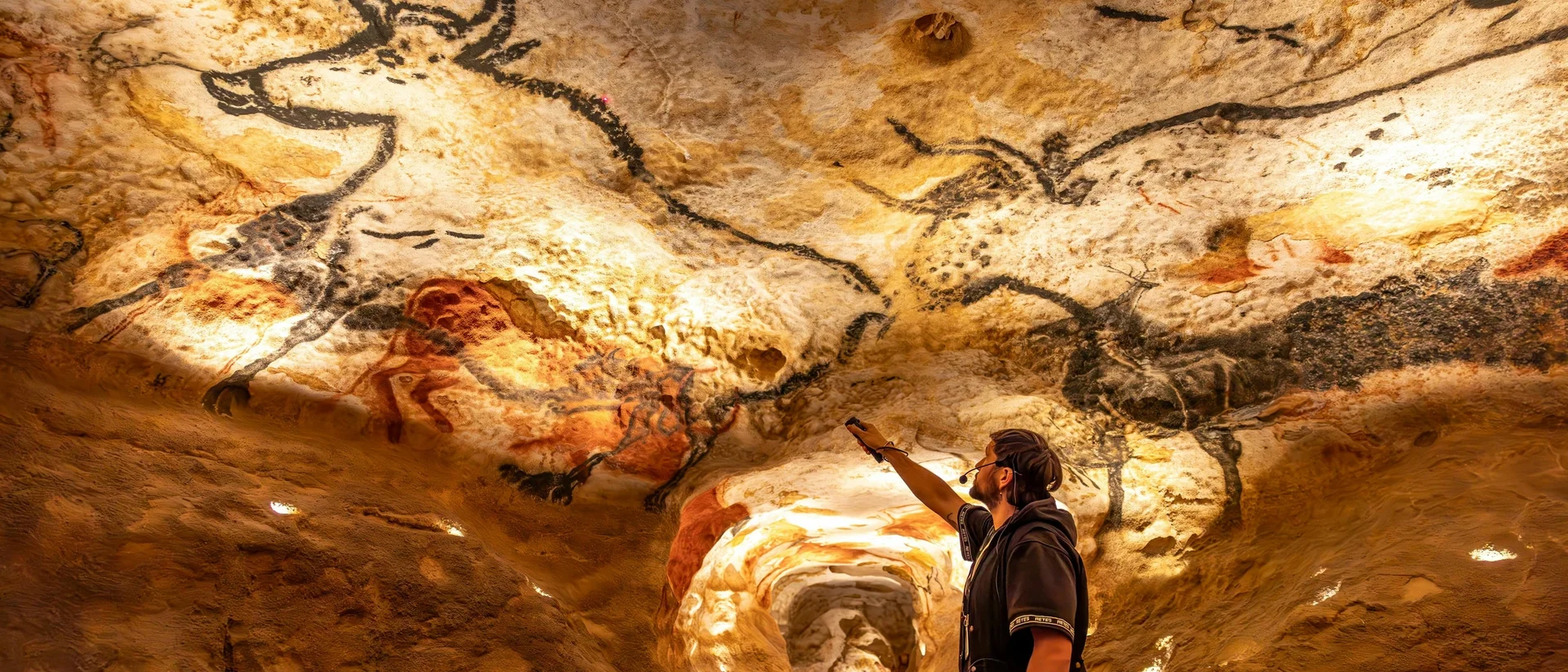
Marcel Ravidat was 18 when his dog went down a hole near Montignac, France. He climbed in after it, then returned days later with three friends. They found cave walls covered in painted animals: over 600 images made some 17,000 years ago. One black bull stretches over 17 feet across the rock. Visitors' breath damaged the paintings so badly the cave closed in 1963. A replica nearby lets people see it today.
The Dog That Found 17,000-Year-Old Cave Paintings
On a September afternoon in 1940, an 18-year-old French boy named Marcel Ravidat watched his dog disappear into a hole in the ground. He had no idea he was about to find one of the greatest art galleries on Earth, sealed shut for 17,000 years.
A Hole Under a Fallen Tree
Ravidat was walking near the village of Montignac in the Dordogne region of southwest France when his dog investigated a gap left by an uprooted tree.
Curious, Ravidat climbed down after it.
Four days later, on September 12, 1940, he returned with three friends, Jacques Marsal, Georges Agnel and Simon Coencas, to explore further.
Popular retellings often say the dog, nicknamed Robot, fell into the hole and the boys followed to rescue it.
That detail does not appear in the earliest accounts of the discovery and may be an embellishment Ravidat added in later interviews, but the discovery itself is well documented.
Walls Covered in Ice Age Animals
What the boys found inside stunned them.
The cave walls and ceilings were covered in paintings and engravings of animals, made using ochre, charcoal and manganese by hunter-gatherers of the Upper Paleolithic period.
Researchers have since identified more than 600 painted animals and nearly 1,500 engravings, including bulls, horses, stags and aurochs.
The largest is a bull known as the Great Black Bull, which stretches more than 17 feet (5.2 meters) across the rock, the biggest animal figure found in any cave art.
The paintings are now estimated to be at least 17,000 years old, with some researchers placing them as old as 22,000 years.
Too Many Visitors, Too Much Damage
Word of the discovery spread fast.
The cave opened to the public in 1948 and quickly became one of France's biggest tourist draws, pulling in as many as 1,200 visitors a day.
But all that foot traffic brought heat, humidity and carbon dioxide into a space that had stayed sealed and stable for millennia.
Green algae and mold began spreading across the ancient paintings.
By 1963, the damage was serious enough that French officials closed Lascaux to the public for good.
A Copy Built to Protect the Original
Rather than let the discovery disappear from public view, France built an exact replica of the cave's most famous chambers nearby.
Lascaux II opened in 1983, and a full-scale replica of the entire cave, Lascaux IV, opened in 2016 as part of an international cave art center.
The real cave is still monitored closely by conservationists, and only a handful of scientists are allowed inside each year.
Four Teenagers and a Dog
Ravidat, Marsal, Agnel and Coencas are still credited as the site's discoverers.
Marsal later spent decades working as a guide and caretaker at Lascaux, a role he kept until his death in 1989.
Whether or not Robot the dog deserves the real credit, the hole he investigated on a September afternoon in 1940 led to one of the most important archaeological finds of the 20th century.
Frequently Asked Questions
When was the Lascaux cave discovered?
How old are the Lascaux cave paintings?
Why is the Lascaux cave closed to visitors?
Can you still see the Lascaux paintings today?
Was the dog that found Lascaux really named Robot?
Verified Fact
Verified Jul 12, 2026 · 2 sources checked
Source: Wikipedia / History TodayShow verification details
Claims checked
- Discovery by Marcel Ravidat, who returned days later with three friends
- Over 600 painted images, about 17,000 years old
- Great Black Bull stretches over 17 feet
- Cave closed in 1963 due to visitor damage; replica nearby
Sources: Wikipedia, French Ministry of Culture, History Today
Related Topics
More from History & Culture
View all History & Culture →