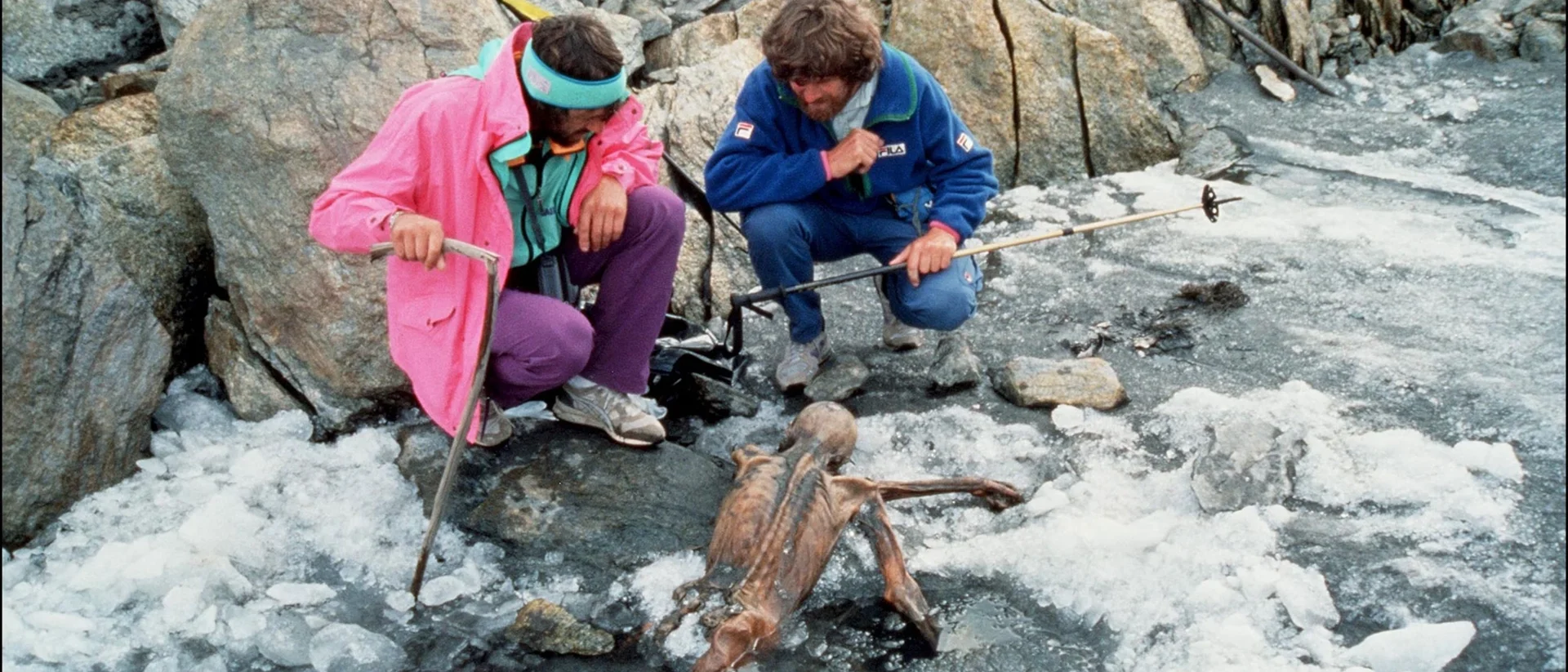
Hikers called the cops when they found a body melting out of an Alpine glacier in 1991. Police treated it as a routine mountain casualty. Carbon dating later revealed the man had been dead for 5,300 years. A decade later, X-rays found an arrowhead in his shoulder - he had bled to death in minutes.
The 5,300-Year-Old Murder Victim Nobody Recognized
On September 19, 1991, two German hikers spotted what appeared to be a recent tragedy on the Similaun Glacier in the Ötztal Alps, on the border of present-day Italy and Austria. The body was partially melting out of the ice. Police were called. Nobody was prepared for what carbon dating would reveal.
The Discovery Nobody Expected
Helmut and Erika Simon had been hiking through the high Alps when they came across the mummified remains. The body was extracted and transported to the office of the Innsbruck medical examiner, where investigators treated the scene as a modern death. Early handling damaged the remains - but that turned out to be a minor footnote in one of archaeology's most extraordinary stories. Radiocarbon dating established that the man had died between 3359 and 3105 BCE, making him roughly 5,300 years old - older than Stonehenge and the Great Pyramid of Giza.
A Copper Age Man, Preserved in Full
Named Ötzi after the Ötztal Valley where he was found, the Iceman turned out to be a remarkable time capsule. He was approximately 45 years old at death, stood 160 cm (5'3"), and had been remarkably well-preserved by the cold and dry conditions in the glacier. His possessions were equally astonishing: a nearly-pure copper axe, a flint dagger, 14 arrows, an unfinished yew bow stave, and a leather quiver. He wore a bearskin cap, leather leggings, a grass cloak, and shoes stuffed with grass for insulation. Analysis of his 61 tattoos - the oldest known tattooed human - found them clustered near joints, suggesting possible therapeutic use. His last meal, consumed within two hours of death, consisted of ibex and red deer meat, einkorn wheat, and wild roots and fruits.
A Cold Case Cracked - Ten Years Late
For a decade after the discovery, cause of death remained uncertain. Then, in 2001, X-rays and a CT scan revealed what early examinations had missed: a flint arrowhead lodged in his left shoulder, with a matching tear in his coat. The arrow had severed the subclavian artery. Ötzi had bled to death in minutes. A subsequent CT scan in 2007 confirmed the arrow wound as the cause of death, along with evidence of a blow to the head. He had been shot from behind - almost certainly ambushed.
What His DNA Revealed
Genome sequencing of Ötzi's remains painted a detailed portrait across millennia. He had dark eyes and darker skin than modern Europeans - a common trait among early European farmers. He was lactose intolerant (normal for the era) and genetically predisposed to heart disease and atherosclerosis. His Y-chromosome haplogroup (G-L91) has since become rare in Europe. Ötzi has been on display at the South Tyrol Museum of Archaeology in Bolzano, Italy since 1998, kept in a specially designed cold cell maintained at -6°C, making him the world's best-preserved natural mummy from the Copper Age.
Enjoyed this? Get a new fact every morning.
A fascinating fact in your inbox every morning. Free. Unsubscribe anytime.
Frequently Asked Questions
Who discovered Otzi the Iceman?
How old is Otzi the Iceman?
How was Otzi the Iceman murdered?
What was Otzi the Iceman wearing when he was found?
Where is Otzi the Iceman now?
Verified Fact
Verified against Britannica, South Tyrol Museum
Source: BritannicaShow verification details
Key claims verified against Britannica, South Tyrol Museum (iceman.it), Wikipedia, and web sources. Discovery date Sept 19 1991 confirmed. Discoverers Helmut and Erika Simon confirmed as German hikers.
Related Topics
More from History & Culture
View all History & Culture →