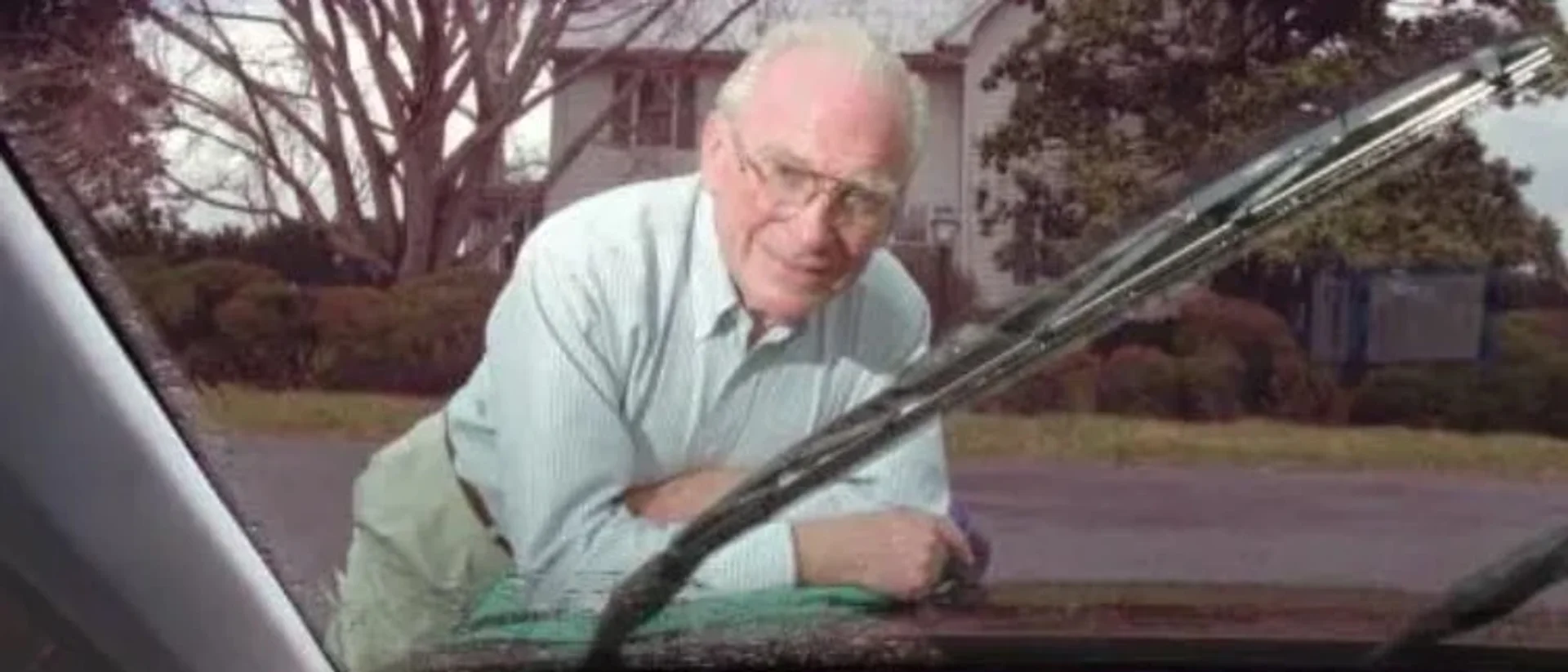
Robert Kearns invented the intermittent windshield wiper. Ford passed - then put it on every car they built. He sued, representing himself for 12 years after three law firms quit. Ford offered $30 million to settle. Kearns turned it down - the offer came without an admission. He didn't want their money. He wanted Ford to say they took it.
He Invented the Windshield Wiper. Ford Stole It.
Every time it rains lightly and your wipers pulse at just the right speed, you are benefiting from a device Robert Kearns built in his basement - and spent most of his adult life fighting two of the world's largest companies to reclaim.
The Idea That Started with a Champagne Cork
On his wedding night in 1953, a champagne cork struck Kearns in the left eye, leaving him partially blind. A decade later, driving his Ford Galaxie through a Detroit drizzle, the constant sweep of the wipers irritated his damaged vision. He began thinking about the human eye - which blinks every few seconds, not constantly - and set about modelling a wiper mechanism on that rhythm. By 1963 he had a working prototype. He filed his first patent on December 1, 1964.
Ford Takes a Look - Then Walks Away
Kearns demonstrated the device to Ford engineers and was initially welcomed. Five months later, Ford told him they had developed their own intermittent wiper and no longer needed him. In 1969, Ford introduced intermittent wipers across its Mercury line. Chrysler, General Motors, and virtually every other major automaker followed. Kearns received nothing.
Twelve Years Against Ford - Mostly Alone
Kearns filed suit against Ford in 1978. Three separate law firms dropped him during the litigation. Rather than give up, he largely represented himself - a mechanical engineering professor taking on one of the most powerful corporations in America. A jury awarded him $5.1 million; Ford, to avoid further appeals, paid $10.2 million to settle in 1990. Earlier in the case, Kearns had rejected a $30 million settlement offer from Ford - because Ford refused to acknowledge that it had used his invention.
Then He Did It Again - Against Chrysler
Kearns filed a separate suit against Chrysler in 1982. That case concluded in 1992 with a jury finding in his favour. Chrysler was ordered to pay $18.7 million plus interest - bringing his total recovery to roughly $30 million across both cases, though he spent over $10 million in legal fees along the way.
The Cost of Winning
The litigation consumed Kearns for decades. He suffered a mental breakdown in 1976. His 27-year marriage ended. His six children watched their father pour his life into the courtroom. He died on February 9, 2005, at the age of 77. Three years later, the 2008 film Flash of Genius, starring Greg Kinnear, dramatised his battle. The next time your wipers pause between strokes on a rainy day, that rhythm belongs to Robert Kearns.
Frequently Asked Questions
Who invented the intermittent windshield wiper?
How much did Robert Kearns win from Ford and Chrysler?
Did Robert Kearns represent himself in court?
What is the film Flash of Genius about?
Why did Robert Kearns reject Ford's settlement offer?
Verified Fact
Verified via Wikipedia
Source: WikipediaShow verification details
Verified via Wikipedia (Robert Kearns), Washington Post archive (Nov 15 1990 Ford settlement), History Hit, The Hustle, Eastern District of Michigan Federal Court Historical Society. Core claims confirmed: patent filed Dec 1 1964, Ford introduced wipers 1969 on Mercury line, Ford lawsuit filed 1978 settled 1990 for $10.2M (jury awarded $5.1M, Ford doubled it to settle), Chrysler suit filed 1982 verdict 1992 for $18.7M, three law firms dropped Kearns, he largely self-represented, he rejected a $30M Ford offer because Ford refused to admit wrongdoing, Flash of Genius 2008 starring Greg Kinnear, Kearns died Feb 9 2005 age 77. NOTE: user specified category L but this is textbook J per rubric (named villain + verdict + survives). Filed as J.
Related Topics
More from People & Mind
View all People & Mind →