
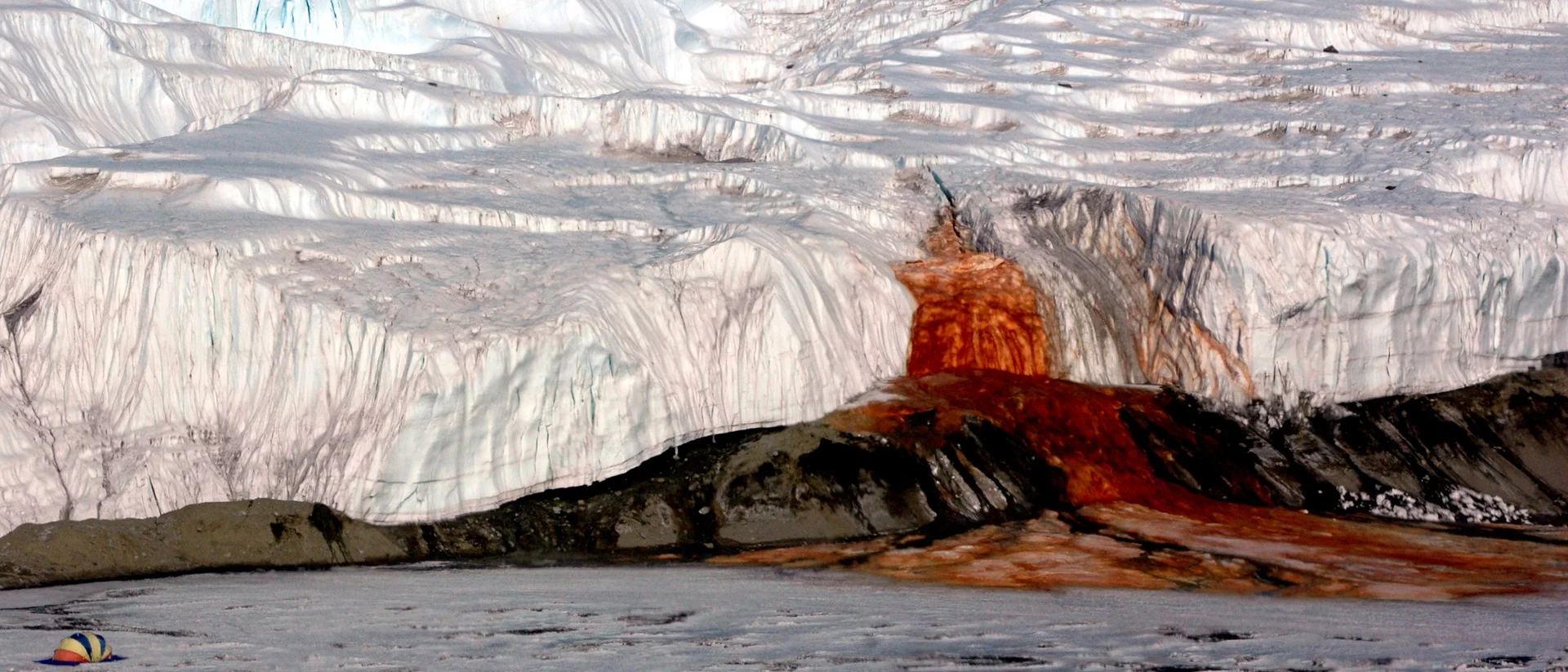
Blood Falls in Antarctica looks like a glacier is bleeding. A five-story red stain pours from Taylor Glacier - not blood. Iron-rich brine seeps from a reservoir sealed under 400 metres of ice for two million years - and the moment it hits air, it rusts red.
Blood Falls: Antarctica's Glacier That Bleeds
Deep in Antarctica's McMurdo Dry Valleys, a vivid crimson stain bleeds from the foot of Taylor Glacier. It looks like a wound. It flows in slow, red pulses. And for more than a century after its discovery, nobody could explain it.
Discovered in 1911, Misread for Decades
Australian geologist Thomas Griffith Taylor first saw Blood Falls in 1911 during a British Antarctic expedition. The red colour was striking and immediate. Early scientists assumed it came from red algae - a reasonable guess in a place where biology seemed to do the impossible. That theory held for decades. It was wrong.
What Is Actually Happening
The true source lies 400 metres beneath the glacier - a subglacial reservoir of ancient, hypersaline brine sealed from the outside world for roughly 1.5 to 2 million years.
This brine was once part of a marine system, trapped as ice advanced across the Taylor Valley. The water is two to three times saltier than the ocean, which keeps it liquid at around -7°C - far below the normal freezing point of freshwater.
When this iron-rich brine seeps upward through fissures in the ice and breaks the surface, it meets open air for the first time in millions of years. The iron oxidises instantly - it rusts. The colourless brine stains the white glacier face a deep, blood red within minutes of exposure.
A World Sealed for Two Million Years
Microbiologist Jill Mikucki led the landmark 2009 study published in Science that revealed what lives in that sealed world.
Her team found at least 17 types of microorganisms surviving in complete darkness with almost no oxygen. These microbes do not photosynthesize. Instead, they use iron and sulfate as chemical fuel - a form of metabolism that requires neither sunlight nor air.
A 2017 study mapped the englacial hydrologic system, confirming how the brine travels through the glacier to reach the surface.
The Mars Connection
Blood Falls sits in the McMurdo Dry Valleys, the most Mars-like terrain on Earth - cold, arid, and largely lifeless at the surface.
The subglacial ecosystem directly mirrors conditions scientists expect to find beneath the ice-covered oceans of Jupiter's moon Europa and Saturn's moon Enceladus, where liquid water, salt, and chemical energy exist in permanent darkness.
Blood Falls is now one of the most studied astrobiology sites on the planet - proof that life sealed from sunlight for over a million years does not merely survive, it adapts.
Frequently Asked Questions
What causes Blood Falls in Antarctica to be red?
How old is the subglacial water source beneath Blood Falls?
Is there life in the subglacial water beneath Blood Falls?
Why does liquid water flow out of a frozen Antarctic glacier?
Why is Blood Falls important for the search for life on other planets?
Verified Fact
Verified Jun 24, 2026 · 5 sources checked
Source: EarthSkyShow verification details
Claims checked
- Five-story height of the red stain
- Brine sealed under 400 meters of ice for about 2 million years
- Iron-rich brine rusts red on contact with air
- Discovered by Thomas Griffith Taylor in 1911
- Red color originally attributed to algae
Sources: Wikipedia, EarthSky, Harvard Gazette, Dartmouth DUJS, National Geographic
