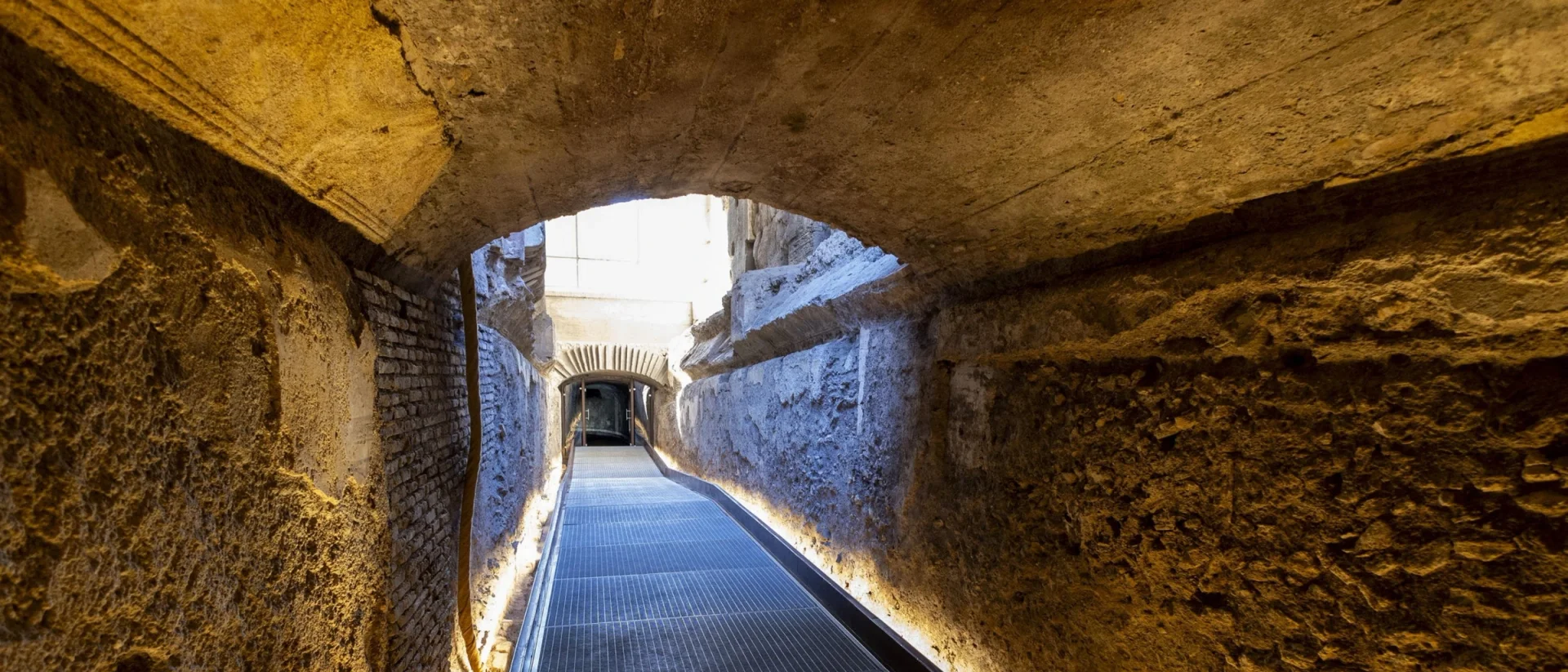
The Colosseum has a hidden underground corridor that Roman emperors used to enter the arena unseen and avoid assassination. Called the Passage of Commodus, it sat sealed beneath Rome for nearly 2,000 years. On October 27, 2025, it opened to the public for the first time after a year-long restoration. Part of the tunnel still leads toward an unknown destination.
The Colosseum's Secret Imperial Tunnel Is Now Open
Beneath the most recognizable arena in history, a secret passage sat sealed in darkness for nearly two millennia - used by Roman emperors to move through the Colosseum unseen, then lost to record until modern excavators found it. On October 27, 2025, visitors walked through it for the first time.
The Emperor Who Named It
Emperor Commodus ruled Rome from 180 to 192 CE and was not a conventional ruler. He considered himself a reincarnation of Hercules, entered the arena to fight as a gladiator, and killed hippos, rhinos, and a giraffe for the entertainment of spectators. He also came close to death inside this very tunnel - the Roman historian Cassius Dio recorded that Commodus nearly faced assassination in the passage. The corridor gave him a way to reach his imperial box without exposure to the 50,000-strong crowd below.
Three Arms and One Unsolved Route
The passage runs as an S-shaped underground gallery with three non-rectilinear arms - two east-west and one north-south - cut through the Colosseum's southern foundations. It linked the emperor's viewing platform (the pulvinar) to the exterior. Brick stamps found in the masonry date the construction to between the reign of Domitian (81-96 CE) and Trajan (98-117 CE). The walls were originally dressed in marble and decorated with stucco: mythological imagery from Dionysus, scenes of hunts, and depictions of acrobats. Skylights called "wolf's mouths" once let in natural light.
One arm of the tunnel bends eastward - probably toward the gladiatorial barracks or the Caelian Hill - but its final destination remains unknown. Excavation work planned for 2026 aims to trace the route further.
A Year of Conservation
The Archaeological Park of the Colosseum ran a 12-month restoration campaign from October 2024 through September 2025, funded in part by the NextGenerationEU program. Conservators stabilized the vaulted structure, used laser tools to reattach fragile plaster fragments, and installed walkways and lighting designed to mimic the natural daylight once filtered through the sealed skylights. Digital video reconstructions show visitors what the decorated walls looked like in their original state.
Now Open to Visitors
Tours run Mondays and Wednesdays between 1 and 4 p.m. Groups are capped at eight people for 25-minute guided visits. The passage is also fitted with a tactile map and a retractable staircase that converts to a lifting platform for accessibility. It was open through March 31, 2026, with the next phase of archaeological work expected to extend the story further underground.
Enjoyed this? Get a new fact every morning.
A fascinating fact in your inbox every morning. Free. Unsubscribe anytime.
Frequently Asked Questions
What is the Passage of Commodus at the Colosseum?
Why is it called the Passage of Commodus?
When was the Commodus Passage restored and opened?
Where does the Passage of Commodus lead?
Can you visit the Passage of Commodus today?
Verified Fact
Verified Jun 13, 2026 · 5 sources checked
Source: Finestre sull'ArteShow verification details
Claims checked
- Opened to the public on Oct 27, 2025, after year-long restoration
- Passage of Commodus used by emperors to enter unseen, avoiding assassination
- One tunnel arm leads to an unknown eastward destination
- Commodus survived an assassination attempt in the passage, died later in 192 CE
- Construction dated to Domitian-Trajan era via brick stamps
Sources: Finestre sull'Arte, ZME Science, ABC 17 News/CNN, Euronews, World History Encyclopedia
Related Topics
More from Places & Culture
View all Places & Culture →