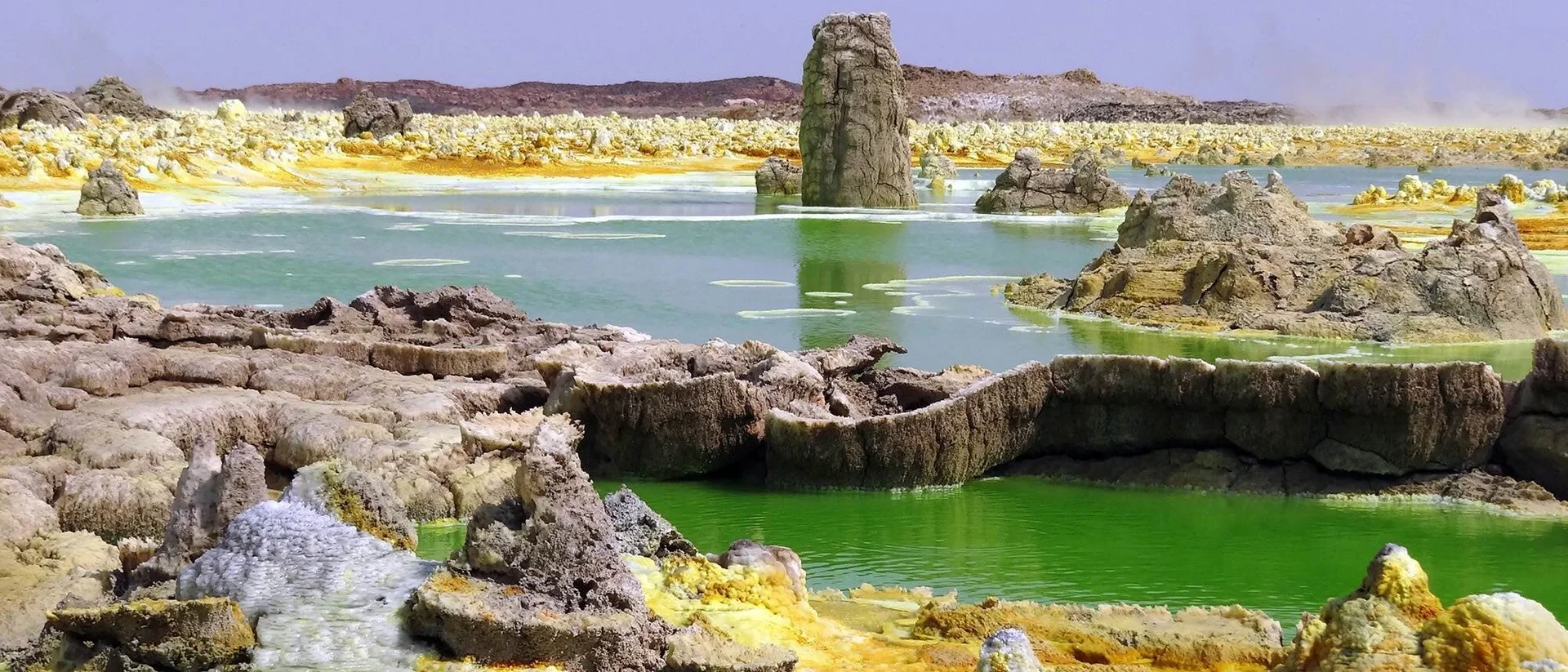
The Dallol springs in Ethiopia glow neon yellow and acid green - and their pH drops below zero, lower than battery acid. In 2019, scientists found no life in the harshest pools despite the liquid water. Liquid water alone is not enough for life.

Acid Pools With a pH Below Zero - and Mars

Posted 3 days agoUpdated 6 minutes ago

In the Danakil Depression of northern Ethiopia, there is a place that looks like it belongs on another planet. The Dallol hydrothermal field glows in shades of neon yellow, acid green, gold and orange - vivid colors produced not by living things but by sulfates, iron oxides and copper salts baking in 108-degree springs.

pH Below Zero

The springs discharge water with a pH below zero - some pools measured as low as -1.7, making them more corrosive than battery acid and among the most hostile natural water environments ever recorded. They are also nearly ten times saltier than seawater and hotter than boiling point.

A Place Where Water Does Not Mean Life

You might expect something to live there. Life has been found in scalding deep-sea vents, in frozen Antarctic lakes, in nuclear reactor cooling pools. But a 2019 study led by biologist Purificacion Lopez Garcia, published in Nature Ecology and Evolution, concluded that nothing survives in Dallol's multi-extreme pools. The combination of hyper-acidity, hyper-salinity, extreme heat and magnesium-rich brine appears to cross every threshold at once. A separate team did find evidence of ultra-small archaea in nearby salt chimneys at slightly less extreme conditions - so the scientific debate continues - but the main acid pools appear sterile.

The finding matters beyond the strange beauty of the springs. If liquid water is not enough to sustain life, then the search for life elsewhere in the solar system becomes far more nuanced.

The Closest Thing on Earth to Ancient Mars

That is exactly why astrobiologists keep coming back. Researchers affiliated with NASA's astrobiology program have identified Dallol as a planetary field analog - an environment on Earth that mirrors what Mars may have looked like billions of years ago, when it had volcanic hydrothermal activity and acidic sulfate deposits. The Spirit rover explored a site on Mars called Gusev Crater with similar geochemical signatures. What scientists learn at Dallol helps shape where they look on the red planet.

The Hottest Inhabited Place - A Separate Record

Dallol sits inside the wider Danakil Depression, which holds a different record: the highest average annual temperature for an inhabited location on Earth, roughly 34.6 degrees Celsius, recorded between 1960 and 1966. The Afar people have lived and worked this landscape for centuries, harvesting salt from its vast evaporite flats. The neon acid pools are a geological feature within that broader world - extreme even by the standards of an already extreme place.

Frequently Asked Questions

What is the pH of the Dallol hydrothermal pools?
The Dallol springs discharge water with a pH below zero. Measurements have recorded values as low as -1.7, making them more acidic than battery acid and among the most corrosive natural water environments on Earth.
Is there any life in the Dallol acid pools?
A major 2019 study led by biologist Purificacion Lopez Garcia and published in Nature Ecology and Evolution concluded that no microbial life exists in the pools. The combination of hyper-acidity, extreme heat and magnesium brine appears to cross every survival threshold at once. A separate research team did find evidence of ultra-small archaea in nearby salt deposits at slightly less extreme conditions, so the scientific debate continues.
Why do scientists study Dallol for Mars research?
NASA-linked astrobiologists consider Dallol a planetary field analog - an environment on Earth that resembles what Mars may have looked like billions of years ago, with volcanic hydrothermal activity and acidic sulfate deposits. The Spirit rover explored a site on Mars called Gusev Crater with similar geochemical signatures, and findings from Dallol help shape the search for ancient life on the red planet.
What makes the Dallol springs neon yellow and green?
The vivid colors come from inorganic chemistry, not biology. Sulfate minerals produce the yellows and whites, iron oxides create orange and red hues, and copper salts color the water green. Unlike Yellowstone, where color partly comes from heat-loving microbes, Dallol's palette is entirely chemical.
Is Dallol the hottest inhabited place on Earth?
The wider Danakil Depression holds the record for the highest average annual temperature for an inhabited location on Earth, roughly 34.6 degrees Celsius, recorded between 1960 and 1966. This is a separate record from the acid pools themselves - the Afar people have lived and worked in the region for centuries.

Verified Fact

Verified 2026-06-08. 4 sources checked. Primary source: phys.org (phys.org coverage of Lopez Garcia 2019 Nature Ecology & Evolution study) Secondary sources: Wikipedia Dallol (hydrothermal system); ACS Earth and Space Chemistry polyextreme study; Liebertpub Astrobiology exceptional planetary field analog paper. Claims checked: - Neon yellow and acid green colors: CONFIRMED - Wikipedia + ACS paper confirm inorganic chemistry (sulfates, iron oxides, copper salts) produce colors, not biology - pH below zero / pH -1.7: CONFIRMED - Wikipedia/ACS confirm range 0.1 to -1.7; phys.org confirms negative pH - 108 Celsius temperature: CONFIRMED - Wikipedia/ACS confirm springs hotter than 108C - 2019 study found nothing lives in pools: CONFIRMED - phys.org (primary source) confirms Lopez Garcia Nature Ecology & Evolution conclusion; Wikipedia confirms - Lopez Garcia led study, published Nature Ecology & Evolution: CONFIRMED - phys.org primary source - Gómez team found archaea in nearby salt chimneys (not main pools): CONFIRMED - Wikipedia; correctly hedged in article as separate/ongoing debate - Mars analog / NASA-affiliated astrobiologists: CONFIRMED - Liebertpub Astrobiology paper (doi 10.1089/ast.2018.1926) calls Dallol 'an exceptional planetary field analog'; well-established in astrobiology literature - Spirit rover / Gusev Crater connection: CONFIRMED - multiple astrobiology sources confirm this geochemical parallel - 34.6C inhabited heat record (Danakil Depression, 1960-1966): CONFIRMED - Wikipedia Dallol ghost town article; correctly walled off as a separate record in its own article section Corrections made in this audit pass: 1. source_url was astrobiology.nasa.gov - this page covers the Gomez LIFE-FOUND study (pH 0.25, not below zero; life found in salt chimneys), directly contradicting the fact's sterility central claim. Replaced with phys.org sterility article which correctly supports the Lopez Garcia finding. 2. text and social_text: removed unsupported superlative 'closest place on Earth to ancient Mars' (no source uses 'closest'; sources say 'an exceptional/excellent planetary field analog'). Replaced with 'one of the best planetary analogs on Earth for ancient Mars'. 3. social_caption: removed 'a finding that directly shaped how NASA searches for life on Mars' - this causal claim is not supported by any source for the Lopez Garcia sterility paper specifically. Replaced with a factual statement about liquid water not being sufficient. 4. social_engagement_comment: same causal overclaim removed and replaced with what the Lopez Garcia finding actually shows. No scheduled_posts existed for this fact. No image_social set yet (pending image-curator). Fact is clean on all remaining claims.

NASA Astrobiology

Related Topics

Enjoyed this? Get a fun fact daily.

One fascinating fact, every morning. No spam, unsubscribe anytime.

More from Places & Culture