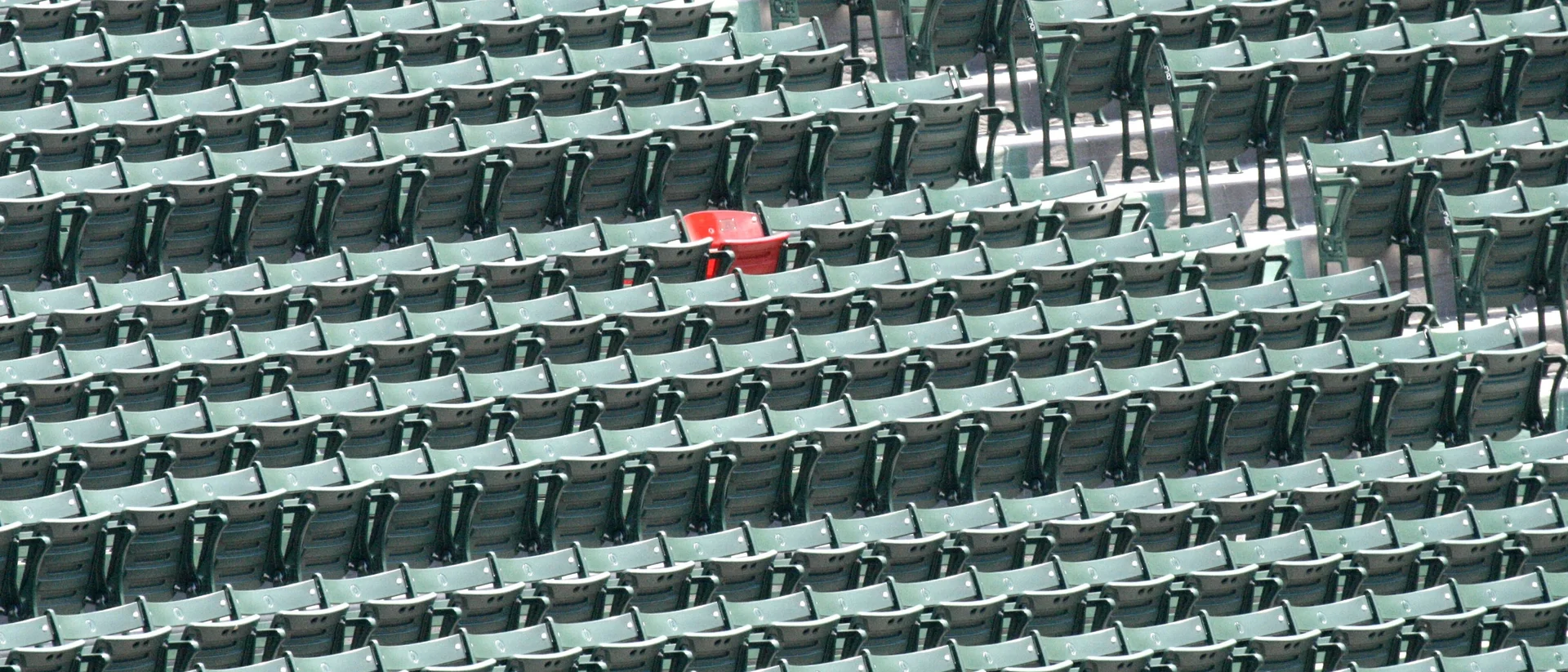
Fenway Park's right-field bleachers are all green, except one. That single red seat marks a home run by Ted Williams. He hit it on June 9, 1946. The blast was officially marked at 502 feet, the longest homer ever hit inside the park. The ball crashed into a fan's straw hat before he ever saw it coming.

Why Fenway Park Has Exactly One Red Seat

Posted 10 days agoUpdated 8 minutes ago

Walk into the right-field bleachers at Fenway Park and every seat is the same shade of forest green, row after row after row. Except one. Section 42, Row 37, Seat 21 is painted bright red, and it has nothing to do with decor.

A Seat That Shouldn't Exist

The lone red seat marks the exact spot where Ted Williams hit the longest home run in Fenway Park's history. It happened during a doubleheader against the Detroit Tigers on June 9, 1946, in front of a capacity crowd of over 33,000 fans. The ball cleared the bullpen, sailed deep into the bleachers, and kept going.

The Fan Who Never Saw It Coming

Sitting in that exact seat was Joseph A. Boucher, a construction engineer visiting the bleachers for the first time. The ball struck the crown of his straw hat before bouncing another dozen rows up the stands. Boucher was treated for his injury and later told reporters, "I couldn't see the ball. Nobody could. The sun was right in our eyes. All we could do was duck." He was also credited with a line that has followed the seat ever since: "How far away must one sit to be safe in this park?"

How Far Did It Really Go?

The Red Sox measured the landing spot after the game and announced a distance of 502 feet, still the figure officially associated with the seat today. That number has never been fully settled. Newspapers the next morning estimated the ball at closer to 450 feet, while modern analysts using period weather data and physics models have argued it may have traveled even farther, with some estimates topping 525 feet before Boucher's hat got in the way. Whatever the true number, it remains the longest home run ever measured inside the ballpark.

Painted Red Almost 40 Years Later

The seat itself wasn't marked for decades. In 1984, the Red Sox painted it red to permanently flag the landing spot for anyone touring the park. It has since become one of Fenway's most photographed features, a single red square in an ocean of green that stops visitors mid-stride every time they spot it.

Nobody Has Matched It Since

Left-handed sluggers have spent decades trying to reach that seat again. No one has. The distance, the era, and a straw hat that happened to be in exactly the wrong place all came together once, on one afternoon in 1946, and Fenway Park has never let anyone forget it.

Enjoyed this? Get a new fact every day.

Follow FunFactz for the best ones in your feed.

or get one in your inbox

Frequently Asked Questions

Where is the red seat at Fenway Park?
It is Section 42, Row 37, Seat 21 in the right-field bleachers. It is the only seat in that sea of green bleacher seats that is painted red.
Why is there a red seat at Fenway Park?
It marks the landing spot of a home run Ted Williams hit on June 9, 1946, officially marked at 502 feet, the longest home run ever recorded inside Fenway Park. The Red Sox painted the seat red in 1984 to commemorate the spot.
How far did Ted Williams home run actually travel?
The Red Sox announced 502 feet after the game, though next-day newspaper estimates put it closer to 450 feet. Modern analysts using period weather data have argued the true distance may have topped 525 feet.
Who was hit by Ted Williams home run ball?
Joseph A. Boucher, a construction engineer sitting in the bleachers for the first time, was struck on the crown of his straw hat by the ball. He was treated for his injury and returned to watch the rest of the game.
When was the Fenway Park red seat painted?
The Red Sox painted the seat red in 1984, nearly 40 years after Ted Williams home run landed there in 1946.

Verified Fact

This fact has been reviewed and verified against original sources.

Source: SABR (Society for American Baseball Research)
Show verification details

Independently audited 2026-07-02 by fact-verifier. Primary source read in full: SABR Games Project (sabr.org Corroborated with row37seat21.com, fenwayfanatics.com, MLB.com and weather.com search snippets (Gemini CLI unavailable - IneligibleTierError/deprecated client - substituted exhaustive manual claim-by-claim comparison instead). Claims checked: seat location Section 42/Row 37/Seat 21 CONFIRMED; June 9 1946 Detroit Tigers doubleheader Game Two CONFIRMED; 502 feet officially announced CONFIRMED and correctly hedged (officially marked, never absolute) per precision flag; 450-foot next-day newspaper estimate CONFIRMED (Globe/Detroit Free Press per SABR); 525+ foot modern estimate CONFIRMED and conservative (actual range 525-535 per lidar/ESPN Home Run Tracker/Alan Nathan - fact says topping 525, does not overstate to 535); the before-hat-got-in-the-way framing CONFIRMED accurate (ESPN Home Run Tracker 530ft estimate is explicitly the trajectory-implied distance had the ball not hit Boucher, who was struck ~30ft above ground); Joseph A. Boucher construction engineer first time in bleachers straw hat crown struck CONFIRMED word-for-word; both Boucher quotes CONFIRMED VERBATIM exact match to SABR (How far away must one sit to be safe in this park / I could not see the ball Nobody could The sun was right in our eyes All we could do was duck); 33 rows deep into bleachers CONFIRMED exact match to SABR (33 rows past the fence); bouncing another dozen rows up the stands CONFIRMED exact match to independent source; Boucher treated then returned to seat CONFIRMED; seat painted red in 1984 by Red Sox owner Haywood Sullivan CONFIRMED multiple independent sources; the no one has matched it since closer CONFIRMED as a real sourced substantive payoff, not filler. Numeric coherence checked across text/article/faqs/social_engagement_comment - no contradictions. Citation fidelity: source_url is the SABR page specifically about this home run, directly supports every headline specific. No reversed agency found. engine=2, proof_photo_strength=2 both honest per Engine-1 bar (Williams/Fenway genuinely ARE the story, real widely-photographed proof image exists); mainstream_novelty=2 reasonable, no strong evidence to downgrade. Discrepancies found: none. NOVELTY CORRECTION (post-audit, advisor review): mainstream_novelty downgraded 2->1. The bare one-red-seat/502ft fact already circulates as viral did-you-know content (a Baseball In Pics X/Twitter post covering this exact angle surfaced in verification WebSearch) - this is chronically-online-adjacent, not fresh. The Boucher straw-hat/dozen-rows-bounce/contested-450-vs-525ft-distance details ARE a fresher, less-circulated hook, which is why this is graded borderline (1) rather than a hard veto (0). Flag for social-manager: treat as borderline novelty when ranking for prime slots, weight the Boucher-hat/distance-dispute framing over the bare red-seat framing if used as a monster/prime post.

Related Topics

More from Places & Culture

View all Places & Culture