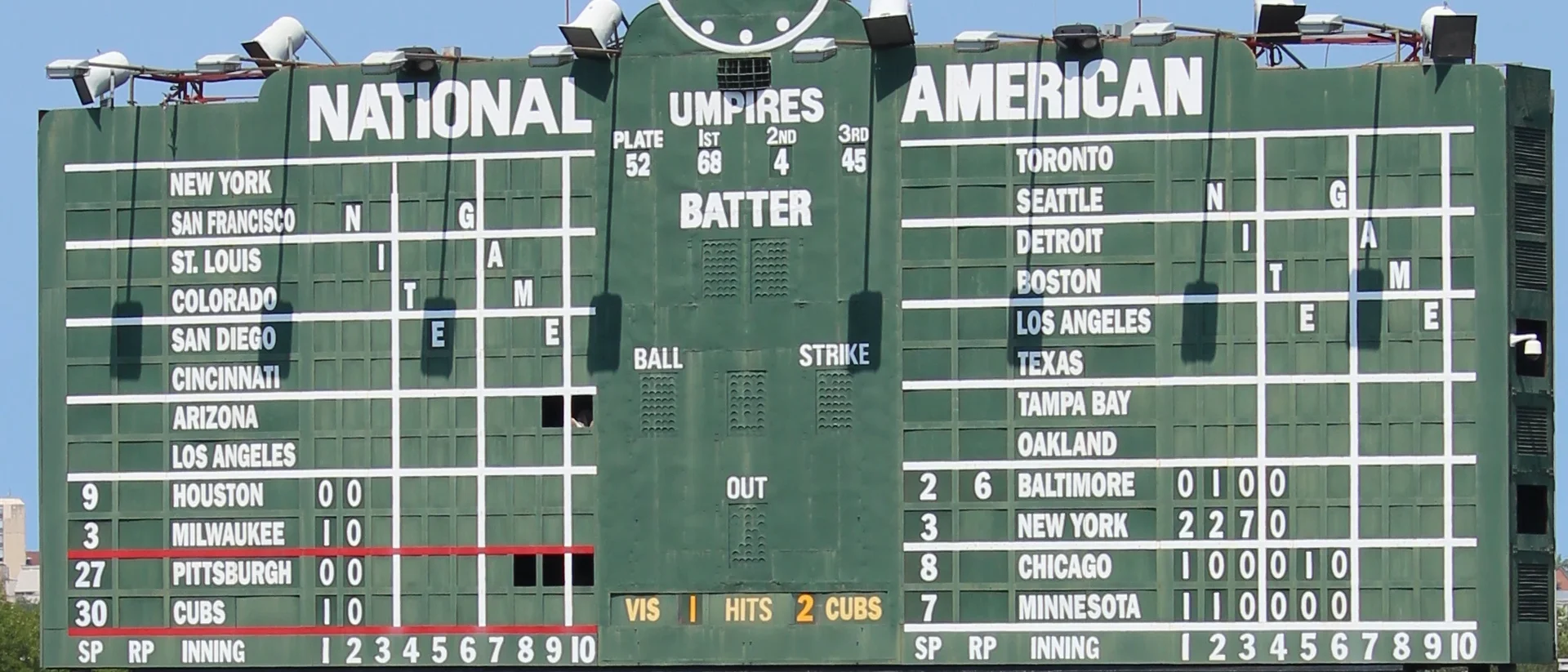
Wrigley Field's scoreboard is a giant board that has loomed over the bleachers since 1937. No batted baseball has ever struck it, the Cubs say, not even Roberto Clemente's legendary blast. A golf ball did. On April 17, 1951, Sam Snead hit two balls off the grass at home plate, no tee. His first shot struck the board. His second cleared it clean. Frankie Frisch just stared. "Look, he didn't even wiggle."

The Wrigley Scoreboard No Baseball Has Ever Hit

Posted 1 day agoUpdated 6 minutes ago

Wrigley Field's center-field scoreboard has loomed over the bleachers since 1937, mounted well above field level rather than at ground height. In more than eight decades of major league baseball, the Cubs say no batted ball has ever reached it. A golfer got there before some Cubs hitters even finished batting practice.

A Board No Hitter Has Touched

The scoreboard sits high above the center-field bleachers, a position that makes it far harder to hit than a wall-mounted board would be.

The closest anyone has come with a bat is still talked about. Roberto Clemente's towering home run during a doubleheader on May 17, 1959, is generally considered the longest in Wrigley Field history. It sailed just to the side of the scoreboard rather than into it.

Cubs outfielder Bill Nicholson is also remembered for a near miss of his own. Neither he nor Clemente, nor anyone else swinging a bat, has ever actually struck the board.

The Golfer Who Stopped By

On April 17, 1951, Sam Snead was in Chicago for a very different reason. The golfing great had broken his wrist over the winter, and a doctor in the city was checking how it had healed.

Snead stopped by Wrigley Field on the Cubs' Opening Day, where a crowd of 18,211 had gathered to watch the Cubs take on the Cincinnati Reds. He decided to find out whether a golf ball could clear the scoreboard from home plate.

He had no tee. He played both shots straight off the grass, in his street clothes.
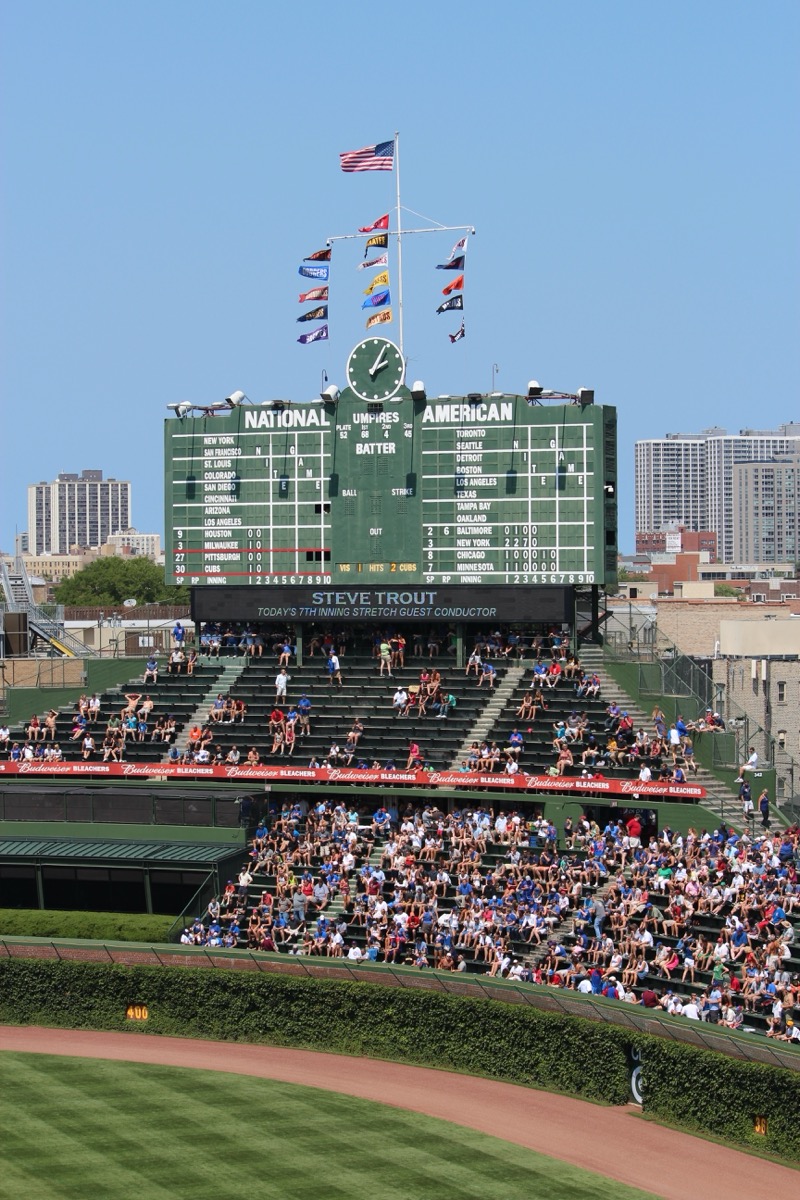
Wide view of Wrigley Field's center-field scoreboard towering above the outfield bleachers, showing its height and position relative to the playing field
The scoreboard has stood above the bleachers since 1937, and no batted baseball has ever reached it.

Two Swings, One Record

Snead's first shot struck the scoreboard. His second cleared it completely, sailing over the top in front of the Opening Day crowd.

The Cubs' Frankie Frisch had one reaction.

"Look, he didn't even wiggle," Frisch said, according to a Chicago Tribune account of the day.

The Tribune's reporter, Edward Burns, described the board as 89 feet high that day, towering well above anything a batter could reach from the plate.

A Forgettable Season, an Unforgettable Shot

The Cubs beat the Reds that afternoon, but the good feeling didn't last. Chicago finished the 1951 season with 92 losses, and Snead's two golf swings remained the highlight of the year.

The scoreboard is still standing today, still hand-operated by workers inside it, and still waiting for the first baseball to reach it. So far, only a golfer has ever managed the shot.

Enjoyed this? Get a new fact every day.

Follow FunFactz for the best ones in your feed.

or get one in your inbox

Frequently Asked Questions

Has any baseball ever hit the Wrigley Field scoreboard?
According to the Chicago Cubs, no batted ball has ever struck the center-field scoreboard since it was installed in 1937. The closest calls include Roberto Clemente's towering 1959 home run and a near miss by Bill Nicholson, but neither actually reached the board.
When was the Wrigley Field scoreboard built?
The hand-operated scoreboard has stood above Wrigley Field's center-field bleachers since 1937 and has only had minor technical and cosmetic changes since then.
Did Sam Snead really hit a golf ball over the Wrigley Field scoreboard?
Yes. On April 17, 1951, before the Cubs' home opener, golf great Sam Snead hit two balls from home plate without a tee. His first shot struck the scoreboard and his second sailed completely over it, according to a Chicago Tribune account of the day.
How tall is the Wrigley Field scoreboard?
A 1951 Chicago Tribune report described the board as 89 feet high. It is also mounted above the outfield bleachers rather than at ground level, which adds to the difficulty of a batted ball ever reaching it.
Why was Sam Snead at Wrigley Field in 1951?
Snead was in Chicago to have a doctor examine a wrist he had broken over the winter. He stopped by the ballpark on the Cubs' Opening Day and decided to test whether a golf ball could clear the scoreboard, in front of a crowd of 18,211 fans.

Verified Fact

Verified equal

Source: Bleed Cubbie Blue (Chicago Tribune archive)
Show verification details

Audited 2026-08-23 (fact-verifier independent pass, creator self-check superseded). Primary source read in full via Wayback Machine (bleedcubbieblue.com/2013/12/13/5203818, direct fetch 403d, snapshot 20231130175953 pulled): quotes contemporaneous Apr 17 1951 Chicago Tribune account by Edward Burns verbatim. Secondary: Wikipedia Wrigley Field article (scoreboard section). Claims checked against Tribune quote: (1) scoreboard 89 foot high per Tribune CONFIRMED verbatim ("89 foot high center field scoreboard"), correctly attributed to the 1951 report not asserted as a modern figure. (2) Two-swing sequence CONFIRMED and NOT reversed: first swing (four iron, unnamed in our copy) struck the board, second (two iron, unnamed in our copy, no tee) cleared it -- Tribune: "Snead first tried a four iron and the ball hit the target. Then Sam, again without benefit of a tee, used a two iron and the ball cleared the board." Confirmed NO golf club model is named anywhere in text/article/FAQs/social fields (correct per brief; the DB row's own verification_notes rationale says clubs are "unpinned across accounts" which is not quite right -- the Tribune is specific and unambiguous on four-iron-then-two-iron -- but since neither club is named in any output field this is a non-issue, just flagging the inaccurate internal rationale for the record). (3) Frankie Frisch quote "Look, he didn't even wiggle" CONFIRMED verbatim, correctly attributed to Frisch (Cubs). (4) 18,211 attendance CONFIRMED verbatim ("modest crowd of 18,211"). (5) Street clothes, no tee CONFIRMED ("He made the drive in his street clothes" / "again without benefit of a tee" implies first swing was also without a tee). (6) Cubs beat Reds 6-2, 1951 season 92 losses (article body) CONFIRMED verbatim. (7) Scoreboard installed 1937, hand-operated ("number turner... manually replacing the numbers"), mounted above bleachers not at ground level, and only minor technical/cosmetic changes since (Wikipedia: "has only seen minor technical and cosmetic modifications") all CONFIRMED, including through the 2010 1060 Project rehab. (8) No batted ball has ever hit it, phrased as the Cubs claim, with Clemente (1959) and Nicholson (1942) near misses -- CONFIRMED via Wikipedia ("No players have hit the current scoreboard"; near misses Clemente, Nicholson, Eddie Mathews). One unconfirmed but low-stakes detail: "hit two balls off the grass at home plate" (text/article/FAQ3/social_engagement_comment) is not explicitly stated in the Tribune excerpt or Wikipedia -- plausible and consistent with the confirmed no-tee detail, and not contradicted anywhere, but I could not independently corroborate the precise staging (home plate location) in this session (WebSearch budget exhausted, MLB.com cut4 piece 403-blocked with no Wayback snapshot available). Recommend treating as medium-confidence on that one clause only; does not affect agency, numbers, or the central claim. social_caption softens "a wrist he had broken over the winter" to "a sore wrist" -- reasonable, not misleading, by April the wrist would still plausibly be tender. Numeric coherence: all figures (1937, 1951, 89 ft, 18,211, 1959/1942 near-misses, 6-2 final, 92 losses) internally consistent and match source, no arithmetic required. Citation fidelity: source_url (bleedcubbieblue.com) directly supports every headline specific -- named person, date, quote, height figure, attendance. Strong citation, no correction needed. Reversed-agency check: none found anywhere (text, article, FAQs, caption, engagement comment, link comment) -- shot order (hit then clear) consistent throughout. Format/gate checks: no emdashes in any field. text (406c) = social_text (430c) with **markers** stripped, verified equal. social_text 430c -- within hard-stop 450 but above the 420 soft target, not a fail. Caption uses proper blank-line paragraph breaks (SQL regex check passed). Caption opener ("A golfer once did something...") differs from social_text opener ("Wrigley Field's scoreboard is..."). Named-object referent test (Aug 16 gate) PASSES: sentence one plainly defines the scoreboard as "a giant board that has loomed over the bleachers since 1937" for a reader who has never heard of it. Share-craft: final sentence lands on a human reaction/quote (Frisch), not logistics; human agents are the sentence subjects throughout; clear turn ("A golf ball did") and escalation (first hit, second cleared) present. Tier/engine field police: tier=SOLID sanity-checked and confirmed appropriate (pf=1 borderline -- no real action photo of the 1951 moment exists, pre-broadcast era -- keeps this out of MEGA territory despite a workable detonator and engine=2 recognizability; SOLID is the honest call, not FILLER, since nov=2 and bf=2 both pass cleanly and engine=2 is defensible: Snead IS the story, not name-dropped trivia). engine=2 confirmed reasonable -- Snead (PGA record 82 wins, Hall of Fame, still a widely-referenced golf name) is the protagonist of the entire narrative, matching the Engine-1/2 structural test even though his modern name recognition among 25-44 FB audience is lower than a current celebrity. nov=2, pf=1, bf=2 all left as graded, no downgrade needed. Tone/fun-brand: wholesome/funny sports trivia, no downer, no demonetization-risk subjects. No fun-brand or CWR flag. Confidence: HIGH on core narrative (agency, quotes, numbers, dates all verified against primary source read in full); MEDIUM on the single home-plate/grass staging clause noted above. Discrepancies found: none material. Fact passes independent audit. ADDENDUM: proof_photo_strength and beat_freshness were NULL in the DB row at audit time (creator report claimed pf=1/bf=2 but never wrote them) -- passes_vetoes was silently false due to the null-coalesces-to-0 generated-column bug. Set proof_photo_strength=1, beat_freshness=2 to match the sanity-checked grading above; passes_vetoes now correctly reads true. mainstream_novelty=2 and engine=2 were already correctly set by the creator.

Related Topics

More from Places & Culture

View all Places & Culture