
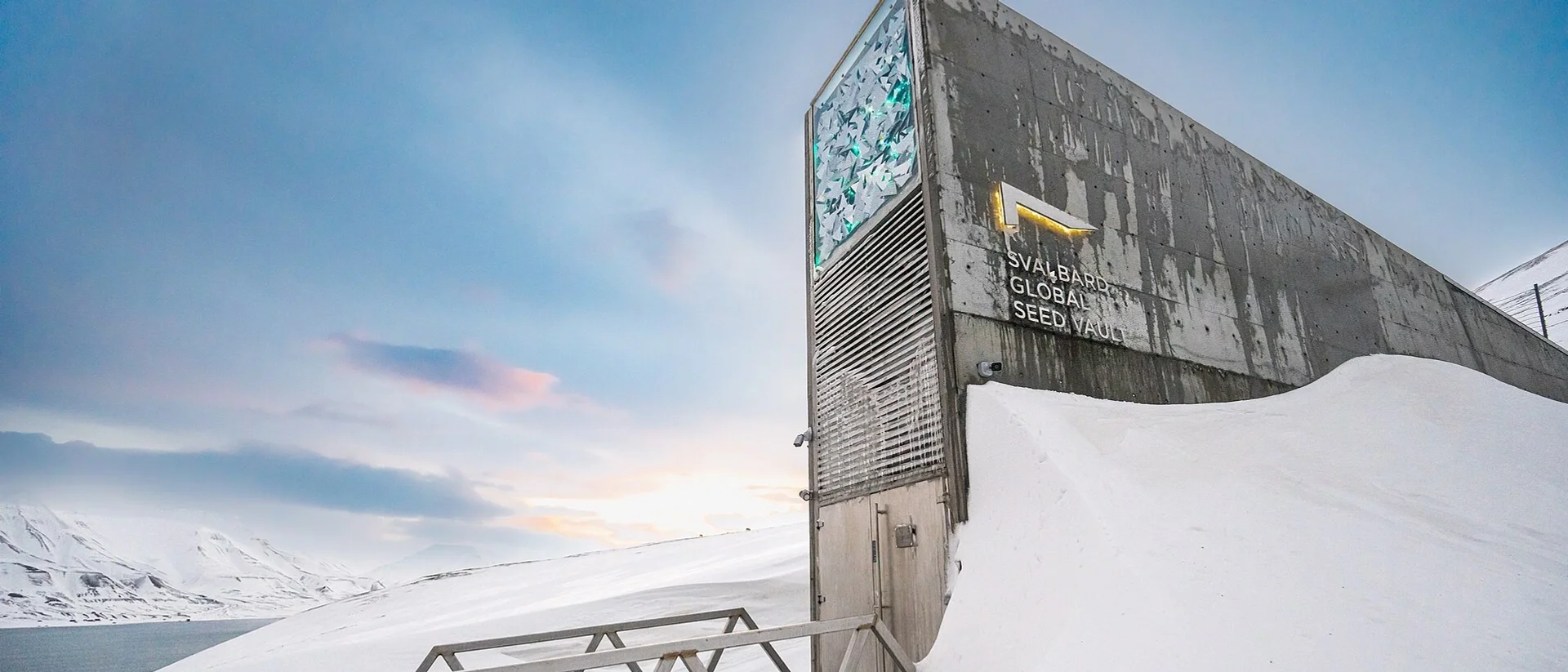
The Svalbard Global Seed Vault is drilled over 100 metres into an Arctic mountain in Norway, keeping more than 1.3 million seed samples frozen - even if the power fails, the permafrost keeps them safe. Syria's conflict made the Aleppo seed bank inaccessible - and researchers made the first-ever withdrawal to rebuild it.
The Doomsday Vault Has Already Been Used Once
There is a vault drilled into an Arctic mountain on a Norwegian island so remote it sits closer to the North Pole than to Oslo. It holds more than 1.3 million seed varieties, contributed by nearly every country on Earth, as a last resort against the collapse of the world's food supply.
Drilled Into Permafrost on Purpose
The Svalbard Global Seed Vault opened on 26 February 2008 on the island of Spitsbergen. The vault chambers sit more than 100 metres inside the Platafjellet mountain, beneath 40 to 60 metres of solid rock.
That depth was chosen deliberately: the surrounding permafrost holds a natural temperature of around minus 3 or 4 degrees Celsius without any mechanical help. Active refrigeration keeps seeds at a constant minus 18 degrees, but if power ever fails, the permafrost provides a long-term backup.
The mountain itself keeps the seeds safe.
The vault has capacity for 4.5 million seed varieties - roughly double what is stored today. Every depositing country retains ownership of its own seeds.
Svalbard is simply the safest address on the planet.
What the World Is Protecting Against
Every major food crop - wheat, rice, barley, maize, legumes - exists in thousands of genetic varieties developed over centuries by farmers across the world. Most of those varieties are held in national seed banks.
If conflict, disease, drought, or a power failure destroys a seed bank, that genetic diversity is gone. The Svalbard vault is the duplicate copy: a backup for the world's backups.
The facility is a joint project of the Norwegian government, the Nordic Genetic Resource Centre (NordGen), and the Crop Trust, an independent organisation funded by governments and foundations to safeguard crop diversity permanently.
The First Withdrawal: ICARDA and the Seeds from Aleppo
The vault had never been designed to open quickly. Then the worst happened.
The International Centre for Agricultural Research in the Dry Areas (ICARDA) had operated a major seed bank near Aleppo, Syria, holding hundreds of thousands of crop varieties adapted to dryland farming across the Middle East and North Africa.
As Syria's conflict intensified, the Aleppo facility became inaccessible. ICARDA made the first-ever withdrawal from the Svalbard vault in 2015, retrieving seeds to replant and restore at new facilities in Lebanon and Morocco.
It was the first real test of what the vault was built for - and it worked. ICARDA has since regenerated the collection and re-deposited it back into Svalbard.
Proven Infrastructure
The Svalbard vault was built on the assumption that the worst might happen one day. Nobody predicted how soon.
Within seven years of opening, it had already served its core purpose - returning seeds to a region torn apart by conflict so that farmers could eventually rebuild their fields.
The structure drilled into the Arctic is not just a symbol of foresight. It is proven infrastructure for civilisation's long game.
Enjoyed this? Get a new fact every morning.
A fascinating fact in your inbox every morning. Free. Unsubscribe anytime.
Frequently Asked Questions
Where is the Svalbard Global Seed Vault located?
How many seeds are in the Svalbard Global Seed Vault?
Why is it called the Doomsday Vault?
Has anyone ever withdrawn seeds from the Svalbard Seed Vault?
Does the Svalbard Seed Vault need power to keep seeds frozen?
Verified Fact
Verified Jun 21, 2026 · 4 sources checked
Source: Crop TrustShow verification details
Claims checked
- Located over 100 metres inside an Arctic mountain in Norway
- Holds more than 1.3 million seed samples as of 2024
- Stays frozen via permafrost if power fails, though active cooling is used (corrected from "no power required")
- Syrian conflict made the Aleppo seed bank inaccessible, not destroyed (corrected)
- First-ever withdrawal in 2015 re-established seeds in Lebanon and Morocco
Sources: Crop Trust, Seed Vault (Svalbard), Wikipedia