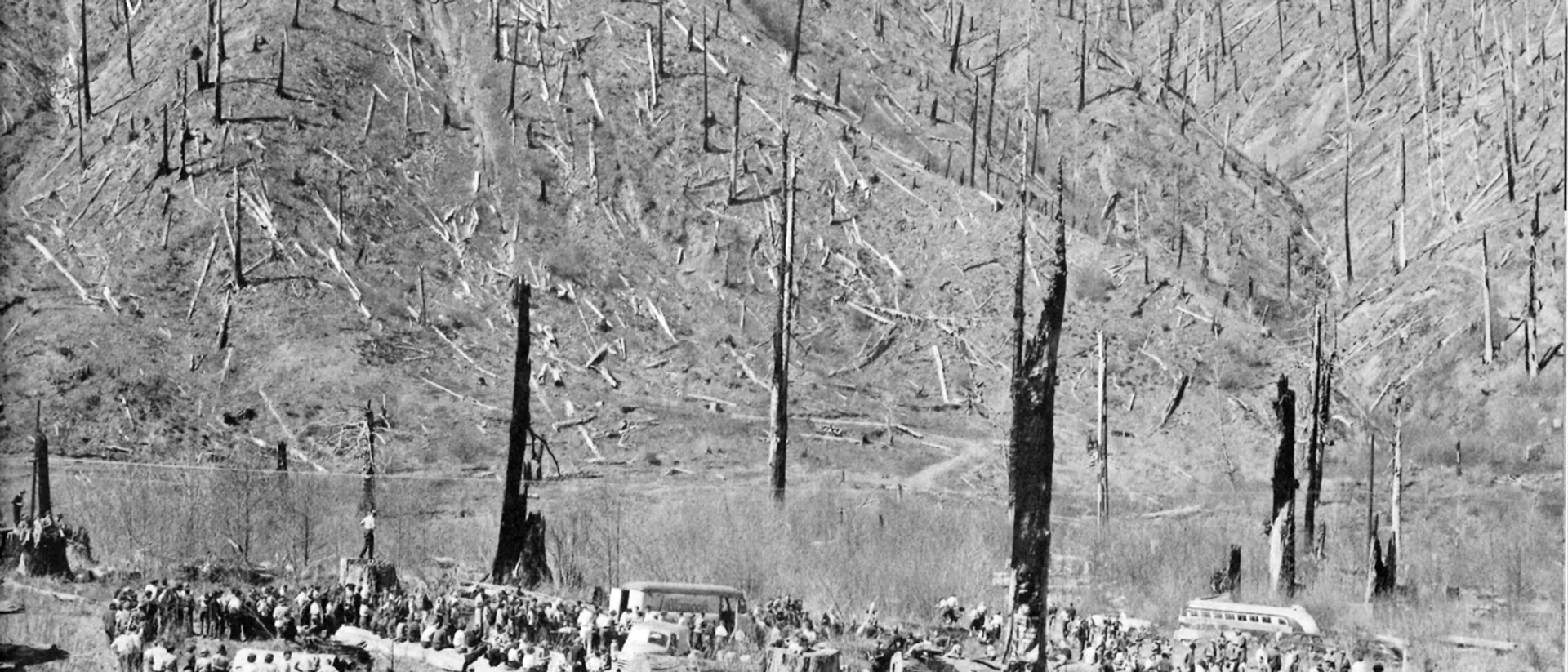
Oregon's Coast Range forest was written off as dead for good after repeated wildfires. Some believed the land was too damaged to ever grow trees again. Oregonians proved them wrong. Between 1949 and 1972, crews hand planted 72 million seedlings. Schoolchildren bused in planted nearly a million of those trees themselves. In 1973, Governor Tom McCall stood in the regrown forest and renamed it Tillamook State Forest.
This Oregon Forest Was Written Off as Dead for Good
By the late 1940s, the hills west of Portland looked like the surface of the moon. Bare grey snags stood for as far as anyone could see, the remains of a landscape that had burned not once but four times in eighteen years.
A Fire That Outran Everyone Fighting It
The first and largest fire started just after noon on August 14, 1933, in a logging operation above the North Fork of Gales Creek, near Forest Grove.
Investigators later traced the cause to friction, generated when a large Douglas-fir log was dragged across a downed tree at the end of a railroad spur. The temperature that day hit 104 degrees, with humidity around 20 percent, in a forest that was tinder dry.
Within an hour the fire had burned through sixty acres of logging debris. Within ten days it had spread across 40,000 acres.
Then, on the evening of August 24, strong east winds pushed the fire to 240,000 acres in twenty hours, one of the fastest rates of forest fire growth ever recorded in the 20th century. The smoke column rose eight miles into the sky and was visible across western Oregon and Washington.
Several thousand firefighters, including loggers, farmers and men from the Civilian Conservation Corps, worked to stay ahead of it. Rain finally stopped the fire's spread on September 5, by which point it had burned about 350,000 acres.
The Same Ground, Burning Again
The dead, dried-out trees left behind became fuel for the next fire. It came in 1939, burning 190,000 acres, most of it ground the 1933 fire had already scorched. Two more fires followed in 1945, burning 180,000 acres, and a final pair in 1951 burned 32,000 acres.
Every one of the four fires started in a logging operation. By the time it was over, locals across the region simply called the scarred area "The Burn."
Too Damaged to Ever Grow Back
Looking at the repeated destruction, some concluded the land had been burned so many times, and so severely, that it would never again support a forest.
Many of the private landowners agreed, in effect, by giving up. Already wiped out by the Depression and the fires, they let their property taxes go delinquent, and ownership passed to the counties.
Through the 1940s and 1950s, Yamhill, Washington and Tillamook counties transferred the land to the state of Oregon in exchange for a share of future timber revenue, an arrangement that still governs the forest today.
72 Million Seedlings, Planted By Hand
The Oregon Department of Forestry decided the land was worth saving anyway. Between 1949 and 1972, crews hand planted more than 72 million seedlings across the burned hillsides, using every method available, including newly designed helicopters.
Helicopters alone scattered roughly a billion Douglas-fir seeds across the burn.
The Kids Who Helped Regrow a Forest
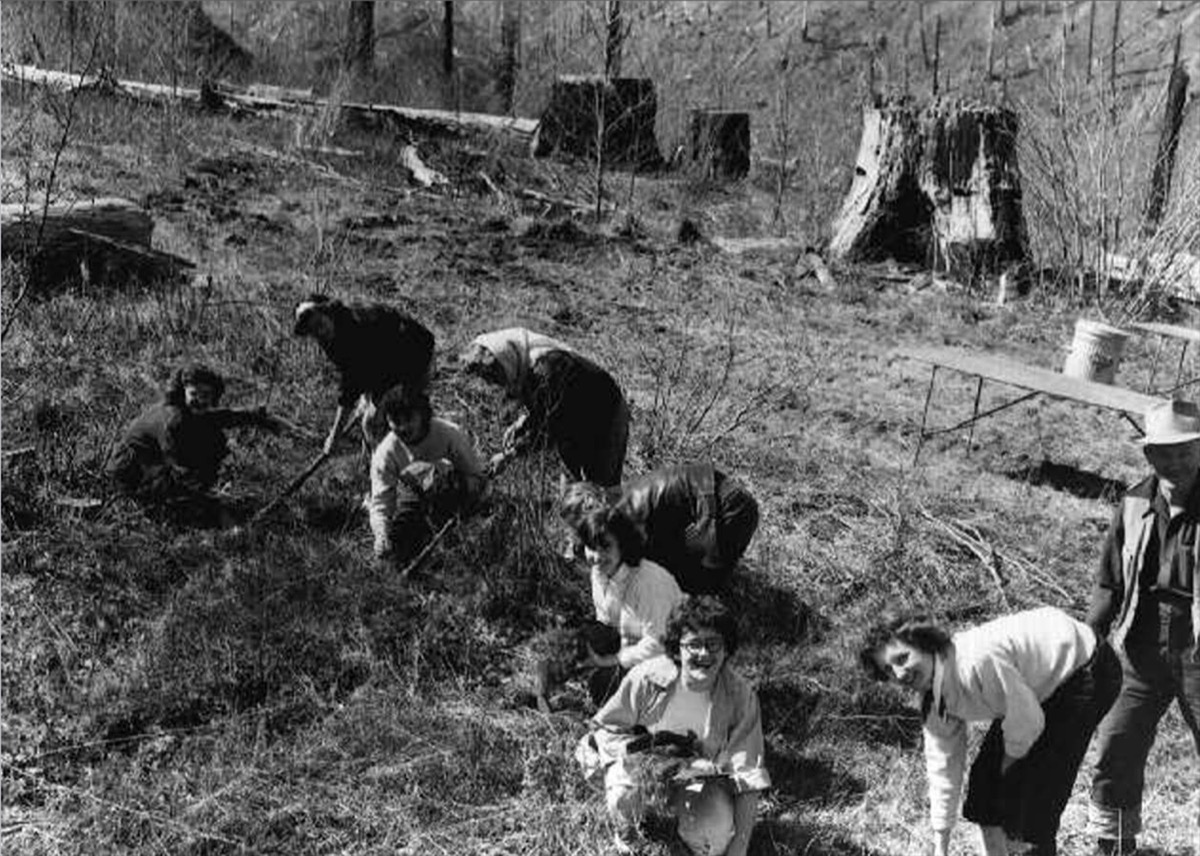
Some of the planting was done by schoolchildren. Buses brought young people in from across northwest Oregon to spend the day on the hillsides, and by the time the program wound down, they had planted almost a million seedlings themselves.
The fires and the decades-long recovery that followed shaped the memory of the region for two generations. It turned up everywhere, from collectible coins and campfire songs to children's books about the forest.
A Governor Renames the Forest
In June 1973, Oregon Governor Tom McCall visited the site to mark the end of the reforestation effort. Standing before a crowd of tree planters, foresters and state officials, he announced that the land would no longer be known as the Tillamook Burn.
From that day forward, it would be called the Tillamook State Forest.
What's Left to See
Visitors today have to look hard to find any trace of the fires. The forest that hikers, campers and mushroom hunters walk through now is the same one that was once written off for good, grown back one seedling at a time by people who refused to accept that verdict.
Frequently Asked Questions
What was the Tillamook Burn?
How many trees were planted to restore the Tillamook Burn?
Did schoolchildren really help replant the forest?
When did the Tillamook Burn become Tillamook State Forest?
Why did people think the land could never recover?
Verified Fact
Verified Aug 9, 2026 · 3 sources checked
Source: Oregon Encyclopedia (Oregon Historical Society)Show verification details
Claims checked
- 72 million seedlings hand planted between 1949 and 1972
- Schoolchildren planted nearly a million of those seedlings
- Governor McCall renamed it Tillamook State Forest in June 1973
- 1933 fire grew from about 40,000 to 240,000 acres in 20 hours (earlier version said it grew by 240,000 acres)
Sources: Oregon Encyclopedia (Oregon Historical Society), Wikipedia, Tillamook Forest Center