The U.S. Capitol has run its own private underground subway since March 1909. The original cars were lemon-yellow Studebakers that held eight senators and took just 45 seconds to cover a 760-foot tunnel. It still runs today - and the public cannot get on without a congressional escort.
The Secret Subway Under the U.S. Capitol
Below the marble floors of the U.S. Capitol, a small electric railway has been carrying senators since the era of top hats and horse-drawn carriages - and it is still running right now.
Two Lemon-Yellow Cars, One Short Tunnel
When the Russell Senate Office Building opened in 1909, senators needed to reach the Capitol chamber fast when a vote was called. Capitol Superintendent Elliott Woods arranged for two custom-built, battery-powered cars from the Studebaker Company - the same firm famous for wagons and automobiles.
The cars were painted lemon yellow, each held eight passengers, and featured an operator on a reversible center seat so the car never needed to turn around.
The Senate Subway opened on March 7, 1909, linking the office building to the Capitol via a 760-foot underground tunnel. The ride took 45 seconds.
From Wicker Seats to Automated Trains
The Studebaker cars lasted only three years. In 1912, a double-track electric monorail with wicker seats took over, carrying up to 18 passengers at a stretch.
Two of those monorail cars were built at the Washington Navy Yard - one in 1915, one in 1920 - and ran for decades.
Today the system serves multiple buildings. The Hart and Dirksen Senate Office Buildings are connected by automated trains on a 90-second schedule.
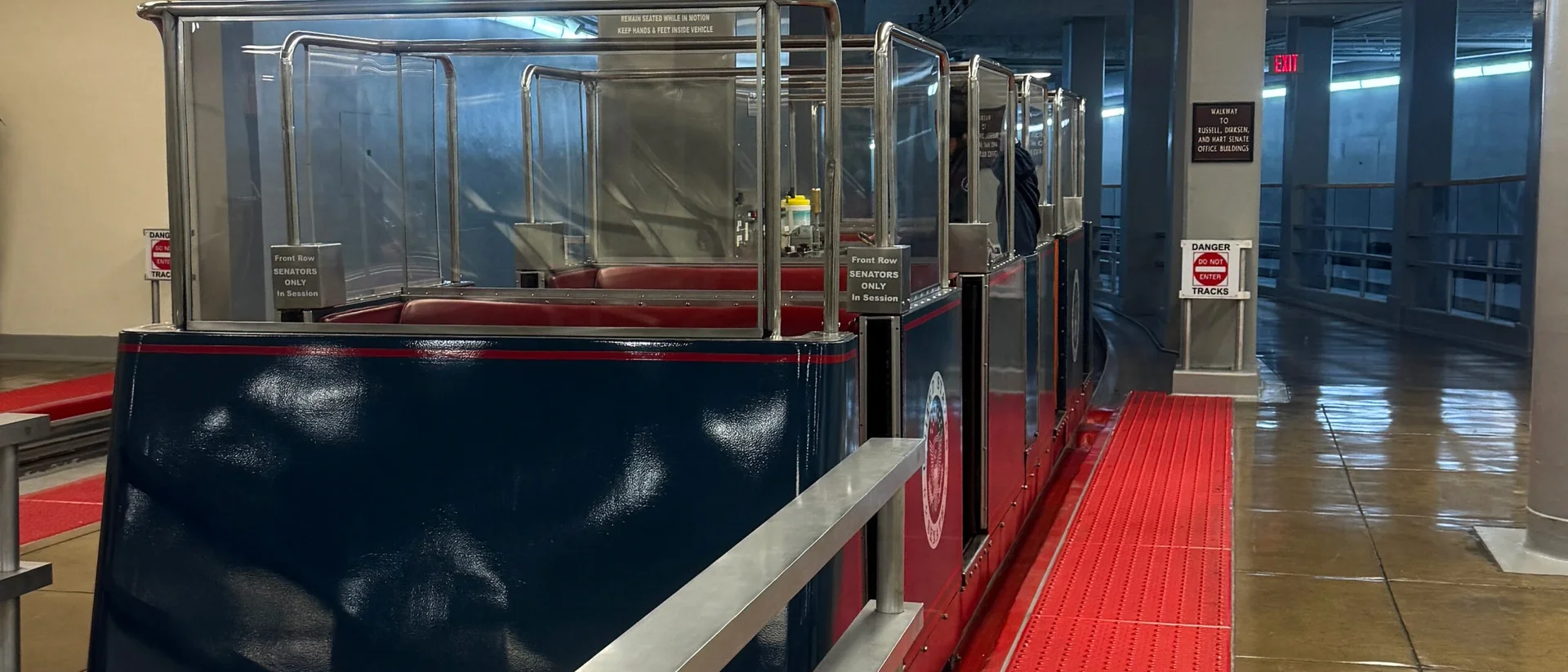
The original Russell line still uses open-sided trams driven by a human operator. A separate House line connecting the Rayburn House Office Building to the Capitol opened in 1965.
Members Only - Unless You Know Someone
The subway exists for one purpose: getting lawmakers to the chamber floor before a vote closes. During active Senate votes, the cars are restricted to members and authorized staff only.
There is no public ticket counter, and visitors cannot simply board. The only route in is a constituent meeting with a senator or representative - if their staffer agrees to escort you with proper identification, you may get a ride.
For most Americans, the closest they will come is watching C-SPAN footage of senators sprinting for the tunnel when a vote bell rings.
116 Years and Still Running
The Capitol subway has operated continuously since 1909 - through two world wars, the Cold War, and every political upheaval since.
The open-sided Russell line cars, now painted blue and red with the U.S. Senate seal, still cover the same short tunnel where lemon-yellow Studebaker cars first rolled on March 7, 1909.
It is one of the oldest continuously operating legislative transit systems in the world. The ride still takes about 45 seconds.
And unless you have a connection on Capitol Hill, you are not getting on.
Frequently Asked Questions
When did the U.S. Capitol subway system open?
Can the public ride the U.S. Capitol subway?
What were the original Capitol subway cars like?
How long does the Capitol subway ride take?
Which buildings does the Capitol subway connect?
Verified Fact
Verified Jun 17, 2026 · 4 sources checked
Source: Wikipedia / U.S. SenateShow verification details
Claims checked
- Opened March 7, 1909, with lemon-yellow Studebaker cars
- Cars held 8 passengers, took 45 seconds over a 760-foot tunnel
- Public still needs a congressional escort to ride
- 1947 Bricker shooting date confirmed; he was inside the car when fired upon
Sources: Wikipedia, The Autopian, The Hill is Home, Ghosts of DC