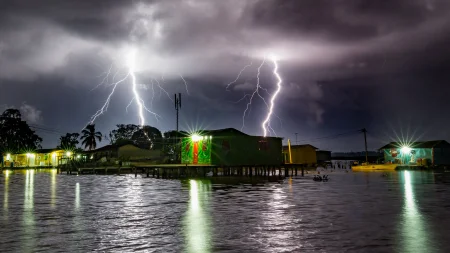
The bright flash of lightning you see actually travels upward from the ground. While invisible downward 'stepped leaders' descend from clouds, the brilliant 'return stroke' that creates the visible lightning bolt travels from ground to sky at one-third the speed of light.
Lightning Strikes Up: The Return Stroke Revelation
Everything you think you know about lightning is backwards. That brilliant white-hot bolt splitting the sky? It's racing upward, not downward. The visible lightning strike is actually the grand finale of an invisible electromagnetic dance between earth and sky.
The Invisible Prelude
Before you see anything, a faint electrical channel called a stepped leader creeps down from the thundercloud at about 150 kilometers per second. It's dim, branching, and completely invisible to your eyes. As this leader descends, it's essentially asking the ground: "Anyone down there want to complete this circuit?"
When the leader gets within 15-50 meters of the surface, the ground shouts back. Positive charges begin streaming upward in what scientists call upward streamers. Tall trees, buildings, telephone poles—anything that sticks up—starts launching these streamers skyward. It's an electromagnetic auction, and the winner gets struck by lightning.
The Flash You Actually See
The moment a streamer connects with the stepped leader, the sky short-circuits to the ground. In that instant, a massive current explodes upward along the channel. This is the return stroke—and it's what your eyes perceive as lightning.
The return stroke is ridiculously fast and hot:
- Speed: 100,000 kilometers per second (one-third the speed of light)
- Peak current: typically 30,000 amperes, sometimes exceeding 200,000 amperes
- Temperature: 30,000°C—five times hotter than the surface of the Sun
- Duration: reaches the cloud base in about 100 microseconds
That superheated channel explosively expands the surrounding air, creating the thunderclap you hear seconds later.
Why the Confusion?
For centuries, humans assumed lightning traveled from cloud to ground because that's the direction it seems to move. The downward stepped leader is so dim that we don't see it. The upward return stroke is so bright and fast that our brains process it as a singular downward flash.
High-speed cameras finally revealed the truth in the 20th century. When you slow lightning down to thousands of frames per second, you can see the faint leader descending, then the brilliant return stroke racing upward.
Recent research from 2025 found that stepped leaders actually speed up as they approach the ground—increasing velocity by an average of 69% near the surface. The faster the leader, the more powerful the return stroke. It's as if the lightning knows it's about to hit and accelerates for maximum impact.
True Upward Lightning
There's also a rare phenomenon where lightning genuinely starts at the ground and travels only upward. This happens from extremely tall structures like skyscrapers or mountain peaks, usually triggered right after a nearby downward strike. These upward propagating discharges skip the stepped leader phase entirely and launch directly skyward.
So the next time you see a lightning bolt, remember: you're watching electricity explode upward at 100,000 kilometers per second, heating the air to temperatures that would vaporize steel in microseconds. The sky doesn't strike the earth—the earth strikes back.
Frequently Asked Questions
Does lightning really travel from the ground up?
How fast does lightning travel?
How hot is a lightning bolt?
What is a lightning return stroke?
Can lightning start from the ground?
Verified Fact
This fact has been reviewed and verified against original sources.
Show verification details
Corrected to accurately describe the return stroke. Original was oversimplified - lightning involves both downward leaders and upward return strokes.
Related Topics
More from Science & Space
View all Science & Space →