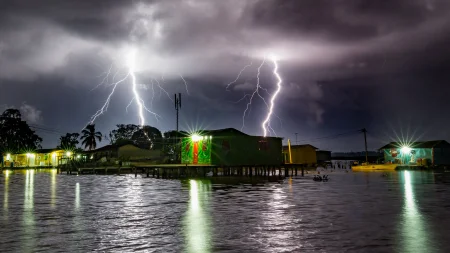
At any given moment, roughly 1,800 thunderstorms are happening somewhere on Earth, adding up to about 16 million storms per year.
1,800 Thunderstorms Are Happening Right Now
As you read this sentence, roughly 1,800 thunderstorms are crackling across our planet. Lightning is striking the ground about 100 times per second. Somewhere, always, the sky is putting on a show.
These aren't rough guesses. NASA and NOAA have spent decades tracking global lightning activity using satellites, and the numbers are almost incomprehensible in scale.
The Math Behind the Mayhem
Earth experiences approximately 16 million thunderstorms every year. That's about 44,000 per day, or around 1,800 happening simultaneously at any moment you care to check.
Each of those storms produces an average of 100 lightning strikes. Do the multiplication and you get roughly 8 million lightning bolts hitting the Earth every single day—or about 93 strikes per second.
Why So Many?
Thunderstorms need three ingredients: moisture, instability, and lift. Our planet has all three in abundance, especially in tropical regions where the sun's heat creates perfect storm-brewing conditions.
The most lightning-struck place on Earth? Lake Maracaibo in Venezuela, where a unique combination of mountain winds and lake moisture produces lightning storms nearly 300 nights per year. Some nights see 28 lightning flashes per minute.
The Global Lightning Hotspots
- Central Africa — The Congo Basin sees more thunderstorms than anywhere else
- Southeast Asia — Tropical heat and moisture create year-round activity
- The Americas — Florida alone gets struck about 1.2 million times annually
- Northern Australia — Darwin holds the record for Australia's most thunderstorm days
Interestingly, the oceans—despite covering 70% of Earth's surface—see relatively few thunderstorms. Land heats up faster than water, creating the rising air currents that storms need to form.
Tracking Every Flash
NASA's Lightning Imaging Sensor has been watching from orbit since 1997, mapping every flash it can detect. The data reveals fascinating patterns: lightning follows the sun, peaking in each hemisphere during its summer months.
Climate scientists are particularly interested in these patterns because thunderstorm frequency may be increasing with global temperatures. Warmer air holds more moisture, potentially fueling more intense storms.
The next time you hear thunder rumbling overhead, remember—you're experiencing just one tiny piece of a planetary electrical system that never, ever stops. Right now, 1,799 other storms are doing the exact same thing somewhere else on Earth.
Frequently Asked Questions
How many thunderstorms happen on Earth at once?
How many lightning strikes hit Earth per day?
Where does lightning strike the most on Earth?
How many thunderstorms occur each year worldwide?
Why are there more thunderstorms over land than ocean?
Verified Fact
This fact has been reviewed and verified against original sources.
Show verification details
Adjusted slightly - the commonly cited figure is ~1,800 thunderstorms happening at any given moment, which translates to roughly 40,000-50,000 per day. The '760 per hour' figure is a reasonable approximation that falls within scientific estimates.
Related Topics
More from Science & Space
View all Science & Space →