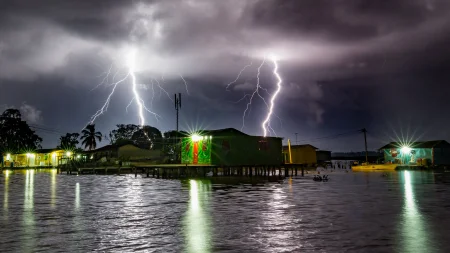
Lightning strikes about 6,000 times per minute on this planet!
6,000 Lightning Strikes Hit Earth Every Minute
Right now, as you're reading this, lightning is striking Earth about 100 times per second. That's approximately 6,000 strikes every minute, 360,000 every hour, and more than 8 million every single day. Our planet is constantly under electrical bombardment.
This isn't just happening in your local area during storm season. At any given moment, roughly 2,000 thunderstorms are active somewhere on Earth, collectively generating this constant barrage of electrical discharge.
Where the Action Happens
Lightning isn't distributed evenly across the globe. NASA satellite observations reveal that about 70% of all lightning occurs over land in the tropics, where warm, moist air creates ideal conditions for thunderstorm formation.
The world's lightning hotspots include:
- Lake Maracaibo, Venezuela (the planet's lightning capital)
- Central Africa, particularly the Democratic Republic of Congo
- The Himalayas and surrounding regions
- Parts of South America near the equator
Meanwhile, the oceans—despite covering 71% of Earth's surface—see relatively little lightning activity. Land heats up faster than water, creating the unstable atmospheric conditions thunderstorms love.
The Science Behind the Strikes
Each lightning bolt represents a massive electrical discharge, typically carrying around 1 billion volts and heating the air to approximately 30,000 Kelvin—five times hotter than the surface of the sun. The rapid heating causes air to expand explosively, creating the thunder we hear.
NASA's Lightning Imaging Sensor has tracked global lightning patterns since 1995, confirming that strike frequency varies with the seasons. During Northern Hemisphere summer, the global flash rate peaks at about 55 strikes per second. In winter, it drops to around 35 per second.
Why It Matters
This constant electrical activity isn't just spectacular—it plays crucial roles in Earth's systems. Lightning helps fix atmospheric nitrogen into forms plants can use, generates ozone, and may have even sparked the chemical reactions that led to life on early Earth.
Understanding lightning patterns also has practical applications. Improved forecasting helps protect people, prevents wildfires, and guides aviation routing. With climate change altering atmospheric conditions, scientists predict lightning frequency could increase by 12% for every degree of warming—meaning our already electric planet might become even more so.
Frequently Asked Questions
How many times does lightning strike Earth per day?
Where does lightning strike most frequently on Earth?
How hot is a lightning bolt?
Does lightning strike more in summer or winter?
Will climate change affect lightning frequency?
Verified Fact
This fact has been reviewed and verified against original sources.
Related Topics
More from Science & Space
View all Science & Space →