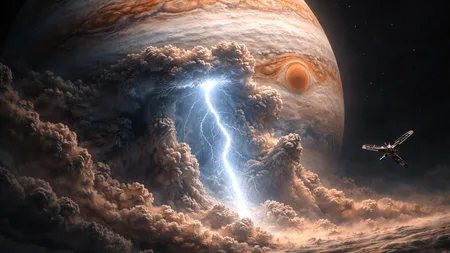
Jupiter is bigger than all the other planets combined.
Jupiter Outweighs All Other Planets Combined
When you look up at Jupiter in the night sky, you're seeing the undisputed heavyweight champion of our solar system. This gas giant doesn't just edge out the competition—it absolutely dominates. Jupiter's mass is roughly 2.5 times greater than all seven other planets combined. Yes, you could merge Mercury, Venus, Earth, Mars, Saturn, Uranus, and Neptune into one mega-planet, and Jupiter would still be more than twice as massive.
To put numbers to this cosmic heavyweight, Jupiter tips the scales at 1.9 × 10²⁷ kilograms. That's 318 times the mass of Earth. If you tried to write out Jupiter's weight in pounds, you'd be scribbling zeros for quite a while.
Why Is Jupiter So Massive?
Jupiter formed in the outer solar system where temperatures were cold enough for water and other compounds to freeze into solid particles. This created more building material for planets to form from. As Jupiter grew, its gravity became strong enough to pull in huge amounts of hydrogen and helium gas—the same stuff that makes up most of the Sun.
The planet acted like a cosmic vacuum cleaner, sweeping up material in its orbital path. Scientists believe Jupiter may have migrated inward during the early solar system, then drifted back out, fundamentally shaping how the other planets formed.
The Solar System's Bodyguard
Jupiter's immense gravity doesn't just make it massive—it makes it protective. The planet acts as a shield for Earth, deflecting or capturing asteroids and comets that might otherwise head our way. Some astronomers estimate that without Jupiter's gravitational influence, Earth would be hit by space debris far more frequently, potentially making complex life much harder to evolve.
That said, Jupiter isn't a perfect protector. Sometimes its gravity can actually fling objects toward the inner solar system. It's complicated, like most things in orbital mechanics.
Compared to the Sun
As dominant as Jupiter is among planets, it's still dwarfed by the Sun. Our star contains 99.8% of all the mass in the solar system. Jupiter's mass is only about one-thousandth that of the Sun—still impressive for a planet, but it puts things in perspective.
Interestingly, if Jupiter were about 80 times more massive, it would have enough gravity to ignite nuclear fusion in its core and become a star itself. Instead, it's classified as a "failed star" or, more accurately, just a really successful planet.
What This Means for Space Exploration
Jupiter's mass creates intense gravity that spacecraft must carefully navigate. NASA's Juno mission, currently orbiting Jupiter, uses this gravity to perform complex maneuvers. The planet's gravitational field has also been used as a slingshot to accelerate probes toward the outer solar system and beyond.
Understanding Jupiter's mass helps scientists model how solar systems form and why ours looks the way it does. It's a reminder that in space, size really does matter—and Jupiter is the king of planetary proportions.
Frequently Asked Questions
How much bigger is Jupiter than Earth?
Is Jupiter bigger than all planets combined?
Why is Jupiter so much bigger than other planets?
Could Jupiter become a star?
Does Jupiter protect Earth from asteroids?
Verified Fact
This fact has been reviewed and verified against original sources.
Show verification details
Jupiter's mass is approximately 2.5 times the combined mass of all other planets in the solar system. Jupiter weighs 1.9 × 10²⁷ kg, which is about 318 Earth masses.