
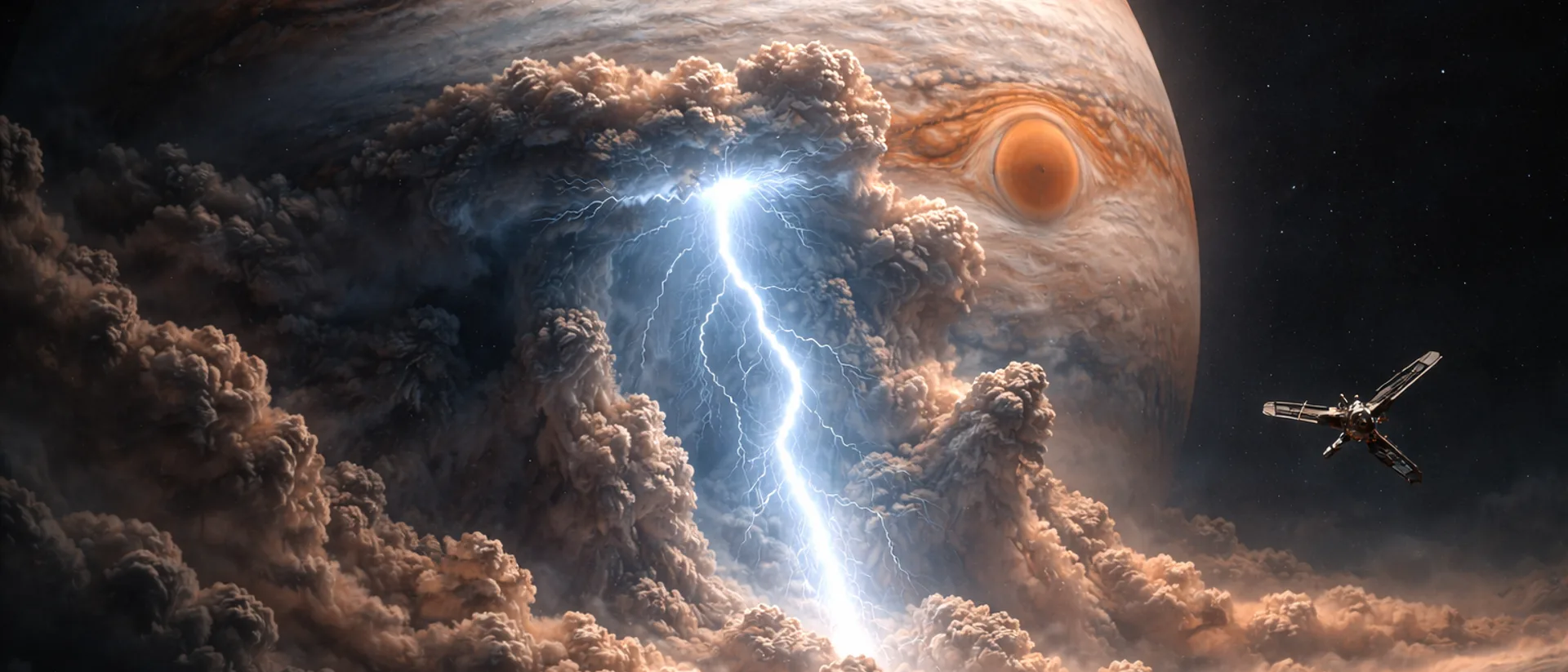
Jupiter produces lightning bolts up to 1,000 times more powerful than anything on Earth, generated by towering clouds of ammonia and water that don't exist anywhere else in the solar system. NASA's Juno spacecraft discovered that ammonia vapour melts high-altitude ice crystals on Jupiter, creating an exotic 'antifreeze' cloud system that generates these extreme electrical discharges.
Lightning on Jupiter Can Be 1,000 Times More Powerful Than on Earth — And It's Fuelled by Ammonia
When we think of lightning, we think of brief, violent flashes during a thunderstorm. On Jupiter, lightning operates on an entirely different scale — and it's powered by a mechanism that doesn't exist anywhere else in the solar system.
1,000 Times More Powerful
Jupiter produces lightning bolts up to 1,000 times more powerful than typical lightning on Earth. NASA's New Horizons spacecraft, during its 2007 flyby, captured flashes that were ten times stronger than the most powerful lightning ever recorded on our planet. These Jovian "superbolts" release staggering amounts of energy into the gas giant's turbulent atmosphere.
Lightning on Jupiter was first detected in 1979 when Voyager 1 and 2 picked up mysterious radio emissions during their flybys. It took nearly four decades and several more missions before scientists fully understood what was happening.
The Ammonia-Water Engine
On Earth, lightning forms in water clouds through collisions between ice crystals and water droplets. Jupiter has something far more exotic.
NASA's Juno mission, which has been orbiting Jupiter since 2016, discovered a process called "shallow lightning". Deep in Jupiter's atmosphere, powerful updrafts hurl water-ice crystals more than 16 miles above the main water cloud layer. At these frigid heights, the ice encounters ammonia vapour — which melts it.
The result is an ammonia-water solution that acts as a natural antifreeze, remaining liquid at temperatures far below water's normal freezing point. This exotic liquid forms slushy hailstones called "mushballs" — roughly 30% ammonia, 70% water — that collide with remaining ice particles, generating enormous electrical charges.
A Unique Phenomenon
This ammonia-driven lightning mechanism is unique to Jupiter. No other planet in our solar system has the right combination of atmospheric ammonia, powerful convection, and deep water clouds to produce it. The discovery solved a 39-year mystery about why Jupiter's lightning radio signals appeared so different from Earth's — and revealed that the gas giant's storms are even more alien than scientists had imagined.
Frequently Asked Questions
How powerful is lightning on Jupiter?
What makes Jupiter's lightning different from Earth's?
What are Jupiter's mushballs?
How was Jupiter's lightning discovered?
Verified Fact
Verified Aug 26, 2026 · 4 sources checked
Source: NASA JPLShow verification details
Claims checked
- Jupiter lightning up to 1,000 times more powerful than Earth's
- Unique ammonia-water "antifreeze" clouds generate shallow lightning
- Jupiter's lightning flashes last 1.4-5.4 ms, shorter than Earth's ~200 ms
Sources: NASA JPL, Nature Communications, Cornell University, Space.com