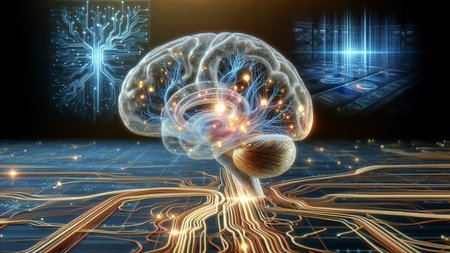
The storage capacity of the human brain is estimated at around 2.5 petabytes—equivalent to about 2,500 terabytes or roughly 3 million hours of TV shows.
Your Brain Can Store 2.5 Petabytes of Data
Forget your laptop's hard drive. The three-pound universe sitting between your ears makes modern storage technology look like a floppy disk.
Scientists at the Salk Institute calculated that the human brain can store approximately 2.5 petabytes of information. That's 2,500 terabytes—or enough storage for roughly 3 million hours of television. You could watch TV continuously for over 300 years and still not fill your mental hard drive.
How Do We Even Measure Brain Storage?
The calculation isn't straightforward. Your brain doesn't have folders and files. Instead, it relies on around 86 billion neurons, each connected to thousands of others through synapses. These synapses can vary in size, and researchers discovered they come in at least 26 different sizes—far more than previously thought.
This discovery was crucial. More synapse sizes means more possible states, which translates to more information storage per connection. It's like upgrading from a light switch (on/off) to a dimmer with 26 settings.
Your Brain vs. Technology
To put this in perspective:
- A typical smartphone: 128-256 GB
- A high-end laptop: 1-2 TB
- Google's entire data center: ~15 exabytes
- Your brain: 2.5 petabytes
Your brain sits comfortably between a personal computer and a tech giant's infrastructure—all while consuming only about 20 watts of power. That's less than a dim light bulb.
Why Don't We Remember Everything?
If your brain has this massive capacity, why can't you remember where you left your keys?
Storage and retrieval are different problems. Your brain constantly prioritizes, compresses, and sometimes discards information. It's less like a hard drive and more like a highly opinionated librarian who decides what's worth keeping and what gets filed under "probably not important."
Sleep plays a major role here. During deep sleep, your brain essentially runs a cleanup operation—consolidating important memories while letting go of the mental clutter from your day.
The Limits of Comparison
Comparing brains to computers is useful but imperfect. Your brain processes information in parallel across billions of connections, while computers typically work sequentially. The brain also combines storage with processing in the same tissue—there's no separation between your "memory" and your "processor."
And unlike your laptop, your brain rewires itself constantly. Every new experience physically changes its structure. Try getting your MacBook to do that.
The 2.5 petabyte estimate might even be conservative. As our understanding of neural complexity grows, so might that number. What we know for certain is that the most sophisticated storage device ever discovered isn't in a data center—it's reading this sentence right now.
Frequently Asked Questions
How much data can the human brain store?
How many terabytes is the human brain?
Why can't we remember everything if the brain has so much storage?
How does brain storage compare to a computer?
How do scientists measure brain storage capacity?
Verified Fact
This fact has been reviewed and verified against original sources.
Show verification details
Corrected the claim - original '4 terabytes' is a vast underestimate. Scientific estimates suggest the brain's capacity is around 2.5 petabytes (2,500 terabytes), though exact figures vary.
Related Topics
More from Science & Space
View all Science & Space →