Skateboards were flat planks. In 1969 a Venice Beach lifeguard named Larry Stevenson bent the back end upward. He patented the bend. It gave the back foot something to slam. Thirteen years later a Florida teenager slammed it on flat pavement and the whole board came off the ground with him. Every ollie still starts on that tail.
The Bent Piece of Wood That Made Skateboards Fly
On flat days at Venice Beach in the early 1960s, the lifeguard on duty kept watching the same thing. The surfers with no waves to ride would go to the parking lot and roll around on crude wooden boards with roller-skate wheels bolted underneath. Larry Stevenson decided he could build them something better.
A Lifeguard With a Woodshop
Stevenson started Makaha in 1963, naming it after a surf beach in Hawaii he had seen while shipping out during the Korean War.
He is credited with building the first genuinely high-quality skateboards, and that same year he ran the first organised skateboard contest and put together the first sponsored team.
The decks themselves, though, were still what they had always been: flat slabs of wood. They rolled, they turned, and that was the end of the list.
The Bend at the Back
On 12 June 1969, Stevenson filed a patent for something plainer than it sounds: a piece of the board that sloped upward at the back.
US Patent 3,565,454 was granted on 23 February 1971 under the title "Skateboard with inclined foot-depressible lever".
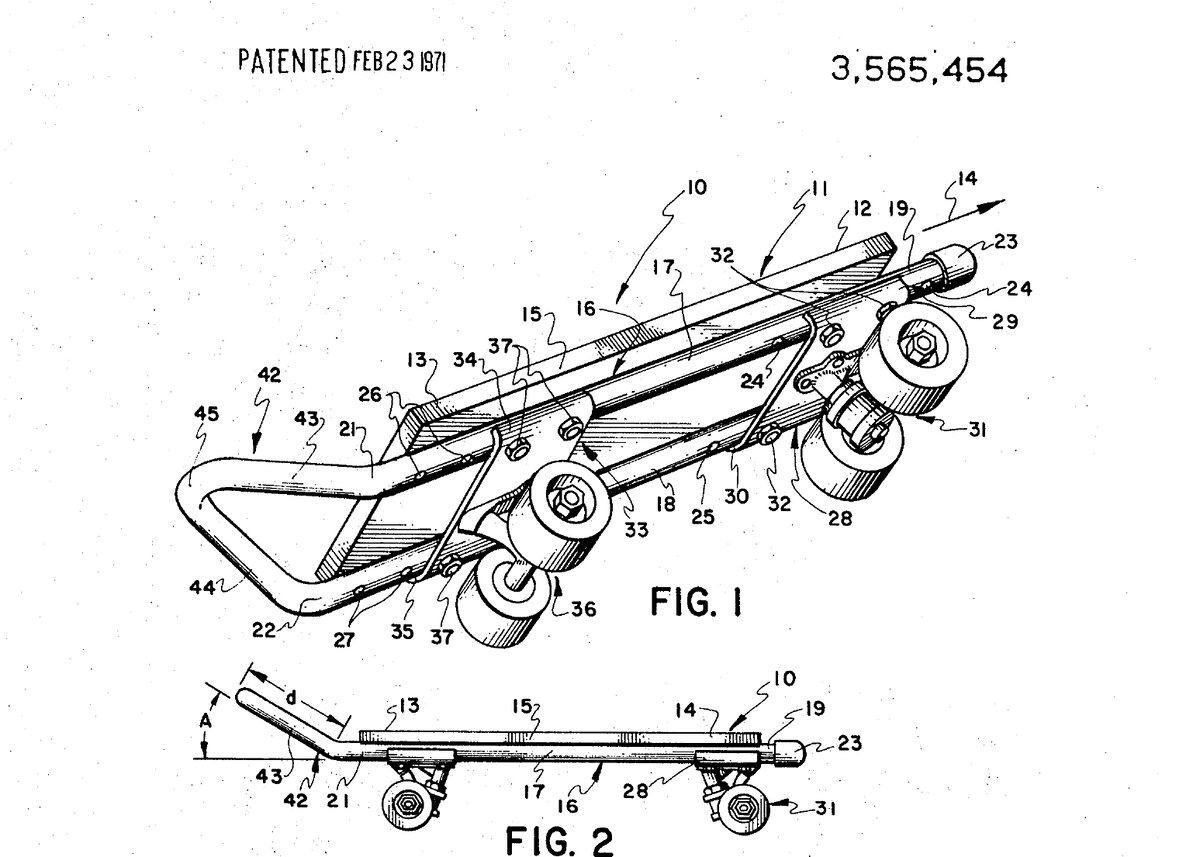
The description is exact about where it goes. "The rear end section of a skateboard mounts an inclined lever that is sloped upwardly and rearwardly from the skateboard," it reads.
It is just as exact about what it was replacing. The rear overhang on the boards of the day, the patent complains, was "aligned in coplanar relationship with the rest of the board" - flat, in other words, which meant it scraped the ground and slid out from under the rear foot.
The word skaters use for the fix is the kicktail.
The Trick the Patent Never Imagined
Read the patent and there is no jumping in it. Nowhere in the document does the word appear.
Stevenson pitched the tail as a safety feature and a training aid: press it with the rear foot to lift the nose, and wheelies, spins and pivots become easier to learn without tumbling off.
In the late 1970s, a teenage skater in Florida named Alan Gelfand found the other use for a board that could leave the ground. Riding the over-vertical walls of a badly built skatepark, he came off the lip and the board pitched back to his feet, and he rode it down again with no hands anywhere near the deck.
"It was all by accident, really," he said of the first ones. Accounts date them anywhere from 1976 to 1978.
His nickname was Ollie. The trick kept it.
From Pool Wall to Sidewalk
Gelfand's was a vertical trick, and by his own account and Rodney Mullen's it worked by scooping off the back trucks as the wall threw the board back, not by striking the tail. Flat concrete offers a rider none of that help.
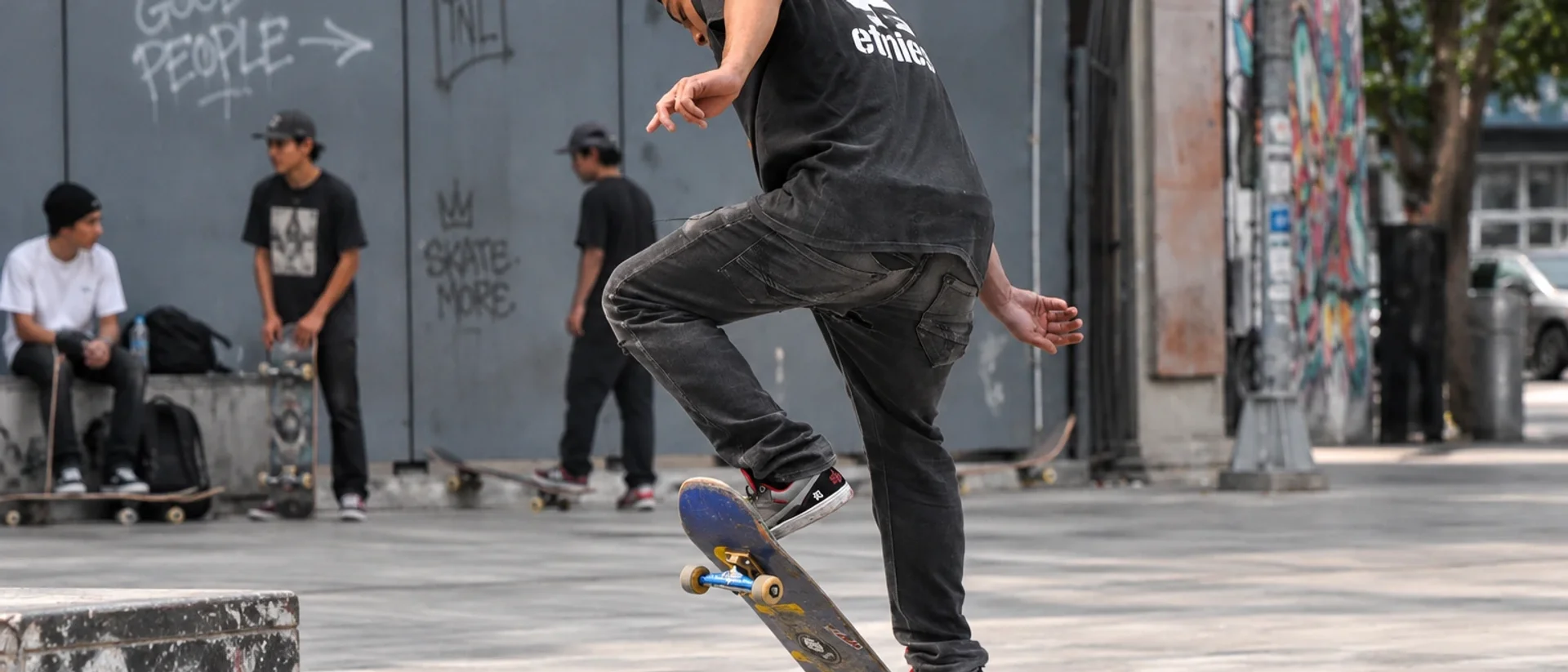
Thrasher was already reporting in April 1981 that skaters were hopping "from street to sidewalk with just a tap of the tail". The run that stuck came in 1982, at the Rusty Harris contest in Whittier, California, where a Florida teenager named Rodney Mullen cracked the tail against level ground, dragged his front foot forward to level the board in mid-air, and rolled away.
Street skating, as a whole discipline, unfolded from that. Every ledge, every handrail, every stair set opened up the moment a board could leave flat pavement.
One Tail, Then Two
For roughly two decades the kick sat only at the rear, the way the patent's main drawings show it. The document does sketch an alternative with a matching lever at the front, but the boards that sold carried one tail, and a true nose kick only reached street decks in the late 1980s and early 1990s.
Modern boards carry both. The one at the back is still the one that does the work.
Walk into any skatepark in the country and the sound carries before the skater does: a sharp crack of wood on concrete, the tail hitting the ground. Every ollie still starts there.
Source:US Patent 3,565,454
Enjoyed this fact?
1 person loved this
Get a new fact every morning.
A fascinating fact in your inbox every morning. Free. Unsubscribe anytime.
Frequently Asked Questions
Who invented the skateboard kicktail?
What is a kicktail on a skateboard for?
When was the ollie invented?
Who first did an ollie on flat ground?
Why do skateboards have a kick at both ends?
Did the kicktail patent mention jumping?
Verified Fact
Verified Sep 12, 2026 · 6 sources checked
Source: US Patent 3,565,454Show verification details
Claims checked
- Larry Stevenson, a Venice Beach lifeguard, filed the kicktail patent in June 1969
- Skateboards before it were flat planks, as the patent itself describes them
- The patent never mentions jumping and sold the tail as a safer way to learn wheelies
- The tail slam that lifts a board off flat pavement corrected to a Florida teenager in 1982 (the 1970s pool ollie scooped off the back trucks instead)
- Date of the first pool ollie, sources give 1976, 1977 and 1978
Sources: US Patent 3, 565, 454, Britannica, Wikipedia, Skateboarding Hall of Fame, Thrasher
Related Topics
More from Technology & Innovation
View all Technology & Innovation →