The U-2 spy plane flies at 70,000 feet, so its pilot lands in a pressure suit that blocks his view of the runway. Fifty feet of wing sticks out each side. A second U-2 pilot chases him in a muscle car at 120 mph, calling the wheels down. Ten. Eight. Six. Four. Two. At two feet it stalls onto the runway. Every landing still ends that way.
The Spy Plane That Needs a Muscle Car to Land
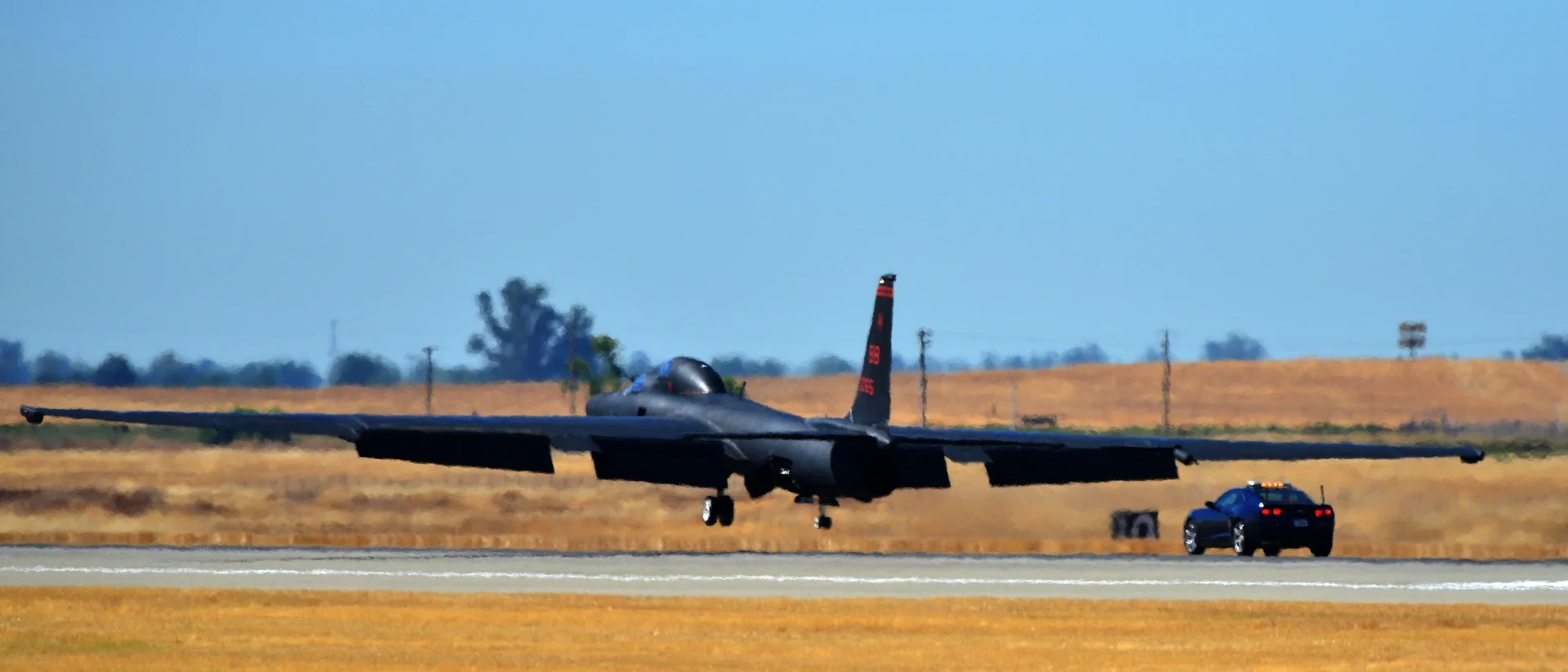
A U-2 coming home to Beale Air Force Base in California is landed by two pilots. One is sealed in a pressure suit in the cockpit, down from above 70,000 feet. The other is sitting on the runway in a muscle car, engine running, waiting to floor it.
Fifty Feet of Wing and No View
The U-2 was built to fly above 70,000 feet, so almost all of it is wing. The span is about 104 feet, which leaves more than fifty feet of it sticking out on each side of the cockpit.
To save weight, it does not get a normal undercarriage. It rolls on two wheels in a line, one under the nose and a tiny one under the tail, like a bicycle.
The pilot is sealed in a full pressure suit. "The helmet cuts off large portions of the peripheral vision," a U-2 pilot with the 99th Reconnaissance Squadron wrote in the Air Force's own explainer. On humid days the front canopy can fog over as well.
And because all that wing keeps making lift, the pilot has to stall the jet a few feet above the concrete, which leaves him looking at the sky at the exact moment the wheels arrive.
The Man They Call Mobile
The answer to all of that is a car. The chase car driver is another qualified U-2 pilot, and in the squadron he is known simply as the mobile.
He preflights the jet for the man in the suit, sets up the cockpit, checks the electrics, hydraulics, navigation and avionics and walks the airframe, because the pressure suit leaves the mission pilot too bulky to do it himself.
He is also the day's backup pilot. If the man in the seat had woken up sick, the mobile is the one who would have flown the mission.
Ten. Eight. Six. Four. Two.
As the jet drops onto final approach, the mobile waits in the car at the threshold of the runway, then launches from a standstill and matches its ground speed, settling in about fifty to seventy-five feet behind the tail.
Any further back and he cannot judge the gap. Any closer and it gets dangerous.
Then he talks. The Air Force says the calls start when the aircraft is ten feet off the runway, and from there the mobile counts the height down in twos, along with everything else the pilot cannot see for himself: whether he is on the center line, whether the wings are level, what control input is needed.
"Ideally you want to be at two feet," a Beale mobile officer told Forces News from behind the wheel of a Dodge Charger. "Any higher than that and it's going to be a pretty heavy landing."
At two feet the pilot holds it, kills the last of the lift and lets the jet stall onto the runway. The Air Force's own figure for the car is a standing start to close to 100 mph, in a turn. A Forces News reporter who rode along clocked one above 120 mph, a few feet off the jet's exhaust.
Station Wagons, El Caminos, Chargers
The cars have been changing for seventy years. Lockheed started the program with two Ford Country Squire station wagons, big enough to carry the jet's detachable "pogo" wheels and dull enough to attract no attention, and then had them re-engined because they were far too slow.
The Chevrolet El Camino, a muscle car with a truck bed, held the job for about two decades. The Ford Mustang took over in the 1980s, police-spec Chevrolet Camaros through the 1990s, and Pontiac GTOs and G8s in the 2000s.
Forces News found Beale running a fleet of V8 Dodge Chargers. Across the U-2 force today, Chargers, Challengers and Camaros all do the work, and the Air Force's own list of past chase cars runs to Pontiacs, Subarus, Mercedes and Audis.
Seventy Years and Still Counting
The first U-2 flew on 4 August 1955. In July 2025 a Beale crew flew one across all forty-eight contiguous states, more than fourteen hours and over 6,000 nautical miles, the longest flight the type has ever made. In January 2026 the 9th Reconnaissance Wing was still generating U-2 sorties from Beale on a readiness exercise.
The routine travels. When Team Beale took a U-2 to EAA AirVenture at Oshkosh in 2025, instructor pilot John Huggins followed it down the runway in a chase car, talking the landing in over the radio in front of the biggest crowd of pilots in America. "There are a lot of pilots down there watching my landing and videoing every second of it," the man in the cockpit said afterwards, "and if it doesn't go well I'm going to hear about it for days."
The Air Force keeps asking to retire the fleet. Congress keeps limiting how many aircraft can go.
A jet comes home from the edge of space. A V8 goes after it. Somebody counts the feet down.
Enjoyed this? Get a new fact every morning.
A fascinating fact in your inbox every morning. Free. Unsubscribe anytime.
Frequently Asked Questions
Why does the U-2 spy plane need a chase car?
How fast do U-2 chase cars go?
What cars does the Air Force use to chase the U-2?
Is the U-2 still flying?
How high does the U-2 fly?
Verified Fact
Verified Sep 11, 2026 · 6 sources checked
Source: Forces NewsShow verification details
Claims checked
- A second qualified U-2 pilot chases every landing and radios the wheel height
- Countdown corrected to start at ten feet and end at two (was five to two)
- Chase cars clocked above 120 mph, and reach close to 100 mph from a standstill
- Claim that the U-2 cannot land by itself removed; the helmet blocks the view
- Car line corrected to Ford wagons, El Caminos, Mustangs, Camaros, then Chargers
- U-2s still fly from Beale and are still chased down, including at Oshkosh in 2025
Sources: Forces News, Beale Air Force Base, Military.com, Roadrunners Internationale, DVIDS