
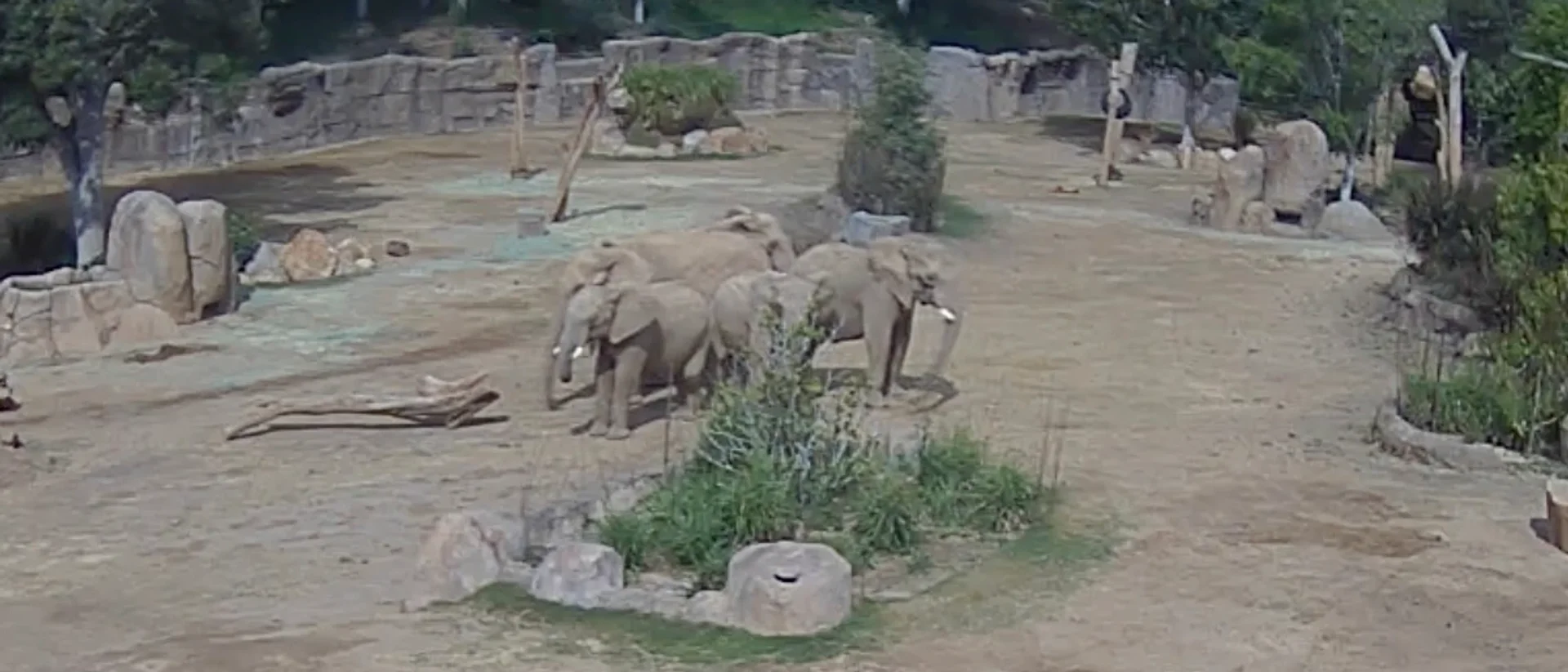
A 5.2 magnitude earthquake shook San Diego on April 14, 2025. Elephants at the San Diego Zoo Safari Park felt it coming through their feet. Three mothers, Ndlula, Umngani, and Khosi, raced to surround two 7-year-old calves, facing outward with ears spread wide. They held the ring for several minutes, then formed it again during an aftershock.
Zoo Elephants Sensed the Earthquake Before Anyone Else
At 10:10 a.m. on April 14, 2025, the ground shook across San Diego County. Security cameras inside the elephant habitat at the San Diego Zoo Safari Park caught something remarkable: the herd reacting to the tremor seconds before any human on site felt it.
A 5.2 Magnitude Quake Near Julian
The earthquake registered magnitude 5.2, with an epicenter near the town of Julian in East San Diego County. It was strong enough to rattle homes and businesses across the region, and it arrived with no warning. Inside the Safari Park's elephant habitat, the herd's reaction was almost instant.
Three Mothers, Two Calves, One Circle
Footage from the park shows the elephants breaking into a run within moments of the shaking. Three adult females, Ndlula, Umngani, and Khosi, moved to protect two seven-year-old calves, Zuli and Mkhaya. Mkhaya was pinned safely in the center of the ring, while Zuli, the herd's other seven-year-old, stayed just outside the circle, reassured by Khosi touching him with her trunk. The adults faced outward in every direction, ears spread wide, scanning the habitat for the source of the danger.
Mammal curator Mindy Albright, who reviewed the footage, said the herd's reaction was immediate. "They sensed something was off and potentially dangerous," she said. "Immediately, they ran together and formed what we call an alert circle."
Feeling the Quake Through Their Feet
An "alert circle" is a defensive formation wild elephants use when they sense a predator or other threat nearby, with adults ringing the youngest members of the herd and facing outward to defend them. Researchers believe elephants can detect it earlier than people because they are extraordinarily sensitive to low-frequency vibration, picking up seismic waves through nerve endings and fatty tissue in their feet as well as through their ears. That sensitivity likely let the Safari Park herd register the earthquake's first waves before the shaking was strong enough for keepers nearby to notice.
It Happened Again
The herd held its alert circle for several minutes before easing back into normal behavior, though the elephants stayed close together afterward. When an aftershock rattled the park later that same morning, the herd repeated the exact same formation, circling the calves again until the danger passed.
Elephant behavior researcher Joshua Plotnik of Hunter College told NPR that the footage is a reminder of how much is still unknown about elephant cognition and social behavior, and of how tightly bonded these herds really are. For a species that spends its life reading the world through vibration underfoot, a shaking earthquake was, in the end, just another threat to face together.
Frequently Asked Questions
What is an elephant alert circle?
How did the San Diego Zoo elephants react to the 2025 earthquake?
Can elephants sense earthquakes before humans do?
Did the San Diego Zoo elephants form the circle more than once?
Where was the April 2025 San Diego earthquake centered?
Verified Fact
Verified Jul 3, 2026 · 9 sources checked
Source: NPRShow verification details
Claims checked
- 5.2 magnitude earthquake near San Diego on April 14, 2025
- Three elephants formed a defensive circle around calves during quake and aftershock
- Elephants sense vibrations through their feet
- Names and ages of elephants and calves
- Only one calf was centered in the circle (earlier version said both)
Sources: KPBS, NPR, CBS News, NBC San Diego, Smithsonian Magazine, Live Science, AccuWeather, USGS, San Diego Zoo