
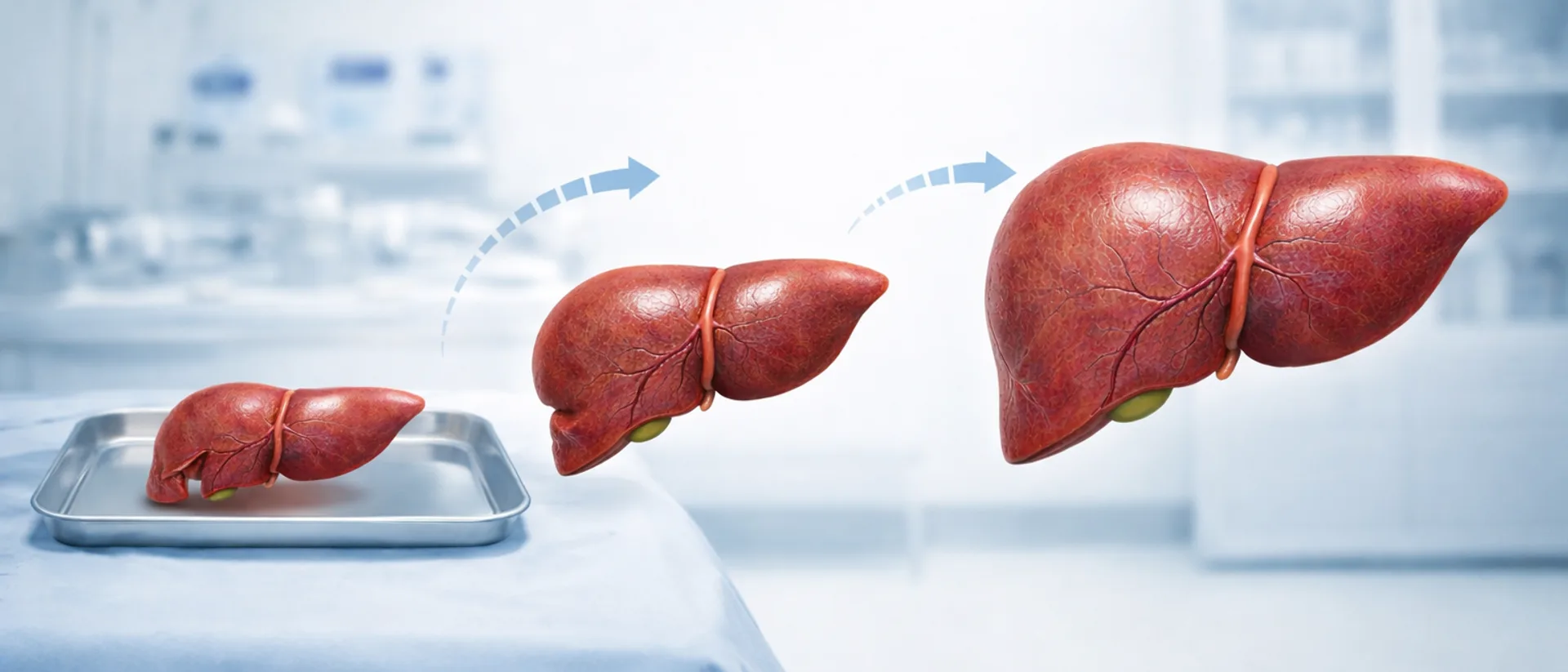
The human liver can regenerate to its full size from as little as 25% of its original tissue. It's the only internal organ that can do this — which is why living-donor liver transplants work. Surgeons remove up to 60% of the donor's liver, transplant it, and both the donor and recipient end up with full-sized livers within months.
Your Liver Can Regrow From Just 25% of Its Original Tissue
If you could pick one superpower for a human organ, you'd probably go with something flashy — super strength for muscles, maybe X-ray vision for eyes. But the humble liver already has one of the most remarkable abilities in biology: it can regenerate itself from as little as 25% of its original tissue.
No other internal organ in the human body can do this. Kidneys can't. Lungs can't. The heart certainly can't. But the liver? Remove three-quarters of it, and the remaining quarter will grow back to its full functional size within months.
How Living-Donor Liver Transplants Work
This regenerative ability is what makes living-donor liver transplants possible — a procedure that has saved thousands of lives. During the surgery, doctors remove up to 60% of a healthy donor's liver and transplant it into the recipient. Within about 8 to 12 weeks, both pieces grow back to near-full size.
The donor keeps living their normal life with a fully functional liver. The recipient gets a new liver that grows to meet their body's needs. It's one of the most elegant solutions in modern medicine.
It's Not Regrowth — It's Something Different
Here's the thing: the liver doesn't regenerate the way a lizard regrows its tail. It doesn't recreate the exact original structure lobe by lobe. Instead, the remaining liver tissue enlarges through a process called compensatory hyperplasia — the existing cells grow bigger and multiply until the organ reaches the mass needed to do its job.
The result looks different from the original liver anatomically, but functionally it's identical. Every metabolic function — filtering toxins, producing bile, storing vitamins, regulating blood sugar — returns to full capacity.
Why Can the Liver Do This?
The liver's regenerative ability likely evolved because of its role as the body's primary detoxification organ. It's constantly exposed to toxins, alcohol, medications, and metabolic byproducts. An organ that can rebuild itself after damage has an enormous survival advantage.
Normally, liver cells (hepatocytes) are in a resting state — they rarely divide. But when liver tissue is lost, a cascade of growth signals triggers the remaining cells into rapid division. The process is so efficient that in mouse studies, a liver reduced to one-third of its size can fully regenerate within a week.
The Limits of Regeneration
There is a catch. The liver's regenerative ability depends on the remaining tissue being healthy. In patients with chronic liver disease, cirrhosis, or severe scarring, regeneration slows dramatically or stops entirely. Years of alcohol abuse, hepatitis, or fatty liver disease can exhaust the liver's regenerative capacity — which is why chronic liver failure remains a serious medical condition despite this remarkable built-in repair system.
Frequently Asked Questions
How much of the liver needs to remain for it to regenerate?
How long does it take for a liver to regrow after donation?
Is the liver the only organ that can regenerate?
Can a damaged liver still regenerate?
Verified Fact
This fact has been reviewed and verified against original sources.
Source: Mayo ClinicShow verification details
Well-documented medical fact. Multiple sources confirm: Mayo Clinic, Cleveland Clinic, NIH, Columbia Surgery, UPMC. Some sources cite as little as 10% can regenerate. Living-donor transplant success rate ~90%.