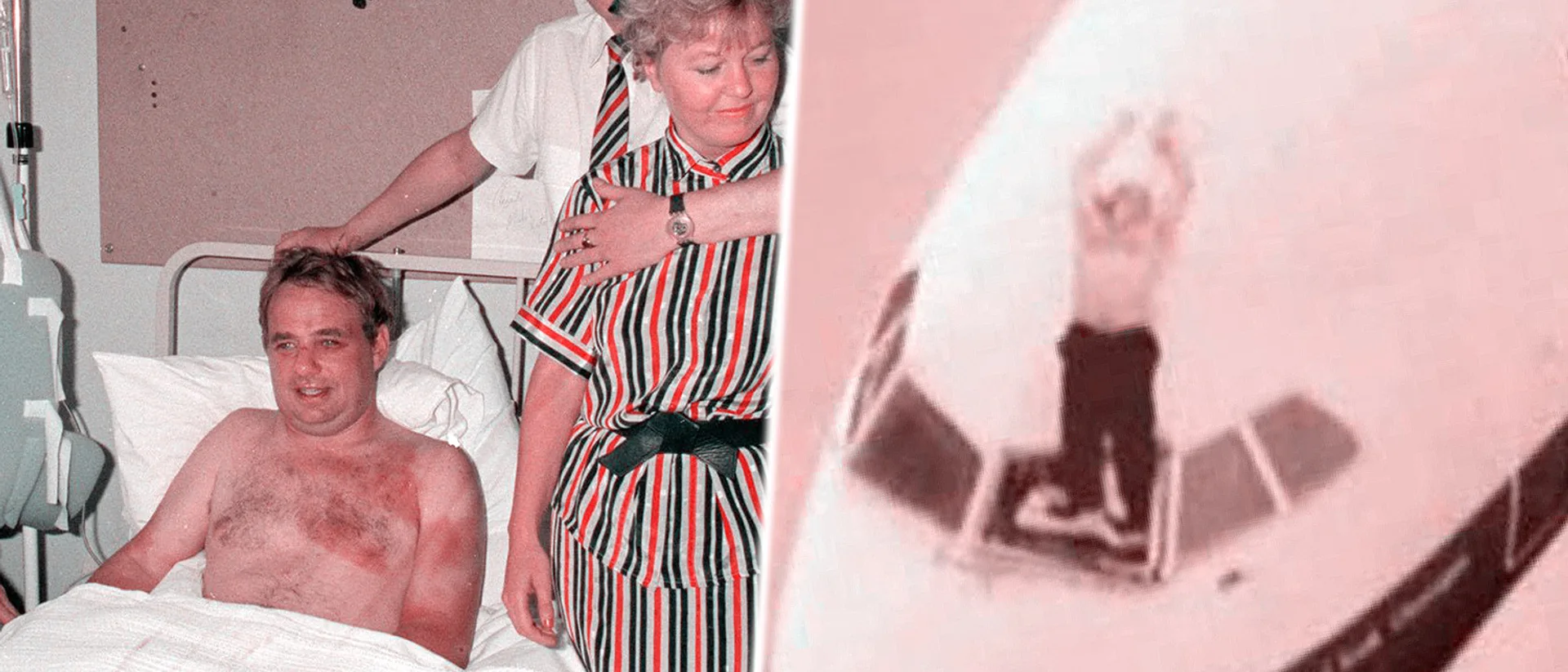
In 1990, the cockpit windshield of British Airways Flight 5390 blew out at 17,400 feet. The captain was sucked halfway out of the aircraft. A flight attendant grabbed his legs and held on for 20 minutes while the co-pilot made an emergency landing. Everyone survived. The cause? 84 of 90 windshield bolts were the wrong size.
A Pilot Got Sucked Out of a Plane. His Crew Held On.
On the morning of June 10, 1990, British Airways Flight 5390 took off from Birmingham heading to Malaga, Spain, carrying 81 passengers and 6 crew. Thirteen minutes into the flight, at 17,400 feet, the left windshield panel of the BAC One-Eleven exploded outward. The sudden decompression ripped Captain Tim Lancaster from his seat and sucked him halfway out of the cockpit.
Hanging On at 300 MPH
Flight attendant Nigel Ogden had just entered the cockpit with a cup of tea. He lunged forward and grabbed Lancaster's legs as the captain's body was pinned against the fuselage by 300-mph winds. The cockpit door had blown onto the control column, disconnecting the autopilot. Loose papers and debris were swirling through the cabin. Co-pilot Alastair Atchison, who had never landed a BAC One-Eleven before, took control and began an emergency descent.
Twenty Minutes of Holding On
For over 20 agonizing minutes, crew members took turns gripping Lancaster's body. Ogden held on until frostbite and exhaustion overwhelmed him, at which point other cabin crew rotated in. At one point, they considered letting go — Lancaster appeared lifeless, his body battered against the cockpit exterior. They held on anyway. Atchison made radio contact and brought the aircraft down for a smooth landing at Southampton Airport.
The Bolts That Nearly Ended 87 Lives
The AAIB investigation found something stunning: 84 of the 90 bolts holding the windshield in place were the wrong size. The shift maintenance manager who'd replaced the windshield the night before had selected the bolts by visual match rather than checking the part number in the maintenance manual. He used A211-8C bolts (0.026 inches too narrow) instead of the correct A211-7D. The undersized bolts couldn't withstand pressurization forces at altitude.
The Comeback
Against all odds, Captain Lancaster survived. He suffered frostbite, bruising, fractures to his right arm, wrist, and thumb, and shock — but he was alive. Five months later, he was back in the cockpit. Nigel Ogden received the Queen's Commendation for Valuable Service in the Air. The incident became one of the most studied cases in aviation safety and fundamentally changed maintenance oversight procedures across the industry.
Frequently Asked Questions
Did Captain Tim Lancaster survive being sucked out of the cockpit?
Why did the windshield blow out on British Airways Flight 5390?
Who held onto Captain Lancaster during the emergency?
How many passengers were on British Airways Flight 5390?
Verified Fact
Verified Aug 26, 2026 · 3 sources checked
Source: Wikipedia / AAIB ReportShow verification details
Claims checked
- Windshield blew out on British Airways Flight 5390 in 1990
- Captain was sucked halfway out and held by a flight attendant for 20 minutes
- Co-pilot made an emergency landing and everyone survived
- Cause was 84 of 90 windshield bolts being the wrong size
Sources: AAIB Report, Wikipedia, BBC News
Related Topics
More from History & Culture
View all History & Culture →