
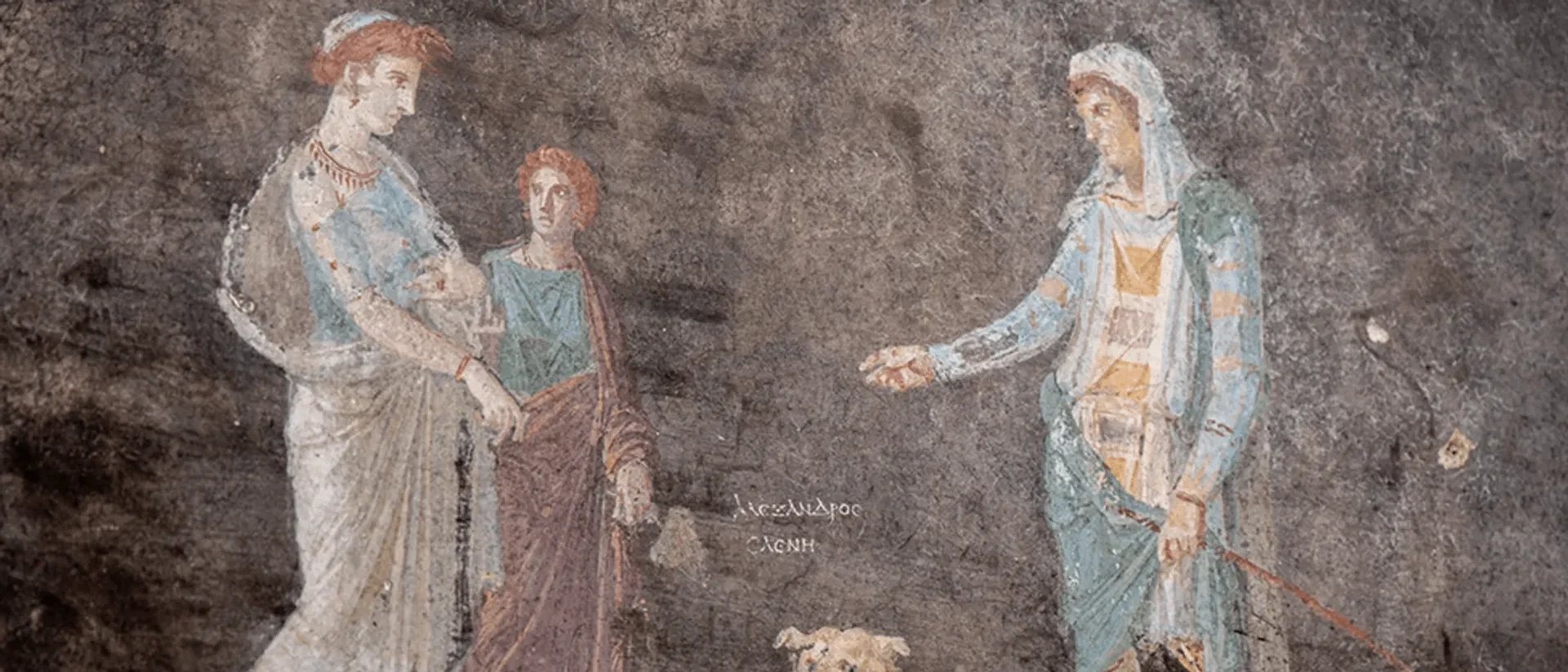
In April 2024, archaeologists in Pompeii uncovered a 15-metre banqueting hall with jet-black walls and vivid frescoes of Helen of Troy meeting Paris - sealed under volcanic ash since 79 CE. Nearly 2,000 years in the dark, and the dinner party was still on.
Pompeii's Black Banquet Room: Sealed 2,000 Years
In April 2024, excavations in a central block of Pompeii broke open a room that had been sealed for nearly 2,000 years - and what they found inside stopped archaeologists in their tracks.
The Black Room
The room sits in Insula 10 of Regio IX, the largest area of ongoing excavation at Pompeii in a generation. It measures 15 metres long and 6 metres wide - a grand space by any standard. Its walls are painted an intense black, a deliberate design choice: the owner knew dinner parties meant oil lamps, oil lamps meant soot, and black walls meant no one would notice. The floor is a mosaic laid with more than a million tiny white tiles.
The Faces on the Walls
Across the black background, in vivid reds, oranges and golds, the frescoes show pairs of figures from the Trojan War. One panel depicts the first meeting of Helen of Troy and Paris - Paris is identified by a Greek inscription using his other name, "Alexandros." A second fresco shows Cassandra and Apollo: Apollo, lyre in hand, attempts to win her over; Cassandra, seer and daughter of the Trojan king, will not be moved. Park director Gabriel Zuchtriegel noted: "The mythological couples provided ideas for conversations about the past and life, only seemingly of a merely romantic nature - in reality, they refer to the relationship between the individual and fate."
Dinner by Lamplight, Then Vesuvius
Zuchtriegel described the intended atmosphere: by the flickering light of oil lamps, the figures on the black walls would appear to shift and move. Guests reclining on couches would look up at Helen and Paris, at Cassandra refusing Apollo, and talk about fate and choice over Campanian wine. In the late summer of 79 CE, Mount Vesuvius buried the room under metres of ash and pumice. The black walls, the mosaic floor, and every brushstroke of those figures waited in the dark for almost two millennia.
Who Was the Owner
The building likely belonged to Aulus Rustius Verus, a wealthy Pompeian politician - his initials "ARV" were found on walls and millstones in the building. The excavations are part of the Great Pompeii Project, a multi-year effort to stabilise and study the site. The Salone Nero is one of the most striking rooms to emerge from that work. When archaeologists finally entered, the colours were still extraordinary - nearly 2,000 years of darkness had done the paintings no harm at all.
Frequently Asked Questions
What is the Black Room at Pompeii?
Why are the walls black in the Pompeii banqueting room?
Who owned the Pompeii Black Room?
What frescoes were found in the Pompeii Black Room?
When was the Pompeii Black Room discovered?
Verified Fact
This fact has been reviewed and verified against original sources.
Source: Pompeii Archaeological ParkShow verification details
org/wp-content/uploads/E-Journal-Guerra-di-Troia-4.pdf); ARTnews; Archaeology Magazine.