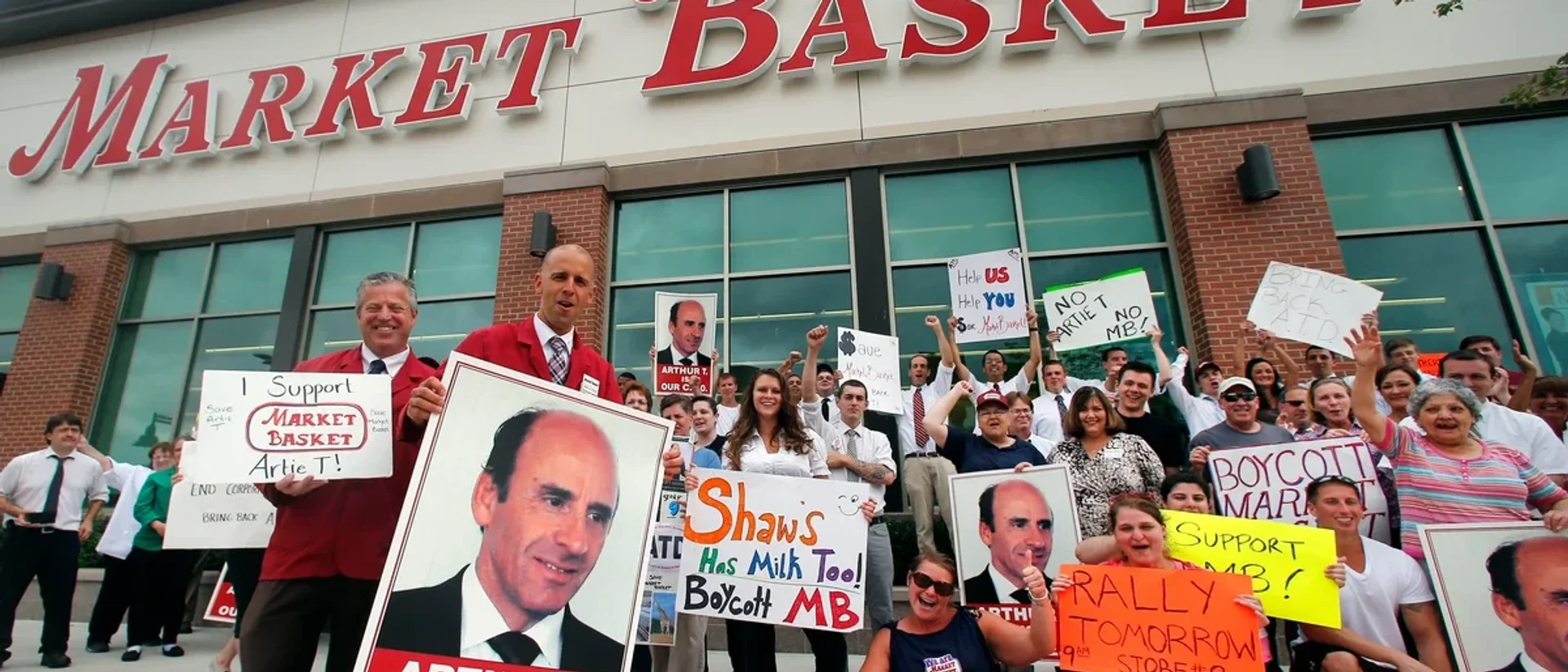
25,000 grocery workers walked off the job to save the CEO their board had just fired. No union. No pay. No budging. Market Basket's board sacked Arthur T. Demoulas for paying workers too well. 71 stores emptied. Sales crashed 95% in six weeks. Customers drove past Market Basket to shop at competitors. The board folded and Arthur T. bought the company back for $1.5 billion.
The Board Fired Him for Caring Too Much About Workers
Most corporate standoffs end with workers losing. In the summer of 2014, a 25,000-person non-union workforce in New England tried something nobody had ever done before - and it worked.
Who Was Arthur T. Demoulas
Arthur T. Demoulas had run Market Basket, a 71-store grocery chain across Massachusetts, New Hampshire, and Maine, for nearly two decades. He was known for keeping store prices well below competitors, paying workers above-market wages, and running a profit-sharing program that made cashiers and warehouse workers feel invested in the company. Employees called him "Artie T." and meant it warmly.
The Firing
In June 2014, the board of directors - controlled by his cousin Arthur S. Demoulas after a decades-long family governance dispute - voted to terminate him. The stated reasons involved real estate dealings, but no misconduct was formally alleged. The real issue was simpler: Arthur T. ran the company for workers and customers first, shareholders second. On June 23, 2014, he was out.
The Walkout Nobody Saw Coming
The response was unlike anything in American labor history. Without a union, without an organizing committee, and without guaranteed pay, the workforce acted. Warehouse workers refused to process deliveries. Truck drivers stopped their routes. Managers walked off floors. Customers - who had no financial stake at all - voluntarily drove past Market Basket to shop at competitors, and taped their receipts from rival stores to Market Basket windows in protest. Within two weeks, sales had collapsed by more than 90%. The company was losing an estimated $10 million per day.
The Board Made It Worse
On July 20, new management fired 8 protest organizers, expecting the move to break the workers' resolve. It had the opposite effect. The walkout intensified. More than 160 mayors and legislators in Massachusetts and New Hampshire signed petitions demanding Arthur T.'s reinstatement. The governors of both states - Deval Patrick of Massachusetts and Maggie Hassan of New Hampshire - personally intervened to help broker a resolution.
He Bought the Company Back
Nine weeks after the initial walkout, on August 27, 2014, the board's faction agreed to sell their controlling 50.5% stake. Arthur T. Demoulas purchased the shares for approximately $1.5 billion and returned to the company as its owner and CEO. Workers who had gone without pay for weeks returned to their jobs the next morning. It remains one of the only documented cases of a large, fully non-union American workforce reversing a board decision through collective action alone.
Frequently Asked Questions
Why was Arthur T. Demoulas fired from Market Basket in 2014?
How many Market Basket employees walked out in 2014?
How much did Arthur T. Demoulas pay to buy back Market Basket?
Was the Market Basket walkout the largest non-union labor action in US history?
What happened to Market Basket after Arthur T. returned in 2014?
Verified Fact
Verified Aug 28, 2014 · 6 sources checked
Source: Wikipedia / Boston GlobeShow verification details
Claims checked
- 25,000 workers walked out over CEO firing
- Sales dropped over 90% within six weeks
- Arthur T. bought company for $1.5 billion
- 71 stores affected, non-union workforce
Sources: Boston Globe, Wikipedia, CBS Boston, NPR, NHPR, Maine Public
Related Topics
More from People & Mind
View all People & Mind →