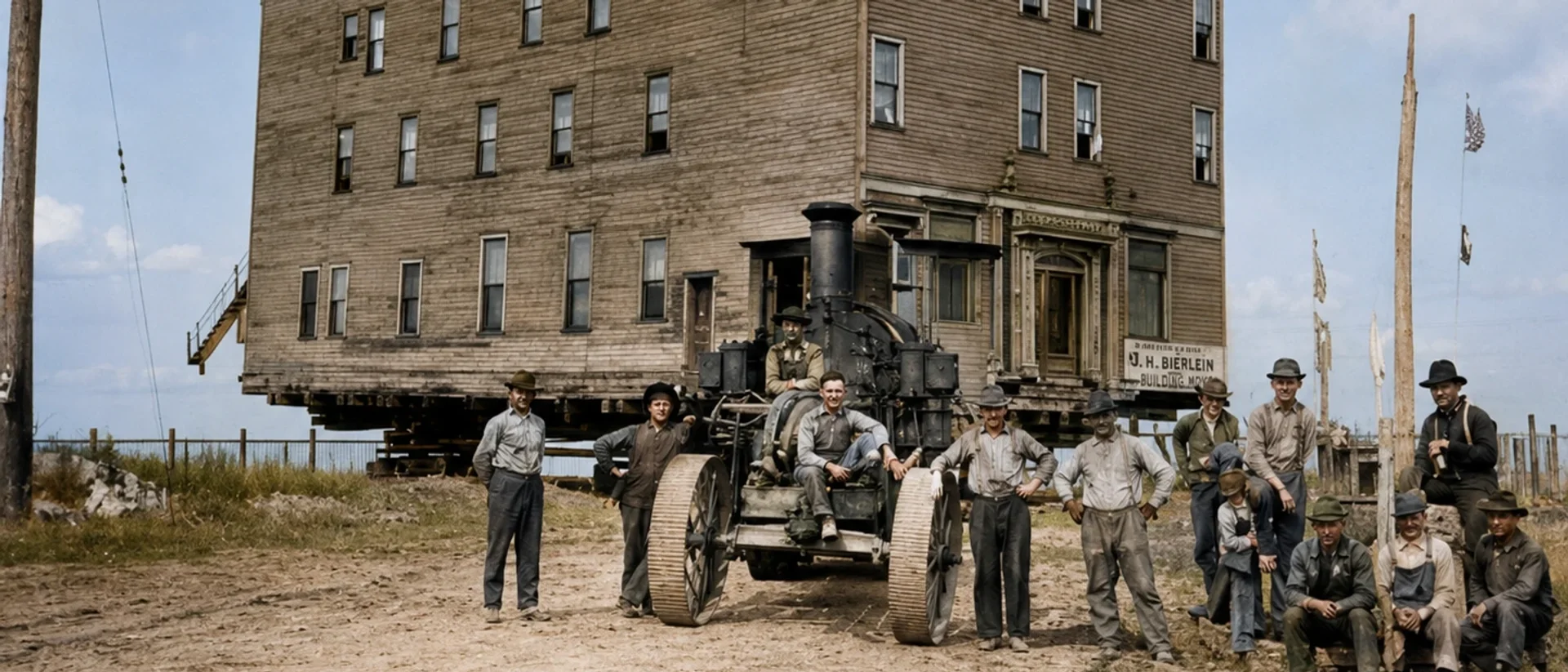
Hibbing is an old mining town on Minnesota's Iron Range. In 1919, the mining company found its ore ran directly under the town. So it moved the entire town two miles south. Workers rolled nearly 200 buildings there on logs and steel rails. One hotel didn't survive the trip. The empty ground became a pit long billed as the world's largest open-pit iron mine. Hibbing still stands today, two miles from where it started.
Minnesota Moved an Entire Town to Reach Its Iron Ore
Hibbing, Minnesota, sits on the Mesabi Iron Range in the northern part of the state, a town built entirely on mining. In 1919, the mining company that ran the pits on its doorstep confirmed something the town had feared for years: the ore didn't stop at the edge of Hibbing. It ran straight underneath it.
The Ore Was Under the Town
By the 1910s, open-pit mines already surrounded Hibbing on three sides. Test drilling showed the ore body continued right under the streets and buildings of the town itself.
In 1916, the Oliver Mining Company told village leaders the northern part of Hibbing would have to go. After negotiations, the town agreed to a plan that sounds almost impossible: instead of tearing Hibbing down, they would move it, whole, two miles south to a new site near the community of Alice.
The company agreed to fund new civic buildings in the process, including Hibbing High School, the Androy Hotel, the Village Hall, and Rood Hospital. Local shop owners were offered low-interest loans to help rebuild.
Nearly 200 Buildings on the Move
The relocation began in 1919. Over the next two years, work crews jacked up building after building and set them onto log rollers and wooden rails laid down what was called the First Avenue Highway.
In total, close to 200 structures made the two-mile trip south, including stores and several large hotels.
The One That Didn't Make It
Almost every building survived the trip. The Sellers Hotel did not.
It tumbled off its rollers partway through the move and crashed to the ground. One witness described what was left as "an enormous pile of kindling." There is no record of anyone being hurt in the collapse.
The rest of North Hibbing, as the old townsite came to be known, kept functioning as a business and residential area for years after the main move. Mining companies bought up the last of its remaining structures in the 1940s, and the very last house wasn't hauled out until 1968, nearly half a century after the first buildings rolled south.
A Hole Big Enough to Swallow a Town
Once the buildings were gone, the ground where old Hibbing had stood was mined away completely. It became part of the Hull-Rust-Mahoning Mine, a pit long promoted as the world's largest open-pit iron mine.
Today it stretches more than three miles long, two miles wide, and 535 feet deep. At its peak output, spanning World War I through the 1940s, the mine supplied as much as one-fourth of all the iron ore mined in the United States, helping turn the country into the world's largest steel producer.
The Buses That Came First
Five years before the first building rolled south, a laid-off miner named Carl Wickman was struggling to sell a car in Hibbing. Instead, in 1914 he and fellow Swedish immigrant Andy "Bus Andy" Anderson started using it to shuttle miners the two miles between Hibbing and Alice for 15 cents a ride.
That short run down the same road the town would later travel grew into the Mesaba Transportation Company by 1915, and eventually into Greyhound Lines, one of the largest bus companies in the country.
Hibbing still stands today, two miles from where it began, with a giant pit where its downtown used to be.
Enjoyed this? Get a new fact every morning.
A fascinating fact in your inbox every morning. Free. Unsubscribe anytime.
Frequently Asked Questions
Why did they move the town of Hibbing, Minnesota?
How many buildings were moved when Hibbing relocated?
How long did it take to move Hibbing?
What happened to the old site of Hibbing?
Is it true Greyhound Lines started in Hibbing?
Verified Fact
Verified Aug 20, 2026 · 5 sources checked
Source: Wikipedia (Hull-Rust-Mahoning Open Pit Iron Mine)Show verification details
Claims checked
- Town moved starting 1919, first phase done 1921
- Nearly 200 buildings rolled on logs and rails
- Sellers Hotel collapsed during move, no injuries
- Pit long billed as world's largest open-pit iron mine
- Greyhound Lines began with a 1914 Hibbing route
Sources: Wikipedia, Minnesota Historical Society