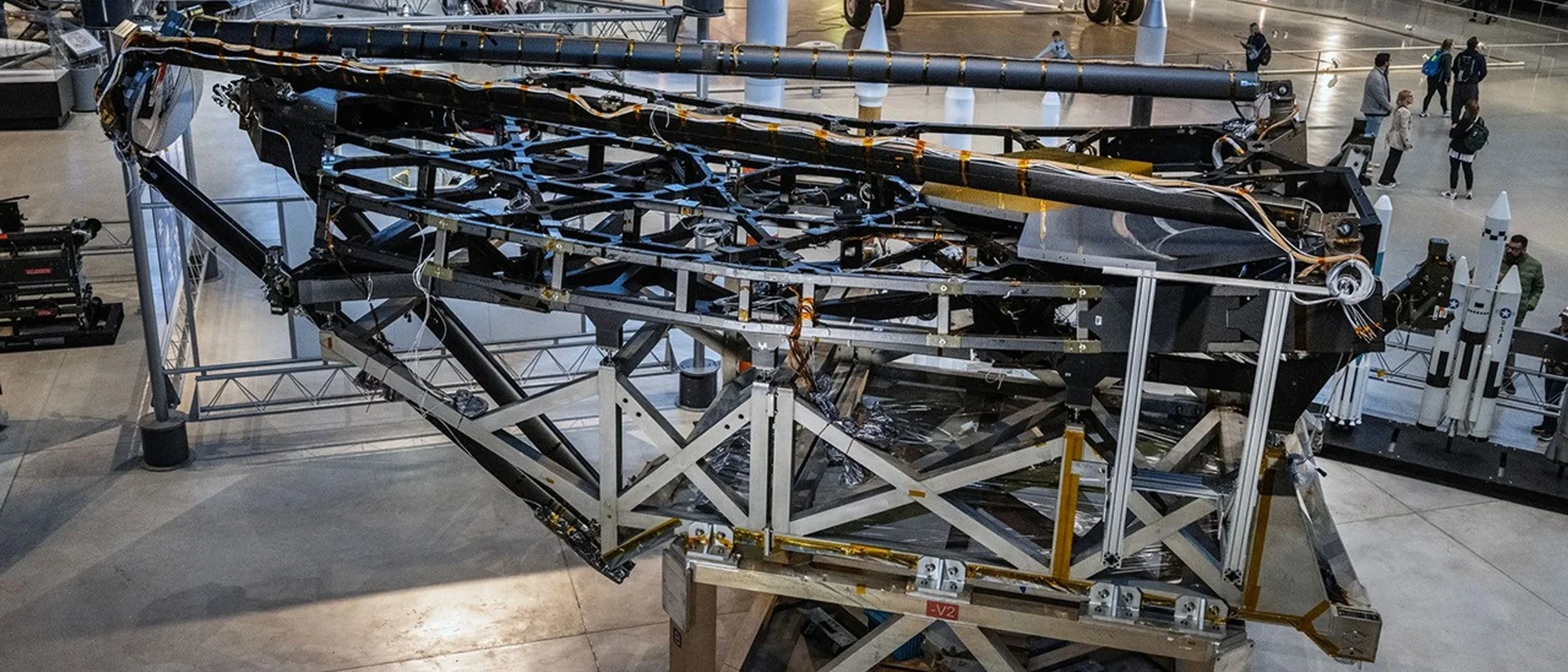
NASA built a full-scale twin of the James Webb Space Telescope. They called it the Pathfinder. Engineers froze it to -400 degrees F inside NASA's biggest cryogenic chamber to prove the mirror-support structure would hold its exact shape in deep space's cold. The real Webb launched in 2021. The Pathfinder just went on permanent display at the Smithsonian. It's the closest thing on Earth to the real Webb.
NASA Froze a Full-Scale Webb Telescope Twin to -400F
NASA never gets a repair mission for the James Webb Space Telescope. Once it launched, no astronaut could ever reach it to fix a mistake. So before trusting the real thing to a rocket, engineers built an exact copy just to try to break it first.
A Telescope With No Room for Error
Webb was designed to unfold itself and settle into orbit nearly a million miles from Earth, far past the reach of any repair crew.
That is much farther than the Hubble Space Telescope, which astronauts could actually visit and fix.
Every part of Webb's design, especially the delicate structure holding its 18 gold mirror segments, had to work perfectly the first time, with no second chances.
Building a Twin Just to Freeze It
To make that possible, engineers built a full-scale engineering model of Webb's mirror-support backbone and nicknamed it the Pathfinder.
NASA describes it as "the largest intact mirror support structure of its kind," built from the same exotic lightweight materials as the real telescope.
It was never meant to fly. Its entire job was to stand in for the flight hardware during rehearsals nobody could afford to get wrong.
Colder Than Anywhere on Earth
Inside Chamber A at NASA's Johnson Space Center in Houston, the largest cryogenic optical vacuum chamber ever built, engineers loaded the Pathfinder with full-size spare mirror segments and cooled the whole structure down to -400 degrees Fahrenheit (-240 Celsius), the same brutal temperature Webb would face in space.
They needed proof that the fragile mirror frame would hold its exact shape at that temperature before ever trusting the real telescope near it.
Standing Over 21 Feet Tall
The Pathfinder stands more than 21 feet tall, and when its secondary mirror boom swings out the way it does in space, it reaches more than 26 feet, the same tricky unfolding sequence the real Webb had to pull off alone, a million miles from any help.
The tests worked.
The James Webb Space Telescope launched for real on December 25, 2021, and has been sending back images of the early universe ever since.
From Test Chamber to Museum Floor
On March 13, 2026, the Smithsonian's National Air and Space Museum announced it had acquired the Pathfinder for permanent display, alongside hardware from the Parker Solar Probe.
It now stands inside the Steven F. Udvar-Hazy Center in Chantilly, Virginia, among the museum's other icons of spaceflight history, including the Space Shuttle Discovery.
NASA has called it the closest thing on Earth to standing next to the actual James Webb Space Telescope.
Nobody will ever get that close to the real Webb.
It is orbiting nearly a million miles away, doing the job its frozen twin spent years proving it could do.
Frequently Asked Questions
What is the James Webb Space Telescope Pathfinder?
Why was the Pathfinder frozen to -400 degrees?
Where can you see the Webb Telescope Pathfinder today?
Is the Pathfinder the same as the real Webb telescope?
When did the James Webb Space Telescope launch?
Verified Fact
Verified Jul 31, 2026
Source: NASA (science.nasa.gov Smithsonian-display announcement, Mar 2026 + NASA Chamber A cryo-test report, 2016)Show verification details
Claims checked
- Pathfinder = full-scale engineering model of Webb mirror-support backbone, "largest intact mirror support structure of its kind"
- Dimensions (21ft tall / 26ft deployed reach)
- Permanent display, Udvar-Hazy Center, Chantilly VA, alongside Parker Solar Probe hardware
- "-400 degrees F (-240C)" cryo test, Chamber A, Johnson Space Center
- Pathfinder never carried the real 18-segment gold flight mirror array or science instruments
- "Closest thing on Earth to standing next to the actual JWST"
- Webb launch Dec 25 2021
- Space Shuttle Discovery co-displayed at Udvar-Hazy