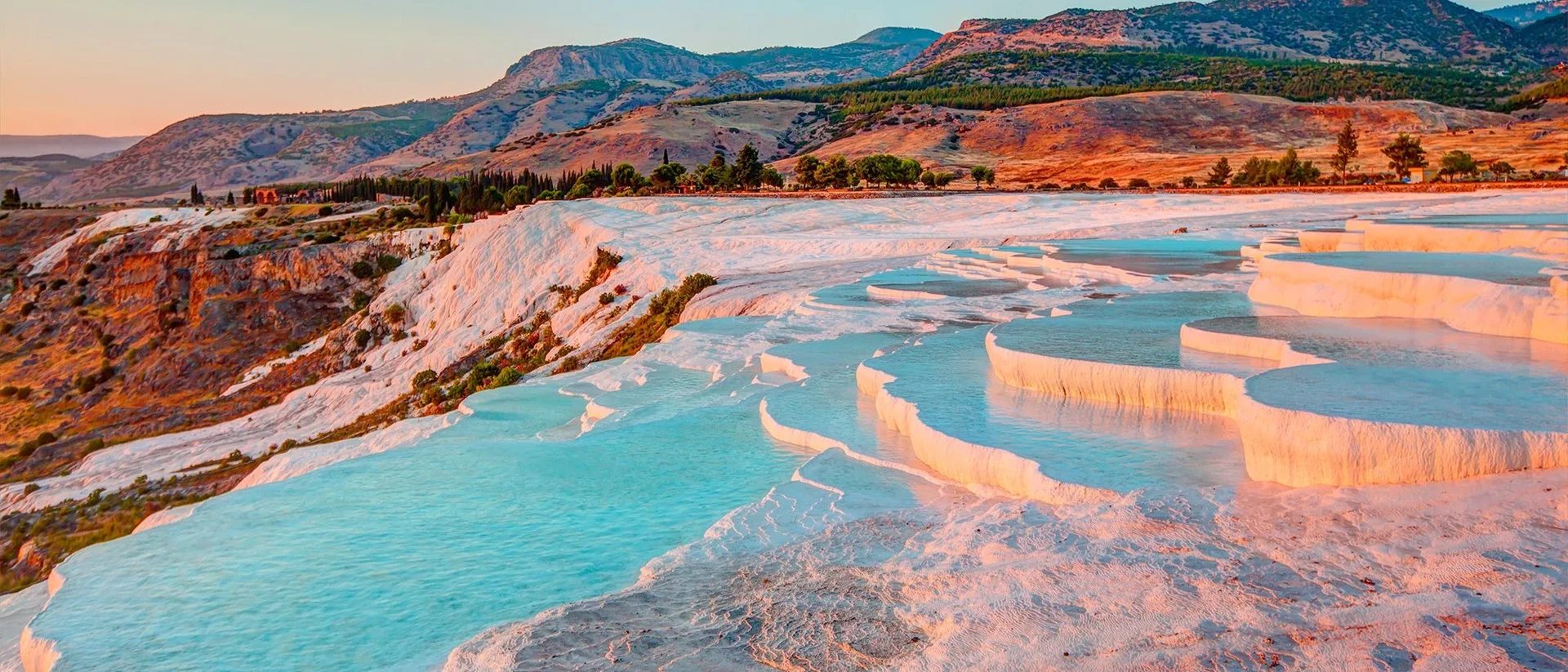
Pamukkale in southwestern Turkey means Cotton Castle, and it looks like snow that never melts. Hot spring water loaded with calcium carbonate has crept down this hillside for hundreds of thousands of years, hardening into blinding white terraced pools. People have bathed in them since Roman times. The ancient spa city of Hierapolis was built right on top, and the whole site is now a UNESCO World Heritage Site.
Turkey's Cotton Castle Looks Like Frozen Snow
From a distance, a hillside in southwestern Turkey looks like it is buried under snow that refuses to melt, even in the middle of summer. Up close, it is something stranger: a solid, gleaming white staircase of pools, built not by people but by water.
A Cliff Built By Water, Not Ice
The site is called Pamukkale, which means "cotton castle" in Turkish. It sits in Denizli Province, about 20 kilometers from the city of Denizli.
The white color comes from calcium carbonate, a mineral carried up from underground by 17 separate hot springs, with water temperatures ranging from about 35 to 100 degrees Celsius (95 to 212 Fahrenheit).
As the hot water reaches the surface and cools, it releases carbon dioxide and the dissolved calcium carbonate hardens into solid rock, called travertine.
A Landscape Still Being Built
The full travertine formation stretches roughly 2,700 meters long and 600 meters wide, rising up to 160 meters in places.
It did not appear overnight. The terraces have formed gradually over hundreds of thousands of years, one thin mineral layer at a time, as spring water flows over the same slopes again and again.
The Spa City Built On Top
People have been drawn to these thermal waters since classical antiquity.
The ancient Greek city of Hierapolis was founded as a thermal spa city early in the 2nd century BCE, within the sphere of the Seleucid Empire, and the city passed to Roman control in 133 BCE after Pergamon's King Attalus III willed his kingdom to Rome.
Hierapolis became a health resort, with more than fifteen bath complexes where physicians sent patients to soak in the mineral-rich water for its therapeutic reputation.
The ruins of the ancient city, including a large theater and a necropolis, still stand directly above the terraces today.
Bare Feet Only
Pamukkale now draws more than two million visitors a year, making it one of Turkey's most visited natural sites.
To protect the fragile mineral surface from scratches and dirt, every visitor is required to remove their shoes before walking across the terraces.
The calcium surface can be rough and slippery underfoot, a small price for standing in water that has been flowing here since before Rome was an empire.
A Site Recognized Twice Over
In 1988, UNESCO inscribed Hierapolis-Pamukkale as a World Heritage Site, a rare dual listing that recognizes both the natural travertine formations and the ancient city built on top of them.
Few places on Earth combine a living geological process with two thousand years of human history in the same view.
Frequently Asked Questions
What does Pamukkale mean?
How were the Pamukkale terraces formed?
Where is Pamukkale located?
What is Hierapolis?
Can you still visit Pamukkale today?
Verified Fact
Verified 2026-07-16 by fact-verifier
Source: WikipediaShow verification details
Claims checked
- Name meaning "cotton castle"
- 17 hot springs, 35-100C (95-212F)
- Travertine formation mechanism (supersaturated calcium-carbonate water surfaces, degasses CO2, deposits as gel that crystallizes into travertine)
- Terrace dimensions 2,700m x 600m x 160m
- UNESCO inscription 1988 (dual cultural+natural)
- 2M+ annual visitors
- "More than fifteen" bath complexes
Related Topics
More from Places & Culture
View all Places & Culture →