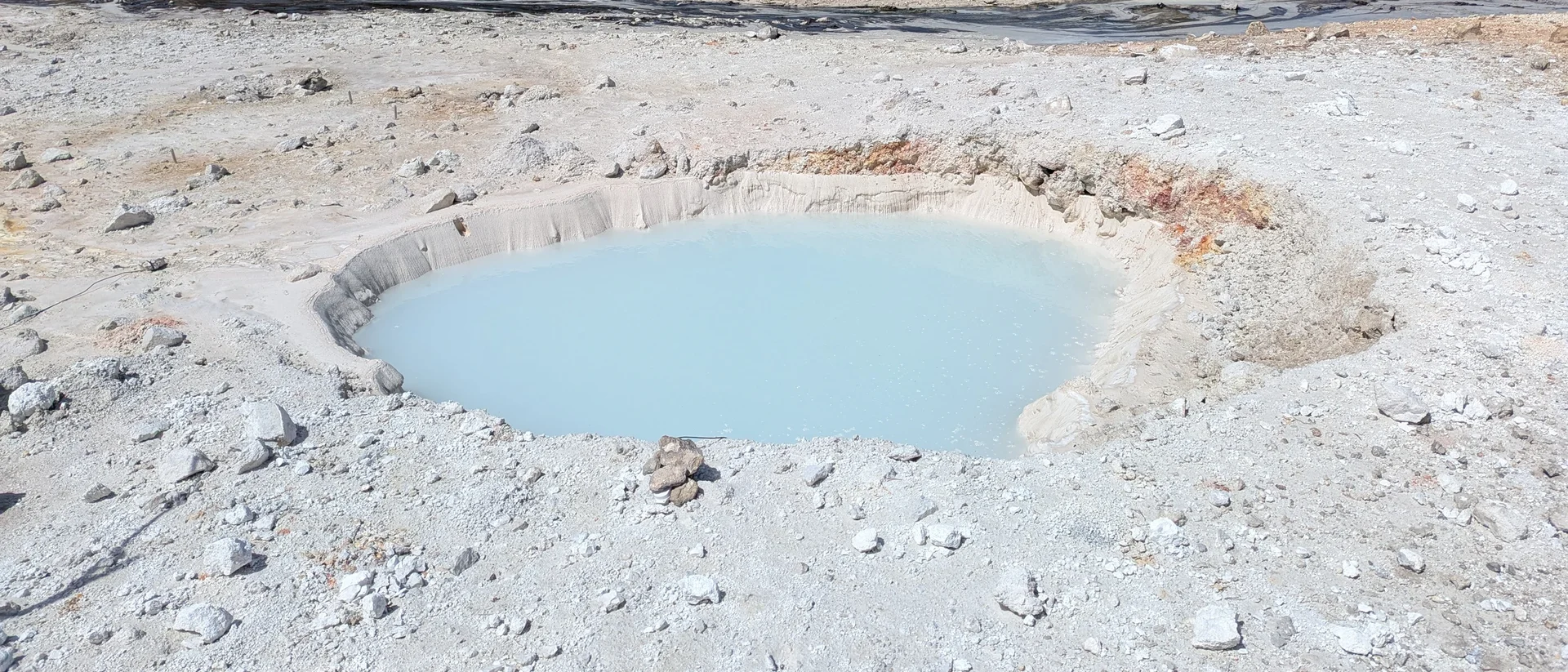
Yellowstone grew a brand new thermal pool over the winter of 2024-25. Nobody saw it happen. Scientists returned to Norris Geyser Basin that April. They found a 13-foot-wide, ice-blue pool that had not been there before. The water was 109 degrees, about as hot as a bath. Sound sensors later traced its birth to tiny explosions in December, January, and February. It had been buried under snow the whole time.
Yellowstone Grew a Secret Pool and No One Saw It Happen
Yellowstone National Park has more than 10,000 thermal features, and park geologists check on them constantly. So when a team walked into the Porcelain Basin area of Norris Geyser Basin in April 2025 to do routine maintenance on temperature sensors, they knew the ground well. That's what made the ice-blue pool sitting in front of them so strange. It had not been there the last time anyone visited.
A Pool That Wasn't Supposed to Be There
The new feature sat just west of a patch of vegetation known informally as "Tree Island." It measured about 13 feet across and about a foot below the rim, filled with milky, ice-blue water at roughly 109 degrees Fahrenheit, warm but nowhere near the scalding 170-degree water at Old Faithful. Around the rim, geologists found light-gray, silica-coated rocks and mud that had clearly been thrown outward as the pool formed.
Solving a Crime With No Witnesses
Nobody had seen the pool form. No park visitor, ranger, or camera caught the moment it opened up. So scientists with the USGS Yellowstone Volcano Observatory turned detective, working backward through satellite imagery and buried monitoring equipment to figure out when it happened.
The trail led to winter. Satellite images showed no sign of the feature as of December 19, 2024. A small depression had appeared by January 6, 2025, and a fully formed pool was visible by February 13. Infrasound sensors, which listen for low-frequency sound waves, had also picked up three faint acoustic signals during that window, on December 25, January 15, and February 11, 2025, with no matching seismic activity strong enough to register as a real earthquake.
What Actually Happened Underground
Putting the evidence together, USGS scientists concluded the pool likely formed through a series of small hydrothermal events rather than one dramatic blast. Pressurized steam and hot water broke through the ground in stages: first hurling rocks outward, then later spraying silica-rich mud a short distance. Each event was too weak to register on seismographs, but together they carved out a pit that slowly filled with hot spring water, all while buried under snow with no one around to notice.
Yellowstone Never Stops Changing
Hydrothermal explosions and new thermal features are part of ordinary life in Yellowstone's geyser basins, where scalding water constantly reshapes the ground from below. Norris Geyser Basin in particular is known as the hottest and most changeable of the park's thermal areas. This latest pool has yet to be given an official name, but it now joins the thousands of hot springs, geysers, and mudpots that make Yellowstone the most geologically active spot in the country.
Enjoyed this? Get a new fact every morning.
A fascinating fact in your inbox every morning. Free. Unsubscribe anytime.
Frequently Asked Questions
When did the new thermal pool at Yellowstone form?
How big is Yellowstone's new thermal pool?
How hot is the water in the new Yellowstone pool?
What caused the new pool to form?
Has the new Yellowstone pool been named yet?
Verified Fact
Verified Jul 2, 2026 · 4 sources checked
Source: USGS Yellowstone Volcano ObservatoryShow verification details
Claims checked
- New thermal pool found at Norris Geyser Basin on April 10 2025
- Pool is about 13 feet wide, 109 degrees F
- Birth traced to small explosions in Dec 2024, Jan and Feb 2025
- Satellite image date corrected to February 13, 2025 (was February 14)
Sources: USGS Yellowstone Volcano Observatory, WyoFile, IFLScience, Scientific American
Related Topics
More from Places & Culture
View all Places & Culture →